
Top 10 Data Analyst Interview Questions to Master in 2026

The demand for skilled data analysts at remote-first companies is at an all-time high, but landing a top-tier role requires navigating a rigorous and multifaceted interview process. This isn't just about knowing syntax; it's about demonstrating your ability to solve real business problems, communicate insights effectively, and collaborate seamlessly in a distributed environment. Excelling in these interviews means proving you possess the complete package of technical expertise, business acumen, and strong communication skills.
This comprehensive guide is designed to be your strategic playbook. We've compiled a curated list of the most critical data analyst interview questions, breaking down everything from advanced SQL query optimization and statistical hypothesis testing to practical case studies and behavioral scenarios tailored for remote work. For each question, we provide more than just sample answers; we dissect the interviewer's intent, highlight common pitfalls, and offer a framework for structuring your response to showcase your unique value.
Mastering the remote data role interview starts with solid preparation, and these general job interview preparation tips are essential for building a strong foundation. This article builds on that by focusing specifically on the challenges and opportunities you'll face when interviewing for a data analyst position.
You will learn to:
- Articulate your technical process for complex SQL, Python/R, and Excel tasks.
- Frame your past experiences to align with key business objectives.
- Tackle ambiguous case studies with a structured, logical approach.
- Communicate your analytical thinking clearly and confidently.
Whether you're a seasoned analyst targeting a senior role or a recent graduate aiming to break into the field, this list will equip you with the practical strategies and in-depth knowledge needed to not just answer the questions, but to ace the interview and secure your next remote opportunity.
1. SQL Query Optimization and Database Performance
Among the most critical technical data analyst interview questions, those focusing on SQL query optimization are paramount. This category tests your ability to not only retrieve data but to do so efficiently. Inefficient queries can be costly, consuming excessive server resources and slowing down applications, a significant problem in a fast-paced remote environment where system performance is key.
Interviewers want to see if you can think beyond just getting the correct result. They're assessing your understanding of database architecture, indexing, join strategies, and execution plans. This skill demonstrates your respect for shared resources and your ability to work with large-scale data systems, which is fundamental for any data analyst role.
Why It's a Top Question
An analyst who writes optimized queries saves the company time and money. A slow query can block other processes, delay critical reports, and frustrate team members waiting for data. By asking you to optimize a query or explain concepts like indexing, employers gauge your practical, real-world SQL proficiency and your potential impact on their infrastructure.
Example Questions & Answers
Question: "Optimize a slow query that joins five tables, each with over one million rows."
Actionable Approach: Start by using
EXPLAINorEXPLAIN ANALYZEto view the query execution plan. Identify bottlenecks like full table scans. Your answer should suggest creating indexes on join keys and columns used inWHEREclauses. Discuss the trade-offs between different join types (INNER JOINvs.LEFT JOIN) based on the required output and data relationships.Question: "Explain the difference between
WHEREandHAVINGclauses."Model Answer: The
WHEREclause filters rows before any aggregations are performed (e.g.,SUM(),COUNT()). TheHAVINGclause filters groups after aggregations are completed. You useWHEREfor row-level filtering andHAVINGfor group-level filtering.
Preparation Tips
- Practice with Execution Plans: Don't just write queries. Use
EXPLAINto understand how the database executes them. This is the key to identifying performance issues. - Think About Scale: Always ask clarifying questions about data volume and query frequency. An optimization strategy for a one-off query on a small table differs from one for a query run every minute on a massive dataset.
- Verbalize Your Logic: Especially in remote interviews, clearly articulate your thought process step-by-step. Explain why you are choosing a specific join or indexing strategy, demonstrating your deep understanding.
2. Excel/Google Sheets Proficiency and Data Manipulation
While advanced tools like Python and SQL dominate discussions, a core category of data analyst interview questions will always test your command of spreadsheets. This evaluates your ability to perform quick, ad-hoc analysis and data manipulation using tools like Excel or Google Sheets. These applications are often the first stop for cleaning, exploring, and visualizing smaller datasets.
Interviewers use these questions to assess your foundational data literacy and attention to detail. In a remote setting where quick reports and data sharing are common, your ability to efficiently use functions like VLOOKUP/XLOOKUP, create pivot tables, and build simple dashboards is a testament to your practical, day-to-day value.
Why It's a Top Question
Many business stakeholders and non-technical team members live in spreadsheets. An analyst who can quickly manipulate data and present findings in a familiar format is invaluable. These questions test your ability to handle messy, real-world data and communicate insights effectively without needing a complex BI tool, proving you can choose the right tool for the job.
Example Questions & Answers
Question: "Given this raw transactional data, create a pivot table dashboard showing sales by region and product category, including a slicer for the month."
Actionable Approach: First, ensure the data is clean and formatted as a table. Insert a pivot table, dragging
Regionto Rows,Product Categoryto Columns, andSalesto Values. Create a second pivot table for a different view, then add a slicer connected to both tables to filter byMonth, demonstrating your ability to build interactive reports.Question: "Explain how you would use
VLOOKUPorXLOOKUPto merge data from two different sheets."Model Answer:
XLOOKUPis the modern, more flexible successor toVLOOKUP. I would useXLOOKUPto find a value in one column (the lookup value), search for it in a corresponding column on a second sheet (the lookup array), and return a value from the same row in a third column (the return array). UnlikeVLOOKUP, it defaults to an exact match and can look up data to its left.
Preparation Tips
- Master Keyboard Shortcuts: Efficiency is key. Knowing shortcuts for formatting, navigating, and applying formulas shows you are a power user.
- Practice with Messy Data: Download sample datasets with inconsistent formatting, duplicates, and errors. Practice cleaning and standardizing them using functions like
TRIM,PROPER, and conditional formatting. - Explain Your Logic Verbally: In a remote interview with screen sharing, narrate your steps. Explain why you chose a specific formula or pivot table configuration. This verbal articulation is often more important than the final result.
3. Statistical Analysis and Hypothesis Testing
Beyond simply retrieving data, an analyst's core function is to derive meaning from it. This is where statistical analysis and hypothesis testing become crucial data analyst interview questions. This category evaluates your ability to use statistical methods to validate assumptions, measure impact, and provide data-backed recommendations. In a remote setting, where decisions rely heavily on clear, defensible data, your ability to conduct rigorous statistical tests is non-negotiable.
Interviewers are probing your understanding of concepts like A/B testing, p-values, confidence intervals, and statistical significance. They want to confirm that you can design a valid experiment, interpret its results correctly, and communicate those findings to a non-technical audience. This skill separates a data puller from a true data analyst who drives business strategy.

Why It's a Top Question
Companies make significant decisions based on statistical tests, from launching new product features to changing marketing strategies. An analyst who misunderstands p-values or sample size requirements could lead the business down a costly path. By asking these questions, employers are assessing your ability to provide reliable insights and mitigate the risk of making decisions based on statistical noise. A critical skill in statistical analysis is knowing how to interpret correlation matrix to understand relationships within your datasets.
Example Questions & Answers
Question: "Design an A/B test to evaluate a new website checkout button's impact on conversion rates."
Actionable Approach: First, state the null hypothesis (the new button has no effect on conversion) and the alternative hypothesis (it does have an effect). Define your primary metric (conversion rate) and determine the required sample size to achieve statistical significance. Explain how you would randomly split users into control and treatment groups and the duration of the test.
Question: "Explain what a p-value of 0.03 means in the context of an experiment."
Model Answer: A p-value of 0.03 means there is a 3% probability of observing the results we did, or more extreme results, assuming the null hypothesis is true. If our significance level (alpha) is set at 0.05, this p-value is smaller, so we would reject the null hypothesis and conclude that our change had a statistically significant effect.
Preparation Tips
- Review the Basics: Solidify your understanding of core concepts like the central limit theorem, p-values, and confidence intervals. Online resources like Khan Academy are excellent for this.
- Avoid Common Pitfalls: Be prepared to discuss common statistical errors like p-hacking or the multiple comparisons problem. This shows a deeper, more practical understanding.
- Use Business Context: Frame your statistical explanations in a business context. Instead of just defining a term, explain how it would help a stakeholder make a better decision.
4. Data Visualization and Dashboard Design
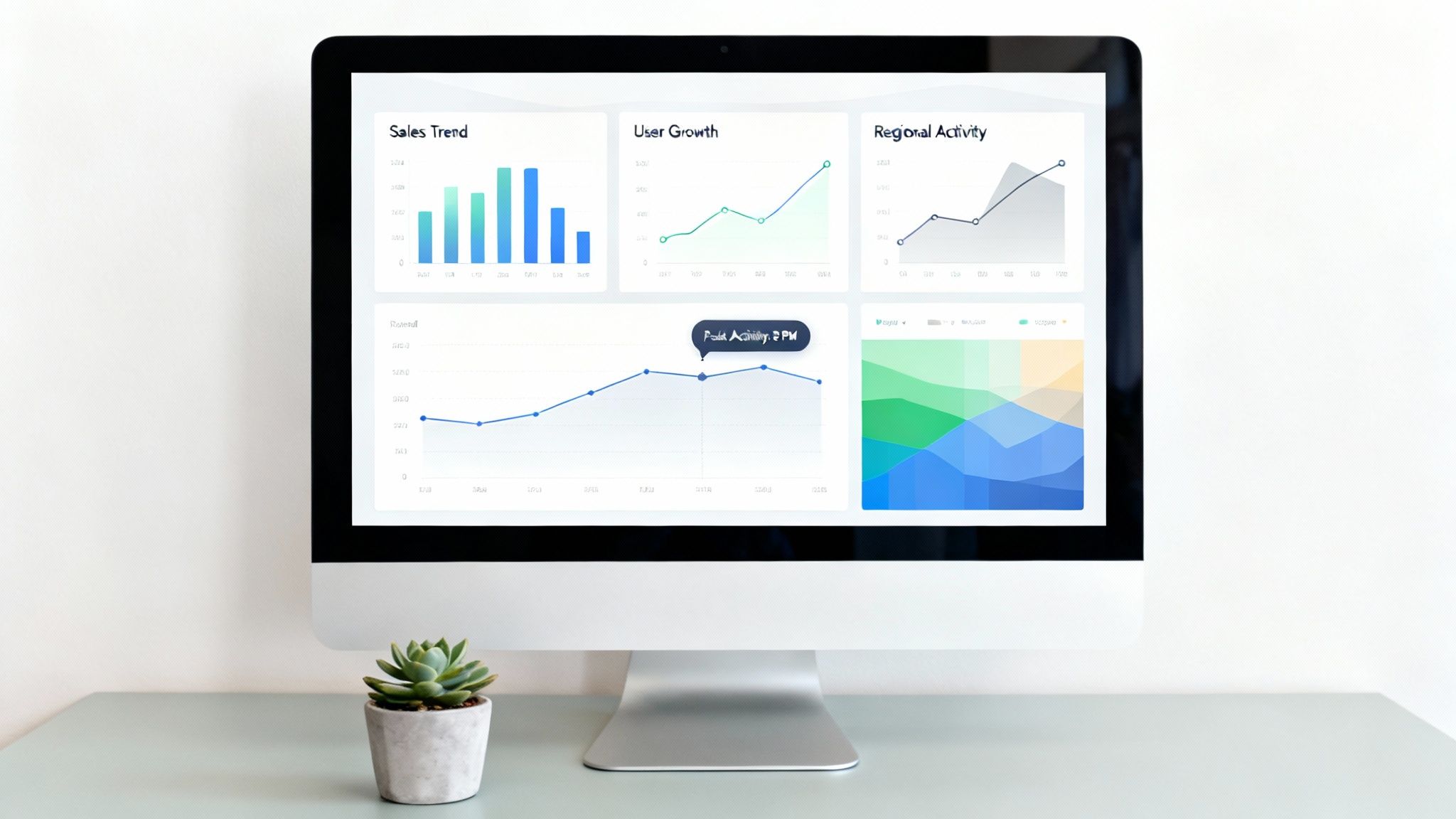
Beyond raw data manipulation, data analyst interview questions frequently test your ability to communicate findings visually. This category assesses your proficiency with tools like Tableau, Power BI, or Looker, but more importantly, it evaluates your design sense and ability to tell a compelling story with data. In a remote setting, where asynchronous communication is standard, a clear and intuitive dashboard is often the primary way stakeholders will interact with your analysis.
Interviewers want to confirm you can translate complex datasets into actionable insights that a non-technical audience can easily understand. This skill involves choosing the right chart types, creating logical layouts, and focusing on the key metrics that drive business decisions. It demonstrates your value not just as a technician, but as a strategic partner.
Why It's a Top Question
A brilliant analysis is useless if it's not understood. An analyst who builds effective dashboards empowers leaders to make informed decisions quickly without needing direct guidance. Employers ask these questions to gauge your ability to create self-service analytics tools that scale, reducing the need for ad-hoc requests and fostering a data-driven culture across the organization.
Example Questions & Answers
Question: "Design a sales performance dashboard for an executive team. What key metrics would you include, and how would you structure it?"
Actionable Approach: Begin by identifying the audience's goals. An executive dashboard should be high-level, focusing on KPIs like Total Revenue, Year-over-Year Growth, and Customer Acquisition Cost. Your design should feature these KPIs prominently at the top, with drill-down capabilities allowing users to explore regional or product-level performance.
Question: "You are given a pie chart showing market share across 20 competitors. How would you improve it?"
Model Answer: A pie chart is ineffective for comparing more than a few categories. I would redesign it as a horizontal bar chart, sorted from largest to smallest market share. This makes it much easier to compare competitors and rank them accurately. I would also use color strategically to highlight our company or key competitors.
Preparation Tips
- Build a Portfolio: Create 3-5 polished dashboards using public datasets on platforms like Tableau Public. This provides tangible proof of your skills that you can share with interviewers.
- Focus on the 'Why': Don't just build a dashboard; be prepared to explain every design choice. Why did you choose a line chart over a bar chart? Why that specific color palette? This demonstrates critical thinking.
- Learn Design Principles: Study dashboard best practices, such as minimizing cognitive load, using pre-attentive attributes, and understanding accessibility requirements like colorblind-friendly palettes.
5. Python/R Programming for Data Analysis
While SQL is the language of data retrieval, Python and R are the languages of data manipulation and analysis. Questions in this category test your ability to go beyond spreadsheets and use programming to clean, transform, explore, and visualize data. Proficiency here indicates you can handle complex workflows, automate repetitive tasks, and work with datasets that are too large for traditional tools.
Interviewers are assessing your practical coding skills with libraries like pandas and NumPy in Python or dplyr and ggplot2 in R. They want to see if you can write clean, efficient, and reproducible code. This is especially crucial in a remote setting where clear, well-documented code is essential for collaboration and maintaining data pipelines.
Why It's a Top Question
A data analyst who can code is a force multiplier. You can build automated reports, create interactive dashboards, and perform sophisticated statistical analyses that are simply not possible in Excel. Employers ask these questions to gauge your technical depth and your ability to scale your analytical impact, making you a more versatile and valuable team member.
Example Questions & Answers
Question: "Given a raw CSV file with missing values and incorrect data types, write a Python script using pandas to clean the data and calculate summary statistics for key columns."
Actionable Approach: Begin by loading the data into a pandas DataFrame using
pd.read_csv(). Your script should identify missing values (.isnull().sum()) and outline a strategy to handle them, such as imputation or removal. Correct data types using.astype(). Finally, use the.describe()method to generate summary statistics and explain the insights derived from the output.Question: "Explain the main differences between a list and a tuple in Python, and when you would use one over the other in data analysis."
Model Answer: The primary difference is mutability. Lists are mutable, meaning their elements can be changed after creation, while tuples are immutable. In data analysis, I would use a list for a collection of items I expect to modify, like a list of columns to drop. I would use a tuple for a collection that should not change, such as a set of coordinates or fixed configuration settings, to ensure data integrity.
Preparation Tips
- Master the Core Libraries: For Python, focus on pandas for data manipulation and Matplotlib/Seaborn for visualization. For R, master dplyr and ggplot2. These are the workhorses of data analysis.
- Build a Portfolio: Use platforms like Kaggle to find real-world datasets. Create Jupyter Notebooks or R Markdown files that walk through your entire analysis process, from cleaning to insight.
- Practice Articulating Your Code: During remote interviews, you will likely share your screen. Talk through your code as you write it. Explain why you chose a specific function or method, demonstrating your thought process clearly. Your ability to code well is a valuable skill, and there are many remote Python developer jobs that value this expertise.
6. Describe a Time You Identified a Data-Driven Insight That Impacted Business Decisions
Behavioral data analyst interview questions like this one move beyond technical skills to assess your real-world impact. The goal is to evaluate your ability to connect raw data to business outcomes. Can you find a meaningful pattern, understand its strategic importance, and communicate it effectively to drive change?
Interviewers use this prompt to gauge your analytical thinking, business acumen, and storytelling capabilities. They want to see a complete thought process, from initial curiosity or a specific business problem to a tangible, quantifiable result. This is especially crucial for remote roles where conveying impact requires clear, concise communication without the benefit of in-person context.
Why It's a Top Question
A data analyst's value is measured by the insights they produce, not just the reports they create. This question directly probes your ability to be a strategic partner. An analyst who can uncover a customer churn pattern leading to a retention campaign or identify a data quality issue that realigns product priorities is an invaluable asset. This question separates candidates who simply process data from those who use it to influence direction.
Example Questions & Answers
Question: "Walk me through a project where your analysis led to a significant business decision."
Actionable Approach: Structure your response using the STAR method (Situation, Task, Action, Result). Start with the business Situation (e.g., declining user engagement). State your Task (e.g., identify the root cause). Detail the Actions you took (e.g., analyzed user behavior cohorts, built a dashboard to track feature adoption, presented findings to product managers). Conclude with the quantifiable Result (e.g., a new onboarding flow was implemented, increasing 30-day retention by 15%).
Question: "Tell me about a time you had to persuade stakeholders with data."
Model Answer: "In my last role, the marketing team believed our recent campaign was a success based on high open rates. (Situation) My task was to validate its true ROI. (Task) I joined campaign data with sales data and discovered the cohort exposed to the campaign had a lower conversion rate and higher acquisition cost than our organic channels. (Action) I created a concise presentation visualizing this disparity and recommended reallocating 20% of the budget to a higher-performing channel. (Result) This shift led to a 10% increase in marketing-qualified leads the following quarter."
Preparation Tips
- Quantify Everything: Prepare two to three stories in advance. For each one, ensure you have hard numbers for the "Result" (e.g., revenue saved, efficiency gained, user growth).
- Focus on 'So What?': Don't just describe the analysis; explain why it mattered. The most critical part of your answer is how your insight helped the business make a better decision.
- Practice Your Narrative: Rehearse telling your story out loud. Aim for a concise 2-3 minute version for live interviews. Your delivery should be confident and clear, demonstrating both your technical skill and your business impact.
7. Tell Us About a Time You Faced Ambiguous Requirements or Incomplete Data
This is one of the most common behavioral data analyst interview questions, designed to assess how you navigate the real-world messiness of data work. Projects rarely begin with perfect, complete datasets or crystal-clear instructions. Interviewers use this question to evaluate your problem-solving skills, proactivity, and communication under pressure.
They are looking for evidence that you can take initiative, make logical assumptions, and collaborate with stakeholders to bring clarity to a project. This is especially vital in a remote setting, where you must be self-sufficient in seeking out information and cannot always rely on immediate, in-person guidance to resolve ambiguity.
Why It's a Top Question
An analyst who crumbles under uncertainty is a liability. Companies need analysts who can transform vague requests like "What's our user engagement?" into concrete, actionable analyses. This question reveals your ability to manage stakeholder expectations, document your process, and deliver value even when the path isn't perfectly paved. It separates a mere number-cruncher from a true analytical partner.
Example Questions & Answers
Question: "Describe a project where you were given an unclear objective. How did you proceed?"
Actionable Approach: Use the STAR (Situation, Task, Action, Result) method. Situation: "A product manager asked for a dashboard to track 'customer health' without defining the key metrics." Task: "My task was to define and visualize customer health." Action: "I researched industry standards, then proposed three distinct models: one based on product usage frequency, another on feature adoption, and a third on support ticket volume. I presented these options with mockups to the stakeholder to facilitate a decision." Result: "They chose the usage frequency model, which became a core KPI for the team, leading to a 15% increase in user retention initiatives."
Question: "What's your process when you discover significant missing data in a critical dataset?"
Model Answer: My first step is to quantify the impact. I determine what percentage of data is missing and which specific segments are affected. Next, I investigate the root cause, collaborating with data engineering to see if it's an ETL error or an issue at the source. Finally, I communicate my findings to stakeholders, presenting potential solutions like data imputation with clearly stated assumptions, or proceeding with the analysis on a limited scope while the data issue is fixed.
Preparation Tips
- Prepare Your Story: Have a specific, compelling example ready that highlights your problem-solving process. Choose a story where your actions led to a positive outcome or a valuable lesson.
- Emphasize Communication: Your answer should heavily feature how you communicated with others. Did you schedule a meeting? Did you use Slack or email to document your questions and assumptions? This is a key part of answering behavioral questions effectively, which you can learn more about in guides on remote job interview questions.
- Document Your Assumptions: A strong answer will mention how you documented any assumptions made during the analysis. This shows foresight and protects the integrity of your work.
8. Describe Your Experience Collaborating with Cross-Functional Teams in a Remote Setting
Beyond technical skills, data analyst interview questions often probe your ability to collaborate, especially in a distributed environment. This behavioral question assesses your communication, stakeholder management, and ability to translate technical findings for non-technical audiences. A data analyst's work is only valuable if it can be understood and acted upon by teams like marketing, product, and engineering.
Interviewers are looking for evidence that you can navigate complex team dynamics without the benefit of in-person cues. They want to know if you are a proactive communicator who can build relationships, manage competing priorities, and drive projects forward using digital tools. This skill is critical for remote roles where clear, intentional collaboration is the foundation of team success.
Why It's a Top Question
An analyst who can't collaborate effectively becomes an information silo. In a remote setting, this problem is magnified. Companies need analysts who can independently reach out to stakeholders, clarify requirements, and present insights in a way that resonates with different departments. This question reveals your soft skills, your understanding of business context, and your experience in making data a shared asset rather than a departmental one.
Example Questions & Answers
Question: "Tell me about a time you worked with engineering and product teams to implement a new analytics tracking event."
Actionable Approach: Use the STAR (Situation, Task, Action, Result) method. Describe the situation (e.g., needing to track a new feature's adoption). Explain your task (defining the event specifications). Detail your actions, highlighting remote collaboration: "I created a shared document with the proposed schema, used Slack for quick clarifications with engineering, and held a brief video call with the Product Manager to align on the business goal." Conclude with the result (e.g., successful implementation and a dashboard that tracked a 15% adoption rate).
Question: "How do you handle disagreements with stakeholders about a metric's definition?"
Model Answer: "My first step is to facilitate a discussion, often asynchronously in a shared document or a dedicated Slack channel to ensure everyone can contribute regardless of their time zone. I focus on understanding each stakeholder's perspective and linking the metric back to the core business objective. By documenting the different viewpoints and proposing a definition that best serves the project goal, I create consensus and a single source of truth that the team can reference later."
Preparation Tips
- Showcase Your Remote Toolkit: Mention specific tools like Slack, Loom, Asana, Jira, or Confluence. Explain how you used them to improve clarity and maintain momentum on projects.
- Emphasize Proactive Communication: Your examples should demonstrate that you don't wait to be asked for updates. Talk about setting up recurring check-ins, sending weekly summaries, or creating self-serve dashboards.
- Focus on Empathy and Translation: Explain how you tailor your communication for different audiences. For instance, you might use more technical language with engineers but focus on business impact and visuals when presenting to marketing. Strong collaboration requires building trust in virtual teams, and empathy is key.
9. Netflix Engagement Analysis Case Study
Business case studies are among the most revealing data analyst interview questions because they simulate the actual work an analyst performs. A Netflix-themed problem tests your ability to take an ambiguous business goal, such as "improving user engagement," and translate it into a structured, data-driven analysis. This exercise assesses your business acumen, technical skills, and communication in a single, comprehensive task.
Interviewers use case studies to see how you approach problems from end to end. They want to observe your critical thinking: how you define metrics, state assumptions, structure your analysis, and present actionable recommendations. For remote roles, this ability to independently tackle a complex problem and clearly communicate findings is exceptionally valuable.
Why It's a Top Question
This question moves beyond theory to practical application. It evaluates whether you can connect data to business impact. An analyst who can not only pull numbers but also interpret them to suggest concrete strategies, like personalizing content recommendations or adjusting subscription tiers, is a huge asset. It separates candidates who can simply code from those who can think like a business partner.
Example Questions & Answers
Question: "You are given a dataset of Netflix user viewing history. How would you measure user engagement, and what three recommendations would you make to the product team to increase it?"
Actionable Approach: First, define engagement with clear Key Performance Indicators (KPIs) like 'average watch time per session,' 'number of unique titles watched per month,' or 'completion rate of series.' Then, structure your analysis. You could segment users (e.g., new vs. tenured, mobile vs. TV viewers) to find patterns. Your recommendations should be specific and tied directly to your findings, such as "Promote binge-watching by auto-playing the next episode for series with a >70% completion rate."
Question: "How would you determine if a new feature, like an interactive movie, was successful?"
Model Answer: I would propose an A/B test, comparing a control group (no feature) to a test group (with the feature). The primary success metric would be a specific engagement KPI, like 'time spent in-app.' I would also track secondary metrics such as user retention rates and survey feedback. A successful feature would show a statistically significant lift in the primary metric without negatively impacting others.
Preparation Tips
- State Your Assumptions: Clearly list any assumptions you make about the data or business context (e.g., "I am assuming this dataset is for US-based subscribers"). This shows structured thinking.
- Prioritize and Quantify: Focus on the highest-impact analyses first. When making recommendations, quantify their potential impact with reasonable estimates (e.g., "This could increase daily watch time by 5%").
- Tell a Story with Visuals: Create two or three key visualizations that powerfully communicate your main findings. A simple bar chart showing engagement by user segment is more effective than a table of raw numbers.
- Document Your Process: In a remote take-home assignment, clearly document your steps, from data cleaning to final insights. A well-commented script or a concise written report demonstrates professionalism and clear communication.
10. E-commerce Conversion Funnel Analysis Case Study
Business case studies are a cornerstone of modern data analyst interview questions, and the e-commerce conversion funnel is a classic scenario. This problem tests your ability to connect data analysis directly to core business metrics like user acquisition, engagement, and conversion. Interviewers present you with a dataset tracking user progression through stages like visiting a homepage, viewing a product, adding to a cart, and purchasing.
Your task is to identify where users are dropping off and hypothesize why. This moves beyond pure technical skill into business acumen and product sense. Can you translate user behavior data into actionable insights that could improve a company's bottom line? This is the central question they are trying to answer about you.
Why It's a Top Question
This case study simulates a real-world project. Companies want to see how you structure an ambiguous problem, perform the necessary analysis (often involving SQL for funnel creation), and communicate your findings. It reveals your ability to think like a stakeholder, focusing not just on the data but on the business impact of that data. A candidate who can pinpoint a significant drop-off and suggest a testable A/B test is immensely valuable.
Example Questions & Answers
Question: "Given this user event data, analyze our conversion funnel. Where is the biggest drop-off, and what are three potential reasons for it?"
Actionable Approach: Start by writing a SQL query to calculate the number of unique users at each stage of the funnel (e.g.,
homepage_visit,product_view,add_to_cart,purchase). Calculate the conversion rate between each step. Identify the stage with the largest percentage drop. Then, segment the data to find patterns. For instance, you could say: "The largest drop-off (40%) is between 'add to cart' and 'purchase'. I would investigate this by segmenting users by device type (mobile vs. desktop) and traffic source. My hypotheses are a complex mobile checkout process, unexpected shipping costs, or a bug in the payment gateway."Question: "What metrics would you track to measure the success of an experiment designed to improve funnel conversion?"
Model Answer: The primary metric is the overall conversion rate from the first to the last step. Secondary metrics include the micro-conversion rate at the specific stage we are targeting, average order value (to ensure we aren't just driving smaller purchases), and user retention for those who convert.
Preparation Tips
- Segment Aggressively: Don't stop at the overall funnel. Break it down by device, user acquisition channel, user tenure, or geography to uncover hidden patterns. Mobile vs. desktop behavior often reveals critical insights.
- Propose Testable Hypotheses: Avoid vague recommendations like "improve the UI." Instead, suggest specific, measurable changes, such as "Simplify the checkout form to three fields and run an A/B test to measure the impact on the cart-to-purchase conversion rate."
- Visualize the Funnel: During a remote interview, be prepared to share your screen and walk through a simple funnel visualization you create in a tool like Google Sheets, Tableau, or even a presentation slide. This makes your findings much more impactful.
10-Point Comparison of Data Analyst Interview Topics
| Item | 🔄 Complexity | ⚡ Resource requirements | 📊 Expected outcomes | 💡 Ideal use cases | ⭐ Key advantages |
|---|---|---|---|---|---|
| SQL Query Optimization and Database Performance | High — DB-specific tuning, execution-plan analysis | DB instance, large datasets, profiling tools (EXPLAIN), time | Faster queries, lower resource use, scalable analytics | High-volume reporting, ETL, slow joins/aggregations | Direct performance gains; objective measurement |
| Excel/Google Sheets Proficiency and Data Manipulation | Low–Medium — UI-based; advanced formulas increase complexity | Spreadsheet software, modest compute, shared cloud for collaboration | Rapid prototyping, ad-hoc reports, stakeholder-ready outputs | Small-to-medium datasets, business reporting, quick dashboards | Accessible; easy to demo; strong for stakeholder communication |
| Statistical Analysis and Hypothesis Testing | Medium–High — requires statistical theory and correct test choice | Statistical tools (R/Python), sufficient sample sizes, calculators | Rigorous inference, confidence intervals, validated decisions | A/B testing, experiments, decisions needing statistical rigor | Evidence-backed recommendations; quantifies uncertainty |
| Data Visualization and Dashboard Design | Medium — design principles plus tool proficiency | BI tool (Tableau/Power BI), design time, sample data | Clear insight delivery, improved stakeholder comprehension | Executive reporting, async insight sharing, KPI monitoring | High-impact communication; makes data actionable |
| Python/R Programming for Data Analysis | High — programming, reproducibility, and tooling | Dev environment, libraries (pandas/dplyr), Git, compute | Scalable pipelines, reproducible analyses, automation | Large datasets, automation, complex transformations | Scalability and flexibility; strong technical differentiator |
| Describe a Time You Identified a Data-Driven Insight That Impacted Business Decisions | Low–Medium — narrative + quantification skills | Past project evidence, metrics, concise documentation | Demonstrated impact, credibility, influence on decisions | Behavioral interviews, evaluating business impact | Authentic evidence of impact; showcases communication |
| Tell Us About a Time You Faced Ambiguous Requirements or Incomplete Data | Medium — clarifying, assumption-setting, iterative work | Documentation, stakeholder outreach, exploratory analysis | Documented assumptions, pragmatic solutions, reduced uncertainty | Assessing independence and judgment in remote roles | Reveals adaptability, problem ownership, and decision process |
| Describe Your Experience Collaborating with Cross-Functional Teams in a Remote Setting | Medium — requires async communication & influence skills | Collaboration tools (Slack, Loom), thorough docs, time-zone coordination | Aligned stakeholders, smoother project delivery, shared understanding | Remote roles requiring stakeholder coordination | Demonstrates remote collaboration, empathy, and influence |
| Netflix Engagement Analysis Case Study | High — ambiguous scope, messy data, broad analysis required | Large, noisy datasets, statistical/visualization tools, time for exploration | Actionable root-cause insights, prioritized recommendations, tests | Case-study interviews, portfolio projects, complex product analysis | Tests end-to-end skills: analysis, judgment, communication |
| E-commerce Conversion Funnel Analysis Case Study | Medium–High — funnel/cohort work and root-cause analysis | Funnel event data, analytics tools, domain knowledge, time | Identified drop-off points, prioritized optimization experiments | E-commerce/SaaS hiring, conversion rate optimization projects | Clear metrics-driven recommendations; objective evaluation |
From Preparation to Offer: Your Next Steps in the Remote Job Market
You've now explored a comprehensive landscape of data analyst interview questions, from the foundational syntax of SQL to the complex storytelling required in a case study. This guide was designed not just to give you answers, but to equip you with a strategic framework for thinking like a top-tier analyst. The goal is to move beyond rote memorization and toward a deep, adaptable understanding of the principles that drive data-driven decision-making.
Remember, every question is an opportunity. A technical query about LEFT JOIN versus INNER JOIN is a chance to show your precision. A behavioral question about ambiguous data is a platform to demonstrate your resilience and problem-solving initiative. A case study on conversion funnels is your stage to showcase business acumen and strategic impact. The most successful candidates connect the dots between technical skills and business value, a crucial link in any role, but especially in a remote setting where clear communication is paramount.
Key Takeaways: From Theory to Interview-Ready
Recapping the core themes from our deep dive, your preparation should be built on three pillars: technical fluency, strategic thinking, and compelling communication.
- Technical Fluency is Non-Negotiable: Your command over SQL, Excel, Python/R, and statistical concepts is the price of entry. Practice writing clean, optimized queries and be ready to explain the "why" behind your technical choices. Why did you choose a particular statistical test? What are the performance implications of your code?
- Context is Everything: A correct answer is good; a correct answer that considers business impact is great. Frame your responses around how your analysis helps the company save money, increase revenue, improve user engagement, or mitigate risk. This business-centric mindset separates senior-level talent from junior applicants.
- The STAR Method is Your Storytelling Tool: For behavioral questions, the STAR (Situation, Task, Action, Result) method is your best friend. It provides a clear, concise structure to narrate your experiences, ensuring you highlight the specific actions you took and the quantifiable results you achieved. This is especially vital for remote interviews, where your ability to communicate your value clearly and asynchronously is under scrutiny.
- Case Studies Test Your Process: Don't fixate on finding a single "right" answer for case studies. Interviewers are far more interested in your structured approach. How do you clarify assumptions, define metrics, outline an analytical plan, and present potential insights and recommendations? Articulate your thought process out loud to guide the interviewer through your problem-solving journey.
Turning Preparation into Your Next Remote Role
Mastering the content of these data analyst interview questions is the most critical step, but it's only one part of the equation. The other is finding the right opportunities where you can apply these skills. The remote job market is vast, but it can also be noisy and filled with roles that don't align with a healthy work-life balance or a supportive culture.
This is where strategic job searching comes into play. Instead of casting a wide net, focus your energy on platforms that curate and vet remote positions. This ensures that the companies you're interviewing with are not just "remote-friendly" but are truly structured for remote success. They understand the importance of asynchronous communication, trust, and outcome-oriented performance metrics.
Ultimately, your journey from applicant to new hire is a testament to your preparation, skill, and persistence. Each interview, whether it leads to an offer or not, is a valuable data point. Analyze what went well, identify areas for improvement, and iterate on your approach. With each conversation, you become sharper, more confident, and one step closer to landing the remote data analyst role that will define the next chapter of your career.
Ready to find companies that value the skills you've worked so hard to build? RemoteWeek curates the best remote data analyst jobs from vetted, remote-first companies, saving you from the noise of traditional job boards. Sign up for free at RemoteWeek to get matched with high-quality roles and start applying your expert interview preparation where it counts.