
How to Reduce Employee Turnover in Remote Tech Teams

Staring at another resignation email from a key engineer? That feeling is more than just a momentary frustration—it's the tip of an iceberg with massive, hidden costs. We often fixate on recruitment fees, but the real damage from turnover runs much deeper, quietly draining your business in ways that are tough to quantify but incredibly painful.
When someone walks out the door, it’s not just a vacant seat. It’s a direct hit to your productivity, team morale, and ultimately, your bottom line.
Understanding the Real Cost of Tech Team Turnover
Losing a great developer isn't cheap. The obvious expenses, like recruitment agency fees and advertising roles, can easily run from 50% to 200% of an employee's annual salary. But that's just the surface.
In remote tech teams, this pain gets amplified. You've already worked hard to build connection and culture across different time zones. Every time someone leaves, it frays the social fabric holding your distributed team together, and the disruption feels even bigger.
The Hidden Financial Drain
Sure, the direct costs are easy to track—recruiter invoices, job board subscriptions, and the hours your hiring team spends sourcing and interviewing. The real killer, though, are the indirect costs. These are the ones that silently torpedo your progress.
- Productivity Nosedive: A vacant role creates an immediate bottleneck. Projects stall, deadlines get pushed, and the remaining team members are forced to pick up the slack. This isn't sustainable and often leads to burnout and a drop in quality as people juggle responsibilities they weren't hired for.
- The Brain Drain: When an experienced engineer leaves, they don't just take their laptop. They take years of institutional knowledge with them—the undocumented workarounds, the deep customer insights, and the intuitive grasp of your codebase's quirks. Rebuilding that knowledge can take months, if not longer.
- Morale Meltdown: Nothing kills team spirit faster than seeing colleagues leave one after another. It creates a sense of instability. The folks who stay start to feel overworked, undervalued, and begin to wonder if they should be looking, too. This is how a turnover problem snowballs.
High turnover is a blaring alarm that something fundamental is broken. It’s not just an HR metric; it’s a business strategy failure that impacts everything from product velocity to your ability to hire in the future.
Beyond the Balance Sheet
The fallout from high turnover extends far beyond your financials. Constant churn can damage customer relationships, especially for engineers in client-facing or support-heavy roles who have built up trust and rapport.
It also wrecks your employer brand. In a tight tech market, your reputation is everything. Candidates are checking sites like Glassdoor to get the inside scoop, and a reputation as a "revolving door" company is a huge red flag that will scare away the very people you want to hire.
This guide is a playbook for turning that around. We'll walk through how to build a resilient, engaged remote workforce where your best people want to stay, making retention your most powerful competitive advantage.
Figuring Out Why Your Best People Are Actually Leaving
Before you can plug the leaks, you have to find them. If you're only relying on exit interviews to understand why people are leaving, you're missing the real story. It’s like trying to figure out why a ship sank by only talking to the last person off the lifeboat—you're getting a small, often sanitized, piece of a much larger picture.
To get to the bottom of it, you need to become a bit of a detective. This means looking at all the clues, from engagement scores and team performance metrics to even subtler signs. A sudden spike in after-hours Slack messages could signal burnout. A consistent dip in engagement for one specific team might point to a management problem. The first step in stopping the bleed is learning to listen to what your data is telling you.
Go Beyond the Standard Exit Interview
Let's be honest, traditional exit interviews often generate polite, generic feedback. Most people don't want to burn bridges on their way out. That's why you need to build channels for honest feedback long before anyone has one foot out the door.
One of the most effective ways to do this is with stay interviews. These are just proactive, one-on-one chats where managers ask their team members what keeps them here and, just as importantly, what might make them look elsewhere.
Some questions you could ask include:
- What do you look forward to when you log on in the morning?
- What are you learning in your role right now? What do you want to be learning?
- What’s one thing that would make your job more satisfying?
- When was the last time you thought about leaving us, and what prompted it?
This simple shift changes the game from reactive damage control to proactive retention. You get the chance to fix issues before they become reasons to resign.
Finding the Truth in Your Data
While stay interviews build trust, sometimes the most candid feedback comes when it’s anonymous. This is where regular, lightweight pulse surveys come in handy. These aren't your massive, once-a-year snoozefests. They're short, frequent questionnaires that can track team sentiment over time and uncover those problems lurking just beneath the surface.
Think about sending a simple two-question poll on Slack every other Friday. You could ask, "On a scale of 1-10, how manageable was your workload this week?" followed by an open-ended question like, "What's one thing we could do to make your experience here better?" It's a quick, low-effort way to get a real-time health check on your team.
The goal isn’t just to collect data; it's to create a continuous feedback loop. When people see you consistently asking for their input and acting on it, they feel heard. That feeling of being valued is a powerful retention magnet all by itself.
Analyzing this feedback can reveal systemic problems you never knew you had. For instance, a pattern of complaints about slow development cycles and frustrating roadblocks could be a direct sign of deeper issues, like mounting What Is Technical Debt and How Do You Fix It, which is a notorious source of burnout for engineers.
The chart below breaks down the very real costs that come with every departure.
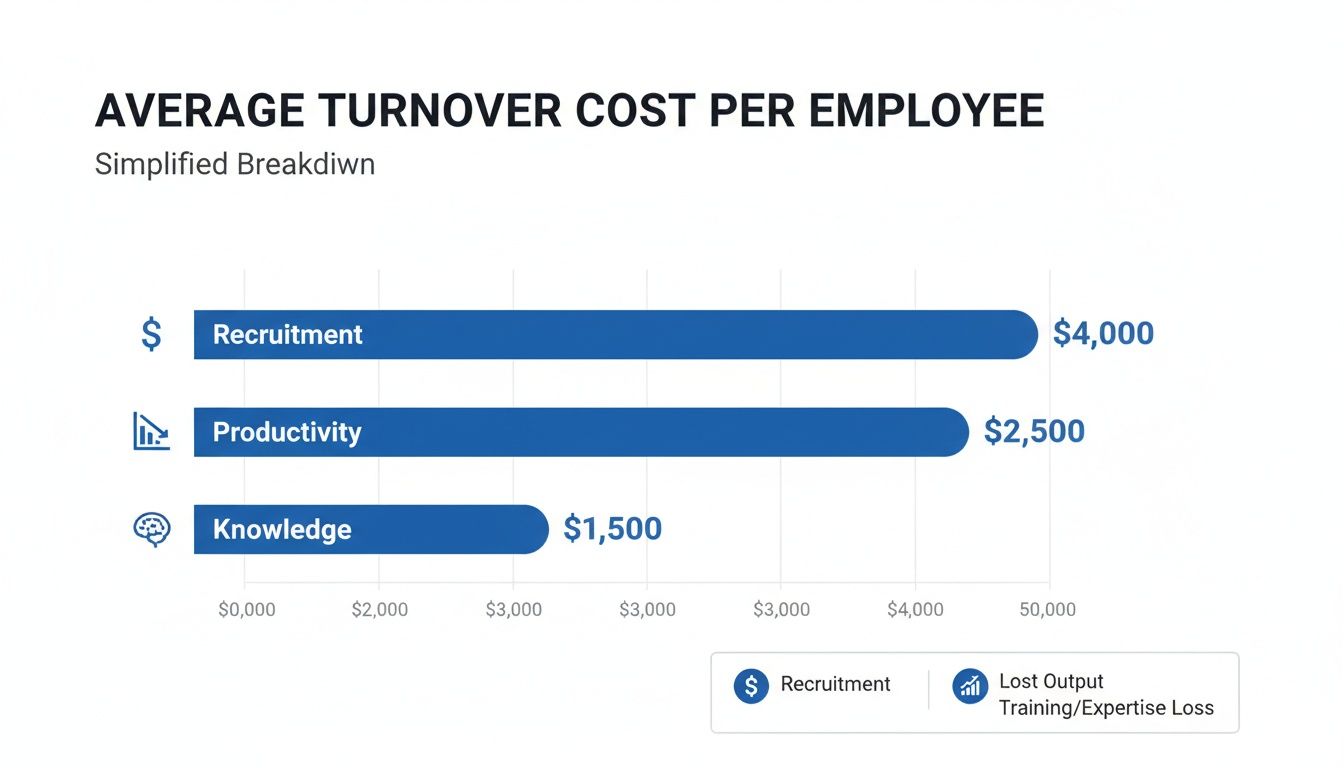
As you can see, the financial hit goes way beyond just recruitment fees. Lost productivity and knowledge drain are often the biggest hidden costs.
When multiple data points—like your survey feedback, 1-on-1 notes, and exit trends—all point toward the same problem, it’s a massive red flag you can't ignore. If you suspect something more serious is going on, it's worth learning the signs of toxic work culture. Pinpointing and fixing these core issues is the only sustainable way to build a place people genuinely don’t want to leave.
Key Turnover Metrics and What They Reveal
To get a clear, unbiased view of what's happening, you need to track the right numbers. Here are a few essential turnover metrics that will help you diagnose specific problem areas.
| Metric | How to Calculate | What It Tells You |
|---|---|---|
| Overall Turnover Rate | (Total Separations in a Period / Average Headcount in Period) x 100 | The high-level health of your organization. A rising rate is your first warning sign. |
| Voluntary Turnover Rate | (Voluntary Separations / Average Headcount) x 100 | Shows how many people are choosing to leave. This is your most critical retention metric. |
| New Hire Turnover Rate | (Separations within 1 Year / Total Separations) x 100 | A high rate here often signals problems with your hiring process or onboarding experience. |
| Manager-Specific Turnover | Turnover Rate Calculated for an Individual Manager's Team | Helps you pinpoint management issues. If one manager has a sky-high rate, it's time to investigate. |
By tracking these numbers consistently, you can move from guessing what the problem is to knowing exactly where to focus your efforts.
You Can’t Fix Turnover Without Fixing Your Hiring Process
If you think you can solve a turnover problem with perks and pay raises, you're treating the symptom, not the cause. The single best way to reduce employee churn starts long before someone’s first day—it’s baked right into how you hire.
A retention-focused hiring process isn't just about filling a role; it's about making a long-term investment in a person. When you attract candidates who are genuinely aligned with your culture and then set them up for success from day one, you drastically cut the odds of them leaving within that critical first year.
Write Job Descriptions That Tell the Real Story
Think about it: your job description is often a candidate's very first real interaction with your company. So why do most of them read like a dry, generic checklist of responsibilities that could apply to any company? It’s a huge missed opportunity.
Instead of just listing tasks, use the job description to paint an honest, vivid picture of what it's really like to work on your team.
Are you a fast-paced crew that lives in Slack and thrives on asynchronous communication? Say that. Do you protect your team's focus with "no-meeting Wednesdays"? Highlight it. This kind of transparency acts as a natural filter. It attracts people who are genuinely excited by your way of working and helps those who wouldn't be a good fit to self-select out.
It's also crucial to clearly communicate your company's mission and values. For a deeper dive, check out our guide on creating a compelling employee value proposition. This helps candidates connect with your purpose, not just the paycheck.
Interview for Cultural Alignment, Not Just Technical Skill
Here's a hard truth: you can teach someone a new coding language, but you can't easily fix a fundamental mismatch in values or work style. To build a remote team that sticks together, you have to assess for long-term cultural alignment with the same rigor you use for a technical screen.
This is where structured, competency-based interviews are your best friend. Ditch the generic questions and design specific ones that get at the behaviors and mindsets that reflect your core values.
- To see if they're truly collaborative: "Tell me about a time you had a strong disagreement with a teammate on a technical approach. How did you two work through it, and what happened?"
- To gauge their autonomy: "Describe a project where you had minimal guidance and had to figure things out on your own. How did you structure your work and keep things moving?"
- To test for adaptability: "Walk me through a situation where project priorities changed suddenly. How did you pivot, and what did you learn from that experience?"
Questions like these give you concrete evidence of how a candidate actually operates. It shifts your evaluation from a vague "gut feeling" to a decision based on real data, which is essential for cutting down on those painful early departures.
A great hire is someone who not only has the skills to do the job but also enhances your team's culture. Hiring for cultural addition, not just cultural fit, builds a more resilient and innovative team.
Design an Onboarding Experience That Actually Works Remotely
For remote teams, the first 90 days are everything. This is the make-or-break period where a new hire either feels connected and supported or isolated and completely lost. A sloppy, unstructured onboarding process is one of the fastest ways to lose a fantastic new employee you just worked so hard to find.
Your goal should be to make them feel like a valued part of the team before they've even written a single line of code.
Here’s a simple but effective blueprint for remote onboarding:
- Give them a 90-Day Plan. Don't leave new hires guessing. A clear document that outlines their goals, key meetings, and learning objectives for the first three months is a game-changer. This roadmap kills anxiety and gives them a clear way to measure their own progress.
- Assign an Onboarding Buddy. Pair every new person with a peer—not their manager. This "buddy" is their go-to for all the informal, "silly" questions about culture, communication norms, or where to find stuff. It creates an immediate, friendly connection.
- Engineer Social Connections. You have to be intentional about this when you're remote. Schedule virtual coffee chats, team game sessions, or create Slack channels for shared interests. These non-work interactions are what build the personal bonds that turn a group of employees into a real community.
Turning Your Managers into Retention Leaders

Let's be blunt: if your retention strategy doesn't start with your managers, it's already dead in the water. Company-wide perks are nice, but an employee's day-to-day reality is almost entirely shaped by their direct leader. They are your single most powerful tool for keeping great people.
This is even more critical in a remote setup. You lose the casual office check-ins and organic connections, so the manager-employee relationship becomes the primary lifeline for culture, support, and engagement. Investing in your managers’ leadership skills isn't just a "nice-to-have"—it’s the highest-return investment you can make in the fight against turnover.
Cultivating Psychological Safety from a Distance
Psychological safety is the bedrock of any high-performing remote team. It’s that shared feeling that you can speak up, ask a "dumb" question, or admit you made a mistake without getting shut down or humiliated. When people don't feel safe, innovation stops cold, and your best talent quietly starts updating their resumes.
Your managers are the chief architects of this environment. It's on you to train them to:
- Model vulnerability. When a manager openly says, "I don't have the answer to that," or shares a lesson from a past failure, it signals to the whole team that it's okay to be human.
- Encourage healthy dissent. They need to actively ask for different points of view. A simple phrase like, "I'm leaning this way, but what am I missing? Poke holes in this idea," reframes disagreement as a valuable part of the process, not a confrontation.
- Separate blame from problem-solving. When things go wrong, the focus has to be on understanding why and fixing the system, not pointing fingers.
This foundation of trust is everything. The data is clear: bad bosses are a primary reason people quit. In fact, a staggering 50% of employees who leave a job do so because of their manager. This stat alone makes manager training one of the most direct ways to slash your turnover rate.
Transforming One-on-Ones into Retention Tools
For too many managers, one-on-ones are just glorified status updates. This is a massive missed opportunity. These meetings should be the main event for building trust, mapping out career growth, and spotting burnout before it’s too late.
Coach your managers to be more intentional with this time. It’s about moving beyond project checklists to connect with the person behind the screen.
A great one-on-one should be 10% about status updates and 90% about the employee—their challenges, their aspirations, and their well-being. It's their meeting, not the manager's.
A simple but powerful agenda could look like this:
- Personal Check-in (5 minutes): How are you, really? This isn't just small talk; it's about building a genuine human connection.
- Their Topics (15 minutes): What's on your mind? What's getting in your way? What support do you need from me?
- Career & Development (5 minutes): What skills do you want to build next? Are you feeling challenged by your current work?
- Feedback & Alignment (5 minutes): Create a safe space for two-way feedback on communication, team dynamics, and performance.
When people feel their manager is truly invested in their growth, their loyalty deepens. For more ideas on boosting team morale, check out our guide on employee engagement best practices.
The Art of Meaningful Recognition
In a remote world, it's far too easy for great work to go unnoticed, leaving people feeling invisible and unappreciated. Managers have to be incredibly deliberate about celebrating wins. And no, a generic "good job" in a Slack channel doesn't cut it.
Train your leaders on the key principles of effective recognition:
- Be Specific: Don't just say, "Thanks for your hard work." Try, "Thank you for finding and fixing that critical bug under yesterday's tight deadline. Your attention to detail saved us from a major headache."
- Be Timely: Acknowledge the contribution as soon as possible. The impact of praise fades with every day that passes.
- Be Public: Whenever appropriate, public recognition in a team channel or a company all-hands meeting amplifies the message and reinforces the exact behaviors you want to see more of.
By equipping your managers with these crucial soft skills, you empower them to build the strong, supportive relationships that make people want to stay.
Designing Career Paths That Inspire Loyalty

Let's be real: talented people don't stick around where they feel stuck. A solid salary and good benefits are just the table stakes. They won't keep your top engineers and designers if they can’t see a future for themselves at your company. Stagnation is a silent motivation killer, and it’s a huge reason people start looking elsewhere in tech.
If you're serious about long-term retention, you have to build visible, compelling pathways for growth. When your team can clearly see how to advance, learn new skills, and tackle bigger challenges, their mindset completely shifts. It goes from "What's my next move outside these walls?" to "What's next for me right here?"
Build a Dual-Track Career Ladder
One of the biggest mistakes I see tech companies make is forcing their best technical minds into management just so they can get a promotion. It’s a classic lose-lose. You take a brilliant engineer away from what they love, shove them into a leadership role they might not want or be suited for, and watch them—and their team—become miserable.
The answer is a dual-track career ladder. This structure creates two distinct but equally valuable paths for advancement.
- The Management Track: This path is for people who are great at leading teams, setting strategy, and nurturing talent. Think Engineer -> Senior Engineer -> Engineering Manager -> Director.
- The Individual Contributor (IC) Track: This path is for the technical experts who want to go deep on their craft without managing people. This might look like Engineer -> Senior Engineer -> Staff Engineer -> Principal Engineer.
The key here is that the pay, influence, and respect for senior IC roles must be on par with management roles. A Principal Engineer should be just as celebrated (and compensated) as an Engineering Manager. This sends a powerful message: we value deep technical mastery just as much as we value people leadership. That’s how you keep your best talent engaged and doing what they do best.
Make Internal Mobility a Reality, Not Just a Slogan
So many companies claim they "promote from within," but their internal application process is a bureaucratic nightmare. If it’s easier for your employees to land an interview at a competitor than to apply for an open role on another team, you’ve got a broken system.
Making it easy to move internally is a massive retention booster. When people see they can explore new roles, join different teams, and learn other parts of the business without having to quit, it fosters a much more dynamic and engaging environment.
A frictionless internal mobility process turns your company into a career playground instead of a dead-end street. It shows your team you're invested in their long-term growth, not just their output in their current role.
Start by making the process simple and transparent. Post all open roles internally first. Guarantee interviews for qualified internal candidates. Most importantly, create a culture where managers actively support their team members' ambitions, even if it means losing them to another department.
Fuel Growth with Dedicated Learning Budgets
Investing in your team's skills is a direct investment in keeping them. When you give people a dedicated budget for learning and development, you’re putting your money where your mouth is. It shows you're genuinely committed to their professional growth, and that’s a huge differentiator for top talent.
The impact is massive. Providing strong career growth opportunities is a game-changer, especially since 74% of Millennials and Gen Z say they’d quit within a year if they feel their development is being ignored. You can dig into more of these employee retention statistics to see just how critical this is.
Consider putting a real L&D program in place. It doesn't have to be complicated:
- An Annual Stipend: Give every employee a set amount (say, $2,000 per year) to spend on courses, books, conferences, or certifications that they choose.
- Mentorship Programs: Pair junior folks with senior leaders. It's an incredible way to transfer knowledge, build connections, and strengthen your culture from the inside out.
- Lunch and Learns: Encourage your own experts to host sessions and share what they know. This is a super low-cost, high-impact way to build a culture where everyone is always learning.
By creating these clear, supported career paths, you change the game. Your company stops being just a stepping stone and becomes a destination. You give your best people every reason to build their future with you.
Answering Your Toughest Questions About Employee Turnover
Even with a great plan, questions about turnover are inevitable. Leaders in remote tech are navigating unique territory, so having direct answers is key to building a team that sticks around. Let's tackle some of the most common questions I hear.
Getting these answers right is the difference between reacting to problems and proactively building a place people don't want to leave.
What’s a Good Employee Turnover Rate in Tech?
In the fast-moving tech world, a "good" annual turnover rate is often cited as being between 10% and 15%. But honestly, that's just a benchmark. It’s not a universal magic number. The right figure for you can shift depending on specific roles, market dynamics, and where your company is in its growth journey.
What’s far more telling is your own internal trendline. A sudden jump from 12% to 22% in a single quarter is a much bigger red flag than a steady rate that’s a couple of points above the industry average. At the end of the day, the real goal is to keep your top performers—their departure is what really hurts.
How Much Does Compensation Actually Affect Turnover?
Let's be blunt: competitive pay is the price of admission. If your compensation isn't aligned with the market, you're fighting an uphill battle from the start. You have to begin with regular market analysis to make sure your salary bands are fair for the roles and locations you’re hiring for.
For remote teams, this means having a clear philosophy. Are you paying based on a national average? A high-cost hub like San Francisco? Or the employee’s local cost of living? There isn't one "right" answer, but your approach has to be consistent and transparent.
While money isn’t the only motivator, falling behind the market is a guaranteed way to increase flight risk. Top talent knows their worth and won’t stay long if they feel financially undervalued.
Beyond the base salary, think about the whole package. This is where you can really stand out:
- Performance Bonuses: Tying real financial rewards to clear, achievable goals.
- Equity or Stock Options: Giving people a real stake in the company’s future.
- Meaningful Benefits: Premium health insurance, generous PTO, and practical wellness stipends go a long way.
What Are Some Quick Wins to Improve Retention Right Now?
If you need to make an impact fast, focus on recognition and communication. These areas often give you the biggest morale boost for the smallest investment.
First, launch a simple peer-to-peer recognition program. Seriously, just a dedicated Slack channel where people can give public shout-outs for great work can completely change the vibe.
Second, train your managers to dedicate part of their one-on-ones to career growth and well-being. It can't just be about project status updates. This small shift shows you care about them as individuals, not just cogs in a machine.
Finally, send out a quick, anonymous survey asking what the company should start, stop, and continue doing. Acting on even one piece of that feedback shows you're listening and can give you a powerful, immediate morale lift.
Can a Strong Culture Really Lower Turnover on a Remote Team?
Absolutely. But for remote teams, culture isn’t about ping-pong tables and free snacks. It's about intentional behaviors and the systems you build for communication.
A strong remote culture is built on a foundation of trust. It thrives on clear asynchronous communication norms that respect people's time zones and a shared sense of mission that everyone can rally behind.
It’s something you have to actively build. This means celebrating wins publicly in shared channels, creating virtual "water coolers" for non-work chatter (like a channel for pet photos or hobbies), and ensuring leadership is transparent from the top down.
Companies that deliberately design their remote culture see much higher engagement and loyalty. Why? Because their people feel connected and valued, no matter where their desk is. For a different perspective with more actionable strategies, you might find this guide on how to reduce employee turnover in the UK incredibly helpful.
Ready to attract candidates who are a perfect fit for your great remote culture? RemoteWeek connects top remote talent with employee-focused tech companies that value their teams. Post your job today and find the people who will stay and grow with you.