
How to stay motivated working from home: Practical Tips

The real secret to staying motivated while working from home has little to do with raw willpower. It’s all about building a framework that supports you, creating clear psychological lines between your work life and your home life.
Build a Resilient Remote Work Routine

When you lose the natural structure of a daily commute and a separate office, your house can quickly feel like a motivation vacuum. The key is to design a routine that tells your brain when it’s time to work and, just as importantly, when it's time to switch off. This is how you avoid the slow, creeping burnout that kills your drive.
This is about more than just setting an alarm clock. It involves creating rituals that bookend your day and fiercely protect your focus in between. To really hit your stride, it helps to adopt a few proven strategies to increase your productivity at work that keep your efforts sharp and effective.
Start and End Your Day with Intention
Think of your morning routine as your productivity launchpad. Instead of stumbling from your bed to your desk, build in a buffer. A powerful morning routine for productivity can genuinely set the tone for the rest of the day.
Here are a few things I've found incredibly helpful:
- Create a "Fake Commute": A simple 15-minute walk around the block before you log on can work wonders. It mimics the mental transition of a real commute, clearing your head and signaling the start of the workday.
- Establish a Start Ritual: Have one specific action that means "work has begun." For me, it's making a specific type of coffee and opening my daily planner. That's the starting pistol.
- Implement an End-of-Day Shutdown: A hard stop time is absolutely non-negotiable. At 5:30 PM, I close my laptop, tidy my desk, and literally say, "Work is done." It sounds silly, but it's a powerful way to mentally clock out.
Your dedicated workspace—even if it's just one corner of the dining room table—is a massive psychological cue. When you're there, you're working. When you leave, you're not. This physical separation is fundamental to keeping work from bleeding into every hour of your life.
This kind of structured approach helps navigate a weird paradox of remote work. We know that remote employees often show 31% higher engagement, yet they also report 45% more stress from things like loneliness and those blurry work-life boundaries. A solid routine gives you the stability to enjoy the perks of working from home without falling victim to the pressure.
Define Your Mission and Acknowledge Every Victory
When your office is just you, it's incredibly easy to feel like you're adrift. Without a manager looking over your shoulder or the buzz of a team, you have to be your own engine. This is exactly why setting crystal-clear, actionable goals isn't just a nice-to-have—it's one of the best strategies for staying motivated when you work from home.
Huge, overwhelming projects are motivation killers. They loom over you and sap your energy before you even begin. The secret is to chop them up into smaller, more digestible pieces—tasks you can knock out in a day, or even in a single focused hour. So, instead of a vague goal like "Finish Q3 Report," your daily list looks more like "Pull sales data for the intro" and "Outline the key findings."
Flip Your To-Do List Into a "Done" List
Let's be honest, a to-do list can feel like an endless mountain of things you haven't done. A "done list," on the other hand, is proof of what you've actually accomplished. At the end of the day, take five minutes to jot down everything you finished, no matter how minor it seems. It’s a simple change, but it completely reframes your perspective from what’s left to what you’ve achieved.
This small habit creates a surprisingly powerful mental boost. There are some great tools out there that can help you see your progress in real-time:
- Project Management Apps: Tools like Trello or Asana give you that satisfying feeling of dragging a task from "Doing" to "Done."
- A Simple Notebook: Never underestimate the pure satisfaction of drawing a thick, heavy line through an item on a paper list. It just feels good.
"Don't forget to celebrate your daily accomplishments, too, even small ones. Be cognizant of what you have been completing, instead of focusing on what you haven't finished yet."
Every time you acknowledge a win—whether it's sending that tricky email or wrapping up a small part of a project—your brain releases a little bit of dopamine. This reinforces the positive behavior and makes it easier to jump into the next thing on your list. We're not talking about throwing a party for every email you send, but about creating a sustainable rhythm of achievement and reward that keeps you going, day in and day out.
Create Strong Boundaries to Prevent Burnout
When your living room doubles as your office, the biggest threat to your motivation isn't a tough project—it's burnout. The lines between work and personal life get blurry fast. Before you know it, work has seeped into every corner of your day, draining your energy and killing your drive.
Protecting your personal time isn’t about slacking off. It's about building a sustainable way to stay focused and productive for the long haul.
The first, most critical step is to define your work hours and then actually stick to them. Just because you can answer that Slack message at 9 PM doesn't mean you should. Set a hard stop for your workday. Shut the laptop. Turn off the notifications. Mentally clock out.
And please, take a real lunch break. Stepping away from your screen, even for 20 minutes, is a powerful way to reset your brain and come back fresh.
How to Communicate Your Availability (Without Feeling Guilty)
Setting your hours is the easy part; getting others to respect them is the real challenge. Many of us feel this unspoken pressure to be "always on." The key is to be both polite and firm. You have to train people how to treat your time.
Here's a real-world example: A colleague sends you a non-urgent request after you’ve already logged off. Instead of jumping on it, wait. Respond the next morning with something simple like, "Got it, thanks! I'm back online now and will dig into this." This small act reinforces your schedule without any confrontation.
For a deeper dive, our guide on how to set boundaries at work has a ton of practical scripts and tactics you can use.
Having clear boundaries also makes it easier to focus on your actual goals. This simple framework is a great reminder of how to keep moving forward.
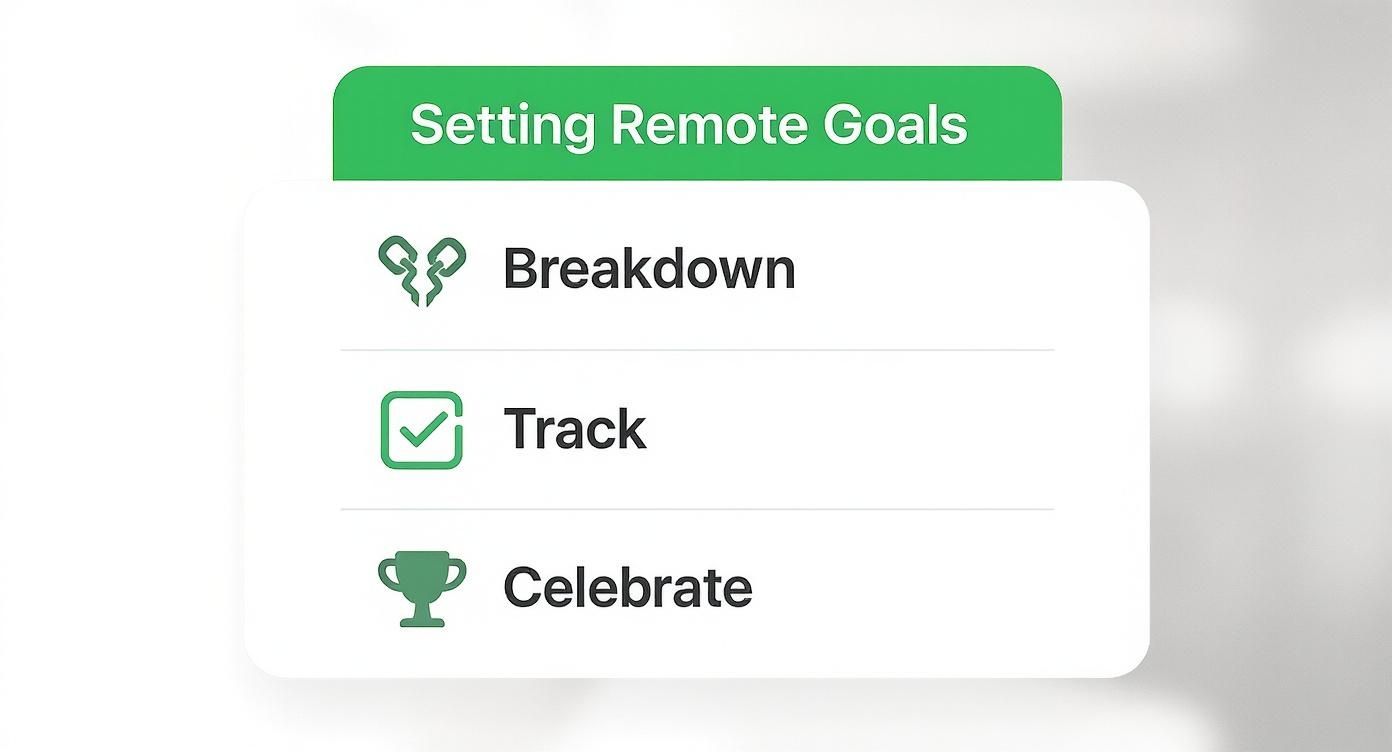
Breaking down big tasks, tracking your progress, and celebrating the small wins are all essential for momentum. None of that is possible if you don’t have protected time to do the work.
Are Your Habits Draining You or Fueling You?
It's easy to fall into bad habits when no one's watching. Take a look at this table and see if any of the "burnout habits" feel a little too familiar. Recognizing these patterns is the first step toward building a more sustainable routine.
Burnout Habits vs Sustainable Motivation Habits
| Burnout Habit (Drains Motivation) | Sustainable Habit (Boosts Motivation) |
|---|---|
| Checking emails/messages as soon as you wake up. | Starting your day with a non-work routine (e.g., walk, coffee). |
| Keeping work tabs open and notifications on 24/7. | Closing all work-related apps and tabs at the end of the day. |
| Eating lunch at your desk while working. | Taking a dedicated break away from your screen. |
| Saying "yes" to every meeting request, regardless of the time. | Blocking out "no meeting" focus time on your calendar. |
| Responding instantly to after-hours messages. | Waiting until the next workday to reply to non-urgent requests. |
| Letting work tasks push past your scheduled end time. | Having a clear "shutdown ritual" to signal the end of the day. |
The goal isn't perfection, but progress. Swapping just one or two of these habits can make a huge difference in your energy levels and overall motivation.
The paradox of remote work is that its biggest perk—flexibility—is also its biggest pitfall. While 82% of remote workers feel their mental health has improved, 86% also admit to experiencing burnout. This shows just how crucial it is to be intentional about creating separation.
Protecting your time isn't a sign of weakness; it's a professional strategy for peak performance. A well-rested, focused mind will always produce higher quality work than a tired, scattered one.
Ultimately, avoiding burnout is an active, ongoing effort. If you're struggling with the mental load, you can learn practical strategies to cope with anxiety for calmer days. By building a strong wall between your work and your life, you give your motivation the space it needs to thrive.
Actively Combat Remote Work Isolation

Let’s be honest: motivation doesn’t grow in a vacuum. The office buzz, the impromptu desk chats, and even just grabbing a coffee with a coworker—those little moments create a social energy that’s completely missing when you work from home. Without it, you have to build that connection yourself.
It's easy to start feeling like you're on an island, which can be a real killer for both your drive and creativity. In fact, studies show that a staggering 67% of fully remote employees report feeling lonelier. That's a huge number, and it proves we need to be intentional about creating social outlets.
Build Your Own Social Structure
You have to be the architect of your own social work life now. This isn't about scheduling forced, awkward virtual happy hours. It’s about weaving genuine human connection back into your workday.
Start small by sprinkling a few social touchpoints throughout your week. Here are a few things that have worked for me:
- Schedule 15-Minute Virtual Coffees: Put a quick video call on the calendar with a teammate and make it clear it's a "no-work" zone. It’s a great way to catch up on their weekend or a shared hobby and build a real rapport.
- Join a Professional Community: Find an active Slack or Discord group for people in your industry. I've found these to be invaluable for asking questions, celebrating small wins, and getting fresh ideas from people outside my company bubble.
- Plan a "Co-working" Day: Even once a month, try working from a local coffee shop or library. Just being around the low hum of other people can break up the monotony and make you feel less isolated.
Sometimes, a quick video call to hash out a complex idea is far better than a long, confusing email chain. It builds a much stronger connection and clears up misunderstandings before they start.
These small habits add up, creating that sense of belonging that’s so vital for staying motivated long-term. If you want to get your whole team involved, check out some fun virtual team-building activities to strengthen bonds and lift everyone's spirits.
Use Your Flexibility to Stay Fired Up
Flexibility is easily the best part of working remotely, but too often we treat it like a background perk instead of the powerful motivational tool it can be. When you actively take control of your schedule, you can build a workday that actually fits your life, not the other way around. This mindset shift is the secret sauce for staying motivated long-term when your office is your home.
Think about it: you could run all your errands on a quiet Tuesday afternoon and have your entire Saturday back. Or you could hit the gym at 2 PM, right when that post-lunch slump usually hits. This isn't about slacking off; it's about being smart and scheduling your work around your natural energy rhythms and personal priorities.
When you do this, flexibility stops being just a nice-to-have and becomes a real, sustainable source of drive. Of course, this kind of freedom is built on a foundation of trust. Proving you can deliver high-quality work consistently is what earns you the autonomy to structure your day in a way that truly works for you.
Build a Schedule That Works for Your Life, Not Against It
Stop trying to cram your life into a rigid 9-to-5 box that was designed for a different era. Leaning into your remote freedom means acknowledging you’re a human with energy that ebbs and flows and a life that doesn’t pause between clock-in and clock-out.
Pinpoint Your Peak Hours: Are you a morning person who does their best thinking before noon? Guard that time for your most challenging, deep-focus tasks. Get a second wind after lunch? Save creative brainstorming for then.
Weave in Personal Errands: Go ahead and schedule that dentist appointment or grocery run without feeling guilty. Integrating these small life tasks into your day prevents them from piling up and becoming a major source of weekend stress.
And you're not alone in wanting this. The demand for real autonomy is massive. In fact, 91% of employees across the globe want remote work options. Here in the US, 64% of remote workers say they'd even think about quitting if that flexibility was taken away. If you're curious, you can dig into more remote work trends to see just how essential this has become. It’s more than a preference—it’s a fundamental change in our relationship with work.
When you use your flexibility to your advantage, you create a powerful cycle. A more balanced life gives you better mental energy, which then directly fuels your motivation and improves the quality of your work. It's a win-win.
Got Questions? We've Got Answers
Even the most disciplined remote workers run into roadblocks. Let's tackle some of the most common questions about staying motivated when your office is also your home.
What's the One Habit That Makes the Biggest Difference?
If I had to pick just one, it’s creating a solid "end of workday" ritual. This is the secret to telling your brain, "Okay, work is over now." Without that clear signal, the lines blur, and you end up feeling mentally drained, which is a surefire motivation killer.
It doesn't have to be anything elaborate. Think simple and consistent:
- Shut down your computer completely—no "I'll just check one more thing."
- Tidy up your desk for a fresh start tomorrow.
- Change out of your work clothes.
- Take a quick walk outside to create a "fake commute."
Doing this every single day builds a powerful mental boundary. It’s what lets you properly unplug and recharge, so you can come back strong the next morning.
How Can I Handle Interruptions from Family or Roommates?
This is a big one. The key is to talk about it before it becomes a problem. Don't wait until you're already annoyed. Sit down and have a calm chat about your core working hours, explaining that even though you're home, you need to focus just like you would at an office.
A simple visual cue can work wonders. A sign on your door or even just putting on headphones can signal to others that you're in "deep work" mode and shouldn't be disturbed unless the house is on fire.
Another great trick is to schedule breaks with them. Knowing they have dedicated time with you later can make it much easier for them to respect your focus time now.
My Energy Tanks Every Afternoon. What Should I Do?
Ah, the classic afternoon slump. It’s real, and it’s not just you. Instead of trying to power through it with another cup of coffee, learn to work with your body's rhythm. Save your less demanding tasks—like clearing out your inbox or organizing files—for this period.
The best fix I've found is taking a 15-20 minute "reset" break completely away from your screen. Get up. Stretch. Step outside for some fresh air. This short, intentional pause is often all it takes to break the cycle and give you enough juice to finish the day strong.
Of course, finding a remote role at a company that actually gets work-life balance is a huge piece of the puzzle. At RemoteWeek, we focus on connecting talented people with employee-first tech companies that understand what it takes to succeed remotely. Discover your next great remote job today.