
Top 12 Remote High Paying Jobs in Tech for 2026

The demand for skilled tech professionals who can work from anywhere has never been higher. As companies fully embrace distributed teams, a new landscape of opportunity has emerged, offering not just unparalleled flexibility but also significant financial rewards. If your goal is to merge the freedom of remote work with the security of a top-tier salary, you have landed in the right place. This comprehensive guide is your definitive resource for navigating the world of remote high paying jobs and securing a role that aligns with your financial and lifestyle ambitions.
This is more than just a list; it’s a strategic blueprint. We will dissect 12 of the most lucrative and in-demand remote tech positions, from Senior Software Engineer to Technical Recruiter. For each role, we provide a detailed breakdown covering:
- Realistic Salary Ranges: Get current, region-specific compensation data to understand your true earning potential.
- Essential Skills & Experience: Discover the exact technical and soft skills hiring managers are searching for right now.
- Top Hiring Companies: Learn which industries and company types are leading the charge in hiring for these specific roles.
Beyond the job profiles, this article equips you with actionable strategies to get hired. We offer tailored advice for optimizing your resume, acing remote interviews, and confidently negotiating your compensation package. We'll also point you to the best platforms for finding vetted listings, including specialized job boards like RemoteWeek. Get ready to explore the specific career moves that will unlock a new level of professional and financial freedom without being tied to a physical office.
1. Senior Software Engineer / Staff Engineer
Senior and Staff Software Engineers are the architectural backbone of modern tech companies, responsible for designing, building, and maintaining the complex systems that power digital products. These senior-level roles go beyond coding; they involve technical leadership, mentoring junior developers, and making high-impact decisions that shape the company's technology roadmap. Given their critical importance, these are some of the most consistent remote high paying jobs available.
Companies like GitLab, Shopify, and Stripe have embraced remote work, actively hiring senior talent globally. A Senior Engineer at a top-tier tech firm can command a significant salary, especially when specializing in in-demand fields like distributed systems, cloud infrastructure, or machine learning. These positions require a deep understanding of software architecture and the ability to lead projects from conception to deployment.
How to Land the Role
To secure one of these lucrative positions, focus on demonstrating both technical depth and leadership.
- Showcase Technical Impact: Contribute to significant open-source projects or build a portfolio that highlights your expertise in system design and complex problem-solving.
- Emphasize Leadership: In your resume and interviews, provide concrete examples of how you have mentored other engineers, led technical initiatives, or influenced architectural decisions.
- Prepare for System Design: The system design interview is a critical hurdle. Practice breaking down large-scale problems and articulating trade-offs clearly.
- Highlight Remote Collaboration: Mention your experience with asynchronous communication, distributed team tools (like Slack, Jira, and Miro), and processes that support a remote-first culture.
For a deeper dive into the salary expectations and specific skills required for these roles, you can explore comprehensive guides on the highest-paying remote jobs.
2. Product Manager (Remote)
Product Managers are the strategic drivers behind a product's success, acting as the central hub between engineering, design, and business stakeholders. They are responsible for defining the product vision, creating the roadmap, and ensuring that what gets built solves real user problems and achieves business goals. As companies like Notion, Calendly, and Slack have demonstrated, strong product leadership can thrive in a distributed environment, making this one of the most sought-after remote high paying jobs.
A great remote PM excels at creating alignment and clarity across globally distributed teams. They are masters of asynchronous communication and data-driven decision-making, ensuring that the product continues to evolve and meet market demands without the need for constant in-person meetings.

How to Land the Role
Landing a remote PM role requires a blend of strategic thinking, communication skills, and a portfolio that demonstrates tangible impact. For those specifically targeting these opportunities, a dedicated guide like Your Guide to Landing Remote Product Manager Jobs can be invaluable.
- Build a Case Study Portfolio: Showcase your product wins with metrics. Detail how you identified a problem, developed a solution, and measured its success through key performance indicators (KPIs).
- Specialize in a Vertical: Develop deep expertise in a specific area like B2B SaaS, e-commerce, or mobile applications to stand out to employers in that niche.
- Master Asynchronous Communication: Practice writing detailed product requirement documents (PRDs) and strategic memos. Clear, concise writing is a superpower for remote PMs.
- Become Data-Fluent: Demonstrate your ability to use analytics, run A/B tests, and interpret user data to inform product decisions. You'll need to answer specific remote job interview questions about how you use data to lead without direct oversight.
3. DevOps Engineer / Site Reliability Engineer (SRE)
DevOps Engineers and Site Reliability Engineers (SREs) are the guardians of system stability and efficiency. They bridge the gap between software development and IT operations, focusing on automating infrastructure, implementing continuous deployment pipelines, and ensuring high system uptime. Their work is critical for remote-first companies, where robust and reliable infrastructure is essential for a globally distributed workforce. This makes them a cornerstone of the remote high paying jobs market.
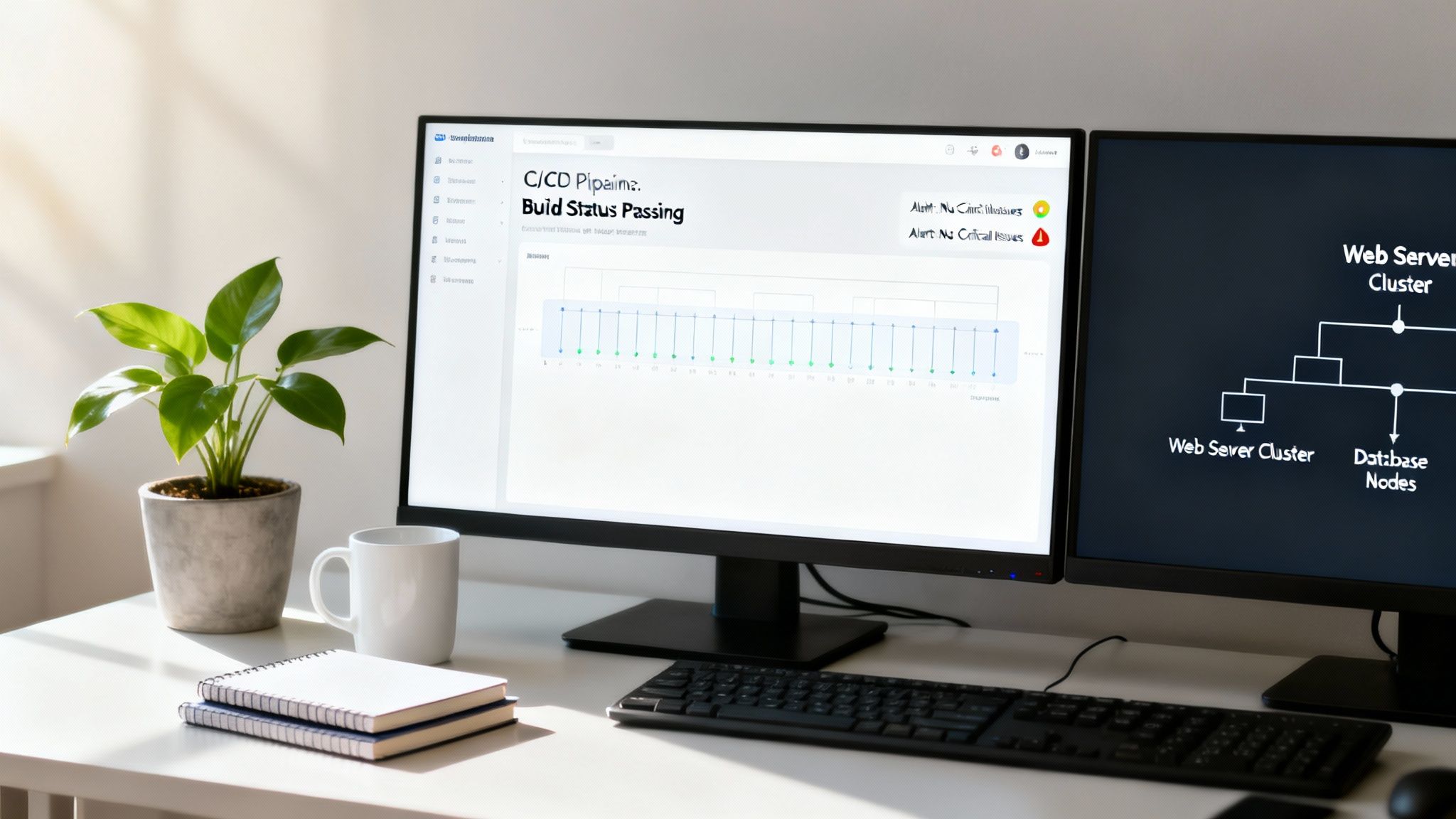
Companies like Stripe, GitHub, and Datadog heavily invest in their SRE and DevOps teams to manage vast, complex infrastructures. For example, a DevOps engineer at HashiCorp helps build the very automation tools that other companies rely on. These roles demand a unique blend of development knowledge and operational expertise, allowing engineers to build scalable, self-healing systems. The high demand for these skills ensures competitive compensation packages.
How to Land the Role
To succeed as a DevOps or SRE candidate, you must demonstrate a strong command of infrastructure automation and reliability principles.
- Master Cloud and IaC: Develop expertise in at least one major cloud platform (AWS is most common) and showcase your skills with Infrastructure-as-Code tools like Terraform, Ansible, or CloudFormation.
- Embrace Containerization: Build deep experience with container technologies like Docker and orchestration platforms like Kubernetes, as they are central to modern infrastructure.
- Build a Portfolio: Create a home lab or a GitHub portfolio that demonstrates practical infrastructure projects, such as setting up a CI/CD pipeline or automating a cloud deployment.
- Focus on Reliability: In interviews, highlight your experience with incident response, monitoring, and designing systems for high availability and scalability. Emphasize how you reduce manual work through automation.
4. Machine Learning Engineer
Machine Learning Engineers bridge the gap between data science and software engineering, building and deploying the sophisticated models that power modern AI features. They are responsible for taking theoretical models and making them work at scale in production environments, driving everything from recommendation engines to fraud detection systems. As companies increasingly rely on data to gain a competitive edge, the demand for skilled ML talent has skyrocketed, making these some of the most sought-after remote high paying jobs.

Pioneering companies like OpenAI, Google, and Scale AI actively hire remote ML engineers, recognizing that top-tier talent is globally distributed. An experienced ML Engineer, particularly one with expertise in a high-growth area like Natural Language Processing (NLP) or Computer Vision, can command a top-tier salary. These roles require a unique blend of research acumen, software development discipline, and a deep understanding of MLOps practices.
How to Land the Role
To secure a remote ML Engineer position, you need to showcase a strong foundation in both theoretical concepts and practical, production-level engineering.
- Build a Tangible Portfolio: Create a GitHub repository with end-to-end ML projects that demonstrate your ability to clean data, train models, and deploy them via an API.
- Master Production Frameworks: While knowing research frameworks like PyTorch and TensorFlow is crucial, demonstrate proficiency in production tools for MLOps, including model versioning and experiment tracking.
- Specialize in a Niche: Develop deep expertise in a specific domain such as NLP, recommender systems, or computer vision to stand out in a competitive market.
- Contribute to Open Source: Contributions to popular ML libraries like scikit-learn, TensorFlow, or Hugging Face are a powerful signal of your skills and commitment.
Once you land an offer, a well-structured onboarding strategy is key. Learn how to create a great first impression by building a 30-60-90 day plan for your new role.
5. Solutions Architect
Solutions Architects serve as the critical bridge between complex technical products and customer business needs. They are responsible for designing and presenting comprehensive solutions that solve specific client challenges, often working closely with sales, engineering, and product teams. This role involves deep product knowledge, strategic thinking, and excellent communication, making it one of the most sought-after remote high paying jobs for those who blend technical acumen with business insight.
Major tech companies like AWS, Stripe, and Salesforce heavily rely on distributed Solutions Architects to guide enterprise clients. These roles are inherently remote-friendly, as the core work involves virtual consultations, creating technical diagrams, and developing proposals that can be delivered from anywhere. A skilled Solutions Architect can significantly influence major sales deals, justifying a high compensation package that reflects their impact on revenue and customer success.
How to Land the Role
To secure a remote Solutions Architect position, you must demonstrate a unique combination of technical expertise, communication prowess, and business understanding.
- Master the Product Ecosystem: Develop deep, demonstrable expertise in a specific technology stack or platform (e.g., AWS, GCP, Salesforce). Certifications are highly valuable here.
- Build Communication Skills: Practice translating complex technical concepts into clear business value. Your ability to create compelling presentations and architectural diagrams is paramount.
- Showcase Consultative Acumen: Frame your experience in terms of problem-solving for clients. Highlight instances where you understood a business need and designed a technical solution that delivered measurable results.
- Develop Cross-Functional Experience: Emphasize your ability to work effectively with both sales and engineering teams, showing you can manage stakeholder expectations and ensure proposed solutions are technically feasible.
6. Security Engineer / Security Architect
Security Engineers and Architects are the digital guardians of a company, responsible for designing and implementing robust systems that protect sensitive data and infrastructure from cyber threats. These roles involve everything from threat modeling and penetration testing to incident response and developing secure coding practices. With the rise of distributed workforces, the demand for experts who can secure cloud environments and remote endpoints has made these some of the most critical remote high paying jobs.
Leading tech companies like Google, Microsoft, and Cloudflare consistently hire for remote security positions, recognizing that talent is global. A Security Architect, for instance, not only implements security controls but also influences product design to ensure security is built-in from the ground up. This strategic importance commands a high salary, particularly for those with specialized expertise in cloud security, application security, or identity and access management.
How to Land the Role
To secure a top-tier remote security position, you must demonstrate a proactive and deeply technical approach to cybersecurity.
- Earn Key Certifications: Credentials like CISSP (Certified Information Systems Security Professional) or OSCP (Offensive Security Certified Professional) are highly valued and validate your expertise.
- Specialize in a High-Demand Domain: Develop deep knowledge in a specific area like cloud security (AWS, Azure, GCP), infrastructure security, or application security.
- Build a Practical Portfolio: Document security vulnerabilities you've discovered (and responsibly disclosed) or contribute to open-source security tools. This provides concrete proof of your skills.
- Demonstrate Cross-Functional Collaboration: Highlight your experience working with development, operations, and legal teams to implement security measures, showing you can protect the business effectively in a remote setting.
7. Full-Stack / Backend Engineer (Senior Level)
Senior Full-Stack and Backend Engineers are the architects of the digital world, building the core logic, databases, and APIs that applications rely on. These senior roles involve owning systems end-to-end, making critical architectural decisions, and ensuring scalability and reliability. As companies increasingly build distributed systems, experienced engineers who can manage complexity remotely are in high demand, making this one of the most stable remote high paying jobs.
Companies known for their strong engineering cultures, like Shopify, GitHub, and Airbnb, frequently hire for senior backend and full-stack positions that are fully remote. These roles command top-tier salaries, especially for those with expertise in high-demand domains like distributed systems, e-commerce platforms, or data processing pipelines. A senior engineer in this capacity is expected to not only write code but also to lead technical discussions and mentor other team members.
How to Land the Role
To secure a senior-level remote backend or full-stack role, you must demonstrate a blend of deep technical skill and effective communication.
- Master System Design: Prepare to tackle complex system design interviews. Focus on distributed systems concepts like databases, caching strategies, message queues, and microservices architecture.
- Specialize and Showcase: Develop expertise in a specific domain like payments, real-time data, or cloud infrastructure. Contribute to relevant open-source projects or write technical blog posts to document and share your learnings.
- Practice Explaining Complexity: A key remote skill is articulating technical decisions clearly in an asynchronous environment. Practice explaining complex systems and their trade-offs to both technical and non-technical stakeholders.
- Stay Current with Trends: Show your commitment to growth by staying up-to-date with modern backend trends, including containerization (Docker, Kubernetes), serverless computing, and observability best practices.
8. Data Engineer
Data Engineers are the architects of a company's data ecosystem, responsible for building and maintaining the infrastructure that collects, stores, and processes vast amounts of information. They design robust data pipelines, optimize databases, and ensure data is clean, reliable, and accessible for data scientists and analysts. As data becomes more central to business strategy, the demand for skilled data engineers has created numerous remote high paying jobs.
Companies with strong data-driven cultures, such as Stripe, Figma, and Slack, actively hire for remote data engineering roles. These positions are critical for enabling everything from business intelligence to machine learning, making them highly valued. A proficient Data Engineer can command a top-tier salary by specializing in modern data stacks, cloud platforms, and scalable data processing frameworks, all of which can be managed effectively from any location.
How to Land the Role
To secure a top remote data engineering role, you must prove your ability to build and manage scalable data systems.
- Master Core Technologies: Demonstrate deep expertise in SQL, a programming language like Python or Scala, and essential data tools such as Apache Spark, Kafka, and Airflow.
- Showcase Practical Projects: Build a portfolio that includes end-to-end data pipeline projects. Document your process, from data ingestion and transformation to loading it into a data warehouse like Snowflake or BigQuery.
- Specialize in Cloud Platforms: Gain hands-on experience with at least one major cloud provider's data services (AWS, GCP, or Azure), as most modern data infrastructure is cloud-based.
- Practice Data Modeling: Be prepared to discuss data modeling concepts and dimensional design in interviews, as this shows you can think strategically about data structure and long-term scalability.
9. Technical Writer / Developer Educator
Technical Writers and Developer Educators are the essential bridge between complex technology and its users. They are responsible for creating clear, accurate, and comprehensive documentation, tutorials, API guides, and educational content that empowers developers to succeed. This role demands a unique blend of technical aptitude and strong communication skills, making it one of the most in-demand remote high paying jobs for those who can translate engineering concepts into accessible language.
Developer-focused companies like Stripe, GitHub, Twilio, and MongoDB rely heavily on their documentation and educational content to drive product adoption. Consequently, they invest in top-tier talent and have well-established remote-first writing and education teams. A skilled Technical Writer or Developer Educator can significantly impact a product's success by reducing user friction and building a loyal developer community, commanding a competitive salary in return.
How to Land the Role
To secure a high-paying remote role as a Technical Writer, focus on building a portfolio that proves you can make complex topics understandable.
- Build a Tangible Portfolio: Create a portfolio showcasing your writing. Contribute to open-source project documentation, write technical blog posts explaining a new technology, or create a detailed tutorial for a popular API.
- Master the Tools of the Trade: Gain proficiency in Markdown, version control systems like Git, and documentation-as-code tools. Understanding how developers work is as important as knowing how to write.
- Demonstrate Audience Empathy: In interviews, articulate your process for understanding developer pain points and tailoring content to meet their specific needs, from beginner tutorials to advanced architectural guides.
- Showcase Visual Communication: Highlight your ability to create and use technical diagrams, code snippets, and other visual aids to clarify complex concepts effectively. This is a critical skill for remote communication.
10. Engineering Manager / Technical Manager
Engineering Managers are the pivotal leaders who guide technical teams toward their goals, blending deep technical understanding with exceptional people management skills. They are responsible for hiring, mentoring, and managing the performance of engineers while ensuring the successful execution of the company's technology roadmap. As organizations increasingly build distributed teams, these leadership roles have become some of the most sought-after remote high paying jobs.
Companies that have mastered remote work, like GitLab, Meta, and Stripe, actively seek Engineering Managers who can foster a productive and inclusive culture across different time zones. A successful remote manager excels at creating psychological safety, driving project delivery, and developing the careers of their team members. This role is less about writing code and more about empowering others to write their best code, making it a critical function for scaling a remote-first engineering organization.
How to Land the Role
To secure a remote Engineering Manager position, you must demonstrate a strong balance of technical credibility and empathetic leadership.
- Develop People Skills: Showcase your experience in mentoring, conducting performance reviews, and resolving interpersonal conflicts. Reading books like Radical Candor or The Effective Manager can provide a strong framework.
- Master Remote Communication: Highlight your proficiency in asynchronous communication and your strategies for building team cohesion and trust without a shared office.
- Demonstrate Business Acumen: Explain how you have aligned engineering efforts with business objectives, managed budgets, and contributed to strategic planning in previous roles.
- Refine Your Hiring Process: Be prepared to discuss your approach to sourcing, interviewing, and onboarding remote engineering talent, which presents unique challenges and opportunities.
11. Founding Engineer / Early-Stage Startup Role
Founding Engineers are the initial technical hires at early-stage startups, responsible for building the product from the ground up. This role is a unique blend of coding, architecture, product strategy, and even customer support. While inherently riskier than established corporate roles, the potential for significant equity upside makes these some of the most lucrative remote high paying jobs for those with an entrepreneurial spirit.
Remote-first startups like Notion and GitLab built their foundations with geographically distributed engineering teams, proving this model's success. A founding engineer at a well-funded startup can secure a competitive salary plus a meaningful equity stake. This position is less about deep specialization and more about versatility, speed, and the ability to build and iterate on a product from zero to one.
How to Land the Role
Securing a founding engineer role requires a mix of technical prowess, business acumen, and a high tolerance for ambiguity.
- Demonstrate Product-Mindedness: Build and ship your own side projects. This shows you can not only write code but also understand user needs and bring an idea to life.
- Evaluate the Opportunity: Before joining, thoroughly vet the startup's founders, market, and traction using platforms like AngelList. Assess if the problem they are solving is significant and if the founding team has a clear vision.
- Negotiate Equity Intelligently: Your early contributions create immense value. Push for a meaningful equity grant (e.g., 0.5% to 2%) and ensure you fully understand the vesting schedule and strike price.
- Highlight Adaptability: Emphasize your ability to wear multiple hats. Provide examples of times you’ve quickly learned a new technology or stepped outside a traditional engineering role to solve a problem.
12. Technical Recruiter / Engineering Recruiter
Technical Recruiters are the critical link between top engineering talent and the companies that need them. They manage the entire hiring lifecycle, from sourcing and screening candidates to negotiating complex offers. This role requires a unique blend of interpersonal skills and a deep understanding of the technical landscape, including different programming languages, frameworks, and engineering roles. As the demand for tech talent continues to outpace supply, these roles have become some of the most sought-after remote high paying jobs.
Companies like GitLab, Atlassian, and Stripe rely heavily on skilled technical recruiters to build their distributed engineering teams. A successful recruiter acts more like a strategic partner than a salesperson, building trust within engineering communities and understanding the nuances of technical skill sets. This position is ideal for remote work, as much of the sourcing, communication, and coordination can be managed effectively with digital tools.
How to Land the Role
To excel as a remote Technical Recruiter, you must build credibility with both hiring managers and candidates.
- Develop Technical Acumen: You don't need to code, but you must understand the difference between a front-end framework and a back-end service. Invest time in learning the terminology and skill requirements for various engineering roles.
- Build Your Network: Engage genuinely with engineering communities on platforms like GitHub, Stack Overflow, and technical forums. Position yourself as a helpful advisor, not just a recruiter pushing a job.
- Master Sourcing Tools: Become an expert in using LinkedIn Recruiter, talent sourcing platforms, and Applicant Tracking Systems (ATS) like Greenhouse or Lever to build and manage candidate pipelines.
- Highlight Negotiation Skills: Provide specific examples of how you have successfully navigated complex compensation discussions, including equity, bonuses, and remote work stipends. Emphasize your understanding of market rates for technical talent.
12 Remote High-Paying Tech Roles Comparison
| Role | 🔄 Implementation complexity | ⚡ Resource & skills required | 📊 Expected outcomes | Ideal use cases | ⭐ Key advantages |
|---|---|---|---|---|---|
| Senior Software Engineer / Staff Engineer | High — complex system design, cross-team ownership | 7+ yrs experience; system design, architecture, leadership | Scalable core systems; technical strategy; team mentorship | Large-scale products, platform ownership, architecture-led initiatives | High compensation, autonomy, strong career progression |
| Product Manager (Remote) | Medium–High — cross-functional coordination and prioritization | 3–5+ yrs; product strategy, data analysis, user research | Clear roadmap, prioritized features, product-market alignment | New product launches, feature prioritization, customer-driven iterations | High impact on direction; diverse skill growth; customer focus |
| DevOps Engineer / SRE | High — infrastructure complexity, incident response | 4–7+ yrs; cloud, Kubernetes, IaC, CI/CD, monitoring | Improved reliability, faster deployments, automated pipelines | High-traffic services, frequent deployments, reliability engineering | Critical operational impact, strong job security, modern tooling |
| Machine Learning Engineer | High — research + productionization complexity | 3–5+ yrs; ML frameworks, data engineering, GPU resources | Production ML models, personalization, business-driving features | Recommendation systems, fraud detection, ML-driven products | Cutting-edge problems, research & engineering blend, high demand |
| Solutions Architect | Medium — consultative design with technical depth | 5–8+ yrs; deep product knowledge, architecture, presentation skills | Validated architectures, successful POCs, smoother sales cycles | Enterprise integrations, custom deployments, pre-sales technical support | Direct impact on deal closure and customer success; varied work |
| Security Engineer / Security Architect | High — security design, compliance, incident readiness | 5–8+ yrs; threat modeling, cloud security, certifications | Reduced risk, compliance adherence, faster incident response | Regulated industries, customer-data protection, cloud security | Executive visibility, transferable expertise, strong demand |
| Full-Stack / Backend Engineer (Senior) | High — end-to-end system ownership and scaling | 6–10+ yrs; APIs, databases, scalability, performance tuning | Robust APIs, performant services, reduced technical debt | Core platform development, backend-heavy product features | Deep technical ownership, mentorship roles, career growth |
| Data Engineer | Medium–High — complex pipelines and data reliability | 4–7+ yrs; SQL, ETL, Spark, Airflow, cloud data warehouses | Reliable data pipelines, accessible analytics, ML-ready data | Analytics platforms, ML data ingestion, reporting infrastructure | Clear business impact, high demand, modern data tooling |
| Technical Writer / Developer Educator | Medium — requires technical understanding and clarity | 3–5+ yrs; writing, docs tooling (Markdown/Git), dev empathy | Accurate docs, faster onboarding, improved developer experience | APIs, SDKs, developer platforms, onboarding flows | Flexible remote work, strong work-life balance, high impact on DX |
| Engineering Manager / Technical Manager | High — people management + technical oversight | 5–8+ yrs engineering + management; hiring, coaching, planning | Team delivery, career development, roadmap execution | Scaling teams, cross-functional delivery, organizational leadership | Significant organizational impact, leadership career path |
| Founding Engineer / Early-Stage Startup Role | Very high — broad responsibilities, high ambiguity | 3–7+ yrs; full-stack/product thinking, adaptability, self-direction | Rapid product iteration, core system launch, equity upside | Seed–Series B startups building MVPs and early products | Meaningful equity upside, rapid learning, full ownership |
| Technical Recruiter / Engineering Recruiter | Medium — process-driven with stakeholder coordination | 2–4+ yrs; sourcing tools, market knowledge, negotiation skills | Filled roles, robust talent pipelines, improved hiring velocity | High-growth hiring cycles, scaling engineering orgs | Performance bonuses/commissions, network building, remote-friendly |
How to Land Your Dream Remote Role and Maximize Your Pay
The landscape of work has fundamentally shifted, and as we've explored, the opportunities for remote high paying jobs are more abundant and lucrative than ever. From the architectural vision of a Solutions Architect to the foundational code of a Senior Software Engineer, these roles offer not just financial rewards but the unparalleled flexibility to design a life that works for you. However, recognizing the opportunity is only the first step; seizing it requires a deliberate and strategic approach tailored specifically for the remote hiring arena.
The path from applicant to new hire in the remote world is paved with intentional actions. It's no longer enough to simply have the technical skills. Companies are looking for candidates who can thrive autonomously, communicate with clarity across time zones, and contribute to a digital-first culture. This guide has provided the blueprint, now it's time to build your strategy.
Your Action Plan: From Applicant to Top Earner
Moving forward, your focus should be on translating your skills and experience into a compelling narrative that resonates with remote-first hiring managers. Here’s a distilled action plan to guide your next steps:
1. Optimize Your Digital Footprint for a Remote World:
Your resume and online profiles are your digital handshake. Go beyond listing job duties and instead showcase quantifiable achievements that demonstrate your ability to deliver results independently.
- Resume Keywords: Integrate terms like "asynchronous communication," "distributed teams," "remote collaboration," "project management tools (Jira, Asana)," and "CI/CD pipelines."
- Show, Don't Tell: Instead of saying you're a "good communicator," describe how you "led a cross-functional project across three time zones using Slack, Notion, and weekly async updates, resulting in a 15% reduction in project completion time."
2. Master the Asynchronous Interview Process:
Remote interviews often involve a mix of live video calls, take-home assignments, and asynchronous communication. Prepare for each stage by practicing how you articulate your thought process clearly and concisely, both verbally and in writing.
Pro Tip: When you receive a take-home assignment, create a brief
README.mdfile explaining your approach, the trade-offs you considered, and how you would improve it with more time. This demonstrates strong documentation and communication skills, which are vital in remote roles.
3. Strategize Your Salary Negotiation:
Securing a high-paying remote job isn't complete until you’ve successfully negotiated your compensation. Your leverage comes from being well-prepared.
- Benchmark Your Worth: Use data from sites like Levels.fyi and Glassdoor to understand the salary bands for your target role, experience level, and the company's location (or location-agnostic pay scale).
- Articulate Your Value Proposition: Prepare a script that connects your specific skills to the company's pain points. For example: "Based on my experience scaling data infrastructure at my previous role, which saved the company over $200,000 annually, and the market rate for a Senior Data Engineer with my expertise, I am seeking a base salary in the range of $185,000 to $200,000."
The Ultimate Advantage: Strategic Job Searching
The difference between a frustrating job hunt and a successful one often comes down to where and how you look. Flooding generic job boards with your application is inefficient. Instead, focus on curated platforms and targeted networking. To navigate the modern hiring landscape, explore effective job search strategies tailored for today's competitive remote market. Adopting a focused approach ensures your efforts are directed at high-quality opportunities with companies that genuinely value remote talent.
Landing one of these elite remote high paying jobs is more than a career move; it's a life-altering decision. It represents a commitment to taking control of your professional growth, your financial future, and your personal freedom. The roles are out there, the demand is high, and with this guide, you now have the tactical knowledge to make your ambition a reality.
Stop wasting time sifting through endless, low-quality listings. RemoteWeek curates the best remote high paying jobs from companies with proven, positive work cultures (Glassdoor rating 3.5+). Find your next six-figure opportunity faster by exploring our vetted job board at RemoteWeek.