
Work Life Integration vs Balance A Guide for Remote Tech Pros

The whole work-life integration vs. balance conversation really boils down to one question: do you want a wall or a revolving door between your job and your personal time? Balance is all about building that wall, keeping work firmly on one side and life on the other. Integration is about letting them blend, creating a single, fluid day. The right choice for you depends entirely on whether you thrive with clear-cut boundaries or prefer the flexibility to weave everything together.
The Old Rules No Longer Apply

For years, work-life balance was the ultimate career goal. You clocked out at 5 PM, and your work persona stayed behind at the office. That model made sense when work was a place you went to. But for remote tech professionals, the office is now the kitchen table, the spare bedroom, or a coffee shop. The physical separation is gone, and the old rules just feel… well, old.
This shift has forced a major rethink, bringing a completely different philosophy into the picture: work-life integration. It’s not just a new buzzword; it’s a fundamentally different way to structure your day and, by extension, your life. There's no one-size-fits-all answer here. Your personality, the demands of your role, and your company's culture all play a huge part. Getting a handle on these two models is the first step to building a career that actually works for you.
Two Philosophies, Two Lifestyles
To figure out which path is yours, you need to understand what each approach is really about. They represent two completely different ways of managing your time and energy.
- Work-Life Balance: This is the classic approach. Think of it as compartmentalization. You create firm, protected time slots for your job and for your personal life. The main goal is to keep work from spilling over into your family time, hobbies, and downtime.
- Work-Life Integration: This is a more modern, fluid concept. Instead of strict separation, you look for synergy. It’s about blending your responsibilities. This could look like taking a two-hour break in the afternoon to hit the gym or pick up your kids, then logging back on in the evening to finish a project.
The table below really gets to the heart of the philosophical differences.
| Dimension | Work-Life Balance (Separation) | Work-Life Integration (Synergy) |
|---|---|---|
| Mindset | Compartmentalized; work and life are two distinct worlds. | Holistic; work and life are interconnected parts of a whole. |
| Boundaries | Rigid and clearly defined, like a classic 9-to-5 schedule. | Fluid and adaptable, shifting based on what your day demands. |
| Flexibility | Less flexible hours, but highly predictable. | Highly flexible schedule, but needs a ton of self-discipline. |
| Primary Goal | To protect your personal time from your work life. | To find harmony and be effective across all areas of your life. |
This isn't just a preference—it's becoming a priority. In fact, 28% of employees now say work-life balance is their single biggest motivator, ranking it even higher than pay. Research into workplace culture trends shows how this desire for structure is shaping what people want from their jobs.
Ultimately, whether you're a balancer or an integrator, remote work offers the freedom to build the structure you need. To dig deeper into how this works in practice, you can explore the pros and cons of remote work in our guide.
Comparing Work-Life Philosophies
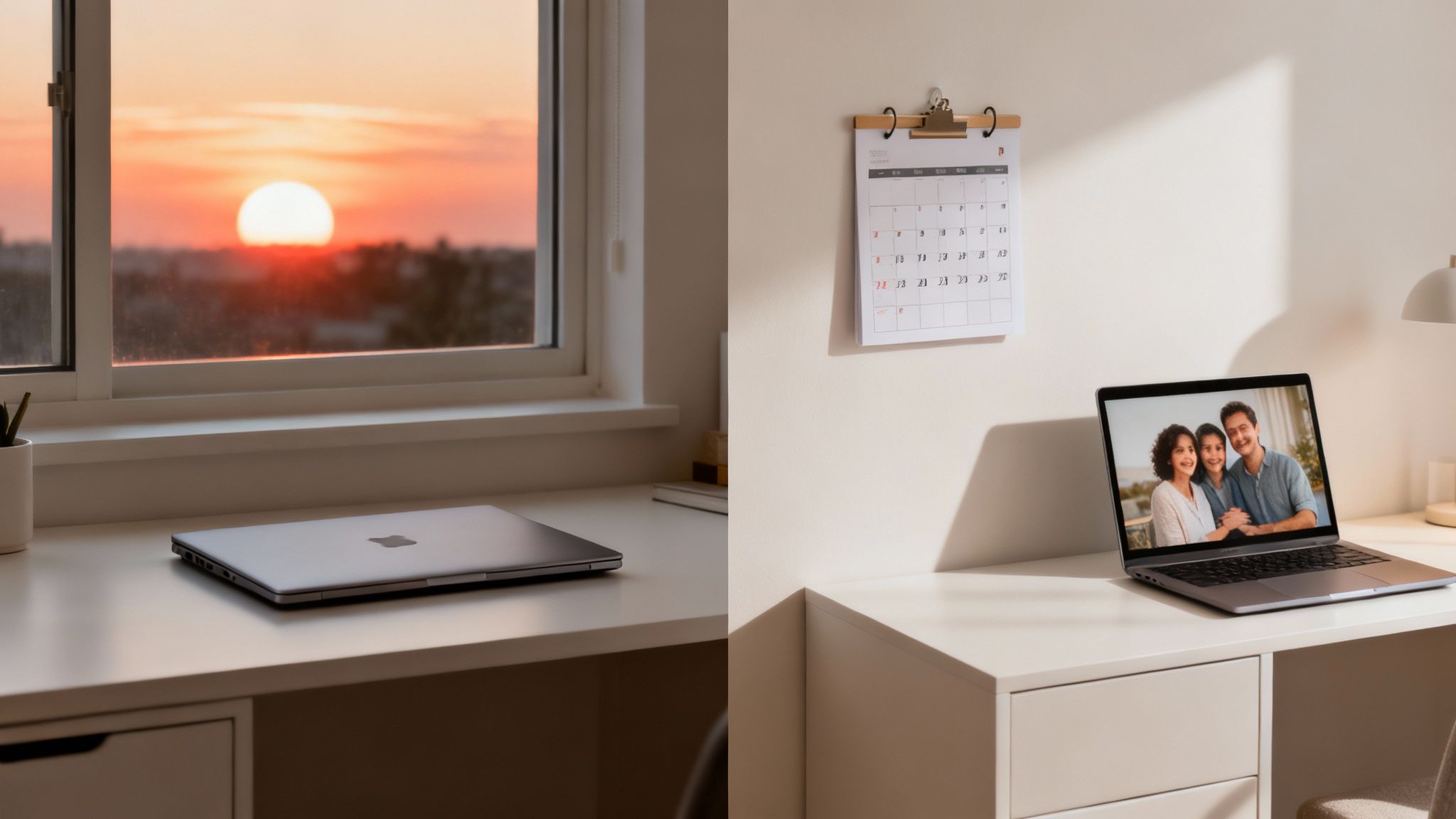
It’s crucial to understand the difference between work-life balance and work-life integration because the philosophy you choose genuinely shapes your entire day. One is built on separation, the other on synergy. And to be clear, neither is inherently “better”—they just fit different personalities, career roles, and life situations.
Work-life balance is the model we all grew up with. It's built on the old-school idea that our professional and personal lives are two separate domains that shouldn’t bleed into each other. This approach is all about creating firm boundaries where work starts and stops at a specific time, giving you predictable and protected personal time.
Work-life integration, on the other hand, throws that rulebook out. It treats your life as one cohesive whole, erasing the hard lines between your job as a tech professional and your other roles as a parent, friend, or hobbyist. With this model, your schedule becomes fluid, allowing you to weave personal appointments and work tasks throughout the same day.
Mindset and Boundaries
The real divergence between these two approaches comes down to mindset. If you're a "balancer," you see your time and energy as finite resources that have to be carefully divvied up between competing priorities. The main goal here is to defend your personal time from work, ensuring you can completely disconnect and recharge.
If you lean more toward being an "integrator," you view your time as more fluid. You're less focused on a strict division of hours and more on your overall life satisfaction. You're perfectly comfortable blending things—like shooting off a work email from your phone while in the waiting room at the dentist or taking a long midday break for a kid's soccer game before jumping back on a project in the evening. This takes a ton of self-discipline to pull off without letting one area completely dominate the other.
The essential distinction is this: Balance seeks to defend personal time from work, while integration aims to weave work into a fulfilling life. One is about protection and separation; the other is about connection and synergy.
Flexibility and Control in Practice
In a remote tech role, these philosophies show up in very different ways. A software developer who practices work-life balance might flip their Slack status to "away" at 5 PM sharp and mute all notifications until the next morning. Their day is predictable and structured, which is fantastic for deep, uninterrupted focus.
Now, picture an engineering manager who's an integrator. They might start their day early to sync with a team in Europe, take a three-hour break in the afternoon for a family event, and then log back on later to collaborate with their team on the West Coast. This gives them incredible flexibility, but it also completely blurs the traditional idea of "off-hours."
To really nail down the differences, let's break down how these two approaches stack up across a few key areas that matter for remote work.
Work-Life Integration vs. Balance At a Glance
This table offers a side-by-side look at how each philosophy plays out in the daily life of a remote tech professional. It breaks down the core principles, practical applications, and potential outcomes of both integration and balance.
| Dimension | Work-Life Balance (The Separationist) | Work-Life Integration (The Harmonizer) |
|---|---|---|
| Core Principle | Compartmentalization. Creates distinct, protected blocks of time for work and personal life. | Synergy. Blends personal and professional activities into a cohesive, fluid day. |
| Daily Application | Adheres to a fixed schedule, such as 9 AM to 5 PM, with clear start and end times. | Operates with a flexible, non-linear schedule, working when most productive or convenient. |
| Communication Style | Prefers synchronous communication during set "office hours." Discourages after-hours contact. | Embraces asynchronous communication, comfortable with messages sent and received outside of a typical workday. |
| Potential Drawback | Can feel rigid and may not accommodate unexpected personal needs or global team collaboration effectively. | Risks creating an "always on" culture, making it difficult to fully disconnect and potentially leading to burnout without strong self-discipline. |
| Best For | Roles requiring deep, uninterrupted focus (e.g., coding, data analysis) and individuals who thrive on routine. | Roles requiring collaboration across time zones or individuals who need high levels of daily flexibility. |
At the end of the day, picking a side isn't just a preference—it's a strategic decision about how you want to manage your energy and attention. The key is to consciously choose the approach that actually aligns with your job, your personal needs, and your company's culture, instead of just falling into a pattern that doesn't really work for you.
The Case for Work-Life Integration
While the idea of a perfect work-life balance sounds great on paper, the reality of remote work has pushed a different, more fluid model to the forefront: work-life integration. This isn't about cramming more work into your life; it's about erasing the hard lines between your professional and personal worlds to create a single, cohesive lifestyle. For many in tech, this is less a choice and more a necessity to thrive in a globally connected, always-on world.
At its core, integration is about reclaiming your autonomy. It empowers you to design your day based on your own rhythm—your energy levels, personal errands, and family needs—not just the ticking of a clock. Life doesn't stop from 9 to 5, and this approach acknowledges that. You can hit a quiet gym mid-day, attend your kid's school play, and then dive back into a deep-focus work session in the evening when you feel most productive.
This kind of synergy can lead to a huge boost in both job satisfaction and actual performance. The data is starting to back this up, showing that when work and life support each other, the results are often far better.
Embracing Flexibility for Peak Performance
The biggest win for work-life integration is its incredible flexibility. If you're a tech professional on a distributed team, a linear workday is practically a myth. A product manager might have a morning sync with developers in Eastern Europe, take a long break in the afternoon for appointments, and then jump back online to connect with the West Coast team in the evening.
This is exactly where integration shines. It allows you to stay responsive and get things done without having to sacrifice the moments that matter in your personal life. The entire mindset shifts from counting the hours you log to celebrating the outcomes you achieve.
Think of a freelance developer who does their best coding late at night. An integration mindset lets them lean into that natural productivity spike instead of forcing creativity into a standard 9-to-5 box. It's built on a simple but powerful idea: you do your best work when you're working at your best. You can dig deeper into this concept in our guide to the benefits of a flexible work schedule.
Debunking the "Always On" Myth
One of the biggest fears about work-life integration is that it just means being "always on." That’s a total misconception. Done right, integration isn’t about working more; it’s about working smarter. It requires serious self-discipline, crystal-clear communication, and the skill to set intelligent, flexible boundaries.
Work-life integration isn't about letting work invade every moment of your life. It's about empowering you to consciously design a life where professional ambitions and personal well-being support each other.
For this to work, everyone needs to be on the same page. Teams need clear norms for communication—like expected response times for non-urgent DMs—and a culture of respect for each other’s unique schedules. It's a system built on trust, where your contribution is measured by your results, not by a little green dot next to your name on Slack.
The proof is in the numbers. Recent studies show that employees who get integration right are 21% more productive and 23% more engaged than those stuck in a rigid structure. Many experts now believe the old 50/50 split is unrealistic in our modern world, making integration a much more practical route to feeling fulfilled. By thoughtfully weaving the threads of work and life together, you can build a richer, more satisfying daily experience without sacrificing your career goals.
The Power of Enforcing Work-Life Balance
While work-life integration offers a more fluid, modern approach, the classic philosophy of work-life balance is still a vital strategy for many remote professionals. This isn't about clinging to rigid, old-fashioned schedules; it's a deliberate act of self-preservation. For a lot of people, creating firm, clear boundaries is the only sustainable way to prevent burnout, protect their mental health, and build a lasting career.
The whole idea behind balance is separation. It's built on the psychological benefits of truly "switching off," which lets your mind completely disengage from the pressures of work. This detachment is absolutely critical for cutting down on chronic stress, sleeping better, and being fully present with family and friends. Without these clear divides, that low-grade hum of work anxiety can easily seep into every part of your life.
The Strategic Advantage of Disconnecting
For certain roles in tech, balance isn't just a preference—it actually boosts performance. Take a data scientist or a security engineer, for example. Their jobs require long stretches of deep, uninterrupted concentration. Constant context-switching, like answering a quick Slack message during dinner or checking emails before bed, shatters their focus and makes it much harder to solve complex problems.
A professional who is truly committed to work-life balance designs a routine to protect that focus. Their day might look something like this:
- Defined Work Hours: They log in at 9 AM and make a point to log out at 5 PM.
- Notification Control: All work-related notifications are silenced on their phone and computer outside of these hours.
- Protected Weekends: Saturdays and Sundays are reserved entirely for personal hobbies, family, and relationships—no exceptions.
- True PTO: When they take paid time off, they actually take it. They don't check in, trusting their team to handle things.
This kind of structure creates a predictable rhythm that allows for peak productivity during work hours and genuine rest during personal time. For anyone who thrives on these clear distinctions, learning how to set and keep these boundaries is crucial. You can find some practical tips for maintaining work-life balance and harmony.
The real power of work-life balance is in its deliberate defense of your personal time and mental energy. It’s an acknowledgment that to be 100% on at work, you need the freedom to be 100% off when you're done.
Setting Boundaries for Sustainable Success
Carving out these partitions in a remote setup takes conscious effort. The physical separation of an office is gone, so you have to create digital and mental ones in its place. This often means having direct conversations with your manager and team about your availability and their communication expectations. Setting these boundaries isn't a sign of weak commitment; it's the mark of a professional who knows how to manage their energy for the long run.
This is a key skill to master in the ongoing work life integration vs balance debate. You can dive deeper into the specifics of how to set boundaries at work to safeguard your well-being. By enforcing a clear separation, you give yourself the space to fully recharge, returning to work each day refreshed, focused, and more creative. This approach builds a career that doesn't just look good on paper but feels sustainable and fulfilling—and it's one of the best ways to avoid the burnout that plagues so many in the tech world.
Choosing the Right Approach for You
So, which is it? Work-life integration or work-life balance? The truth is, there's no single "best" philosophy. It's about making a strategic choice that fits your personality, your job, and whatever season of life you're in right now. Think of it less like a permanent label and more like a strategy you can adjust as your world changes. The goal is to build a work life that feels both productive and genuinely sustainable.
Moving from concept to reality starts with some honest self-reflection. Do you thrive on a predictable schedule and clear boundaries? Or do you crave the freedom to pivot and adapt your day as you go? The right approach will play to your strengths and help shore up your weaknesses.
This little decision tree can help you figure out where you might land based on how you’re currently feeling about work.
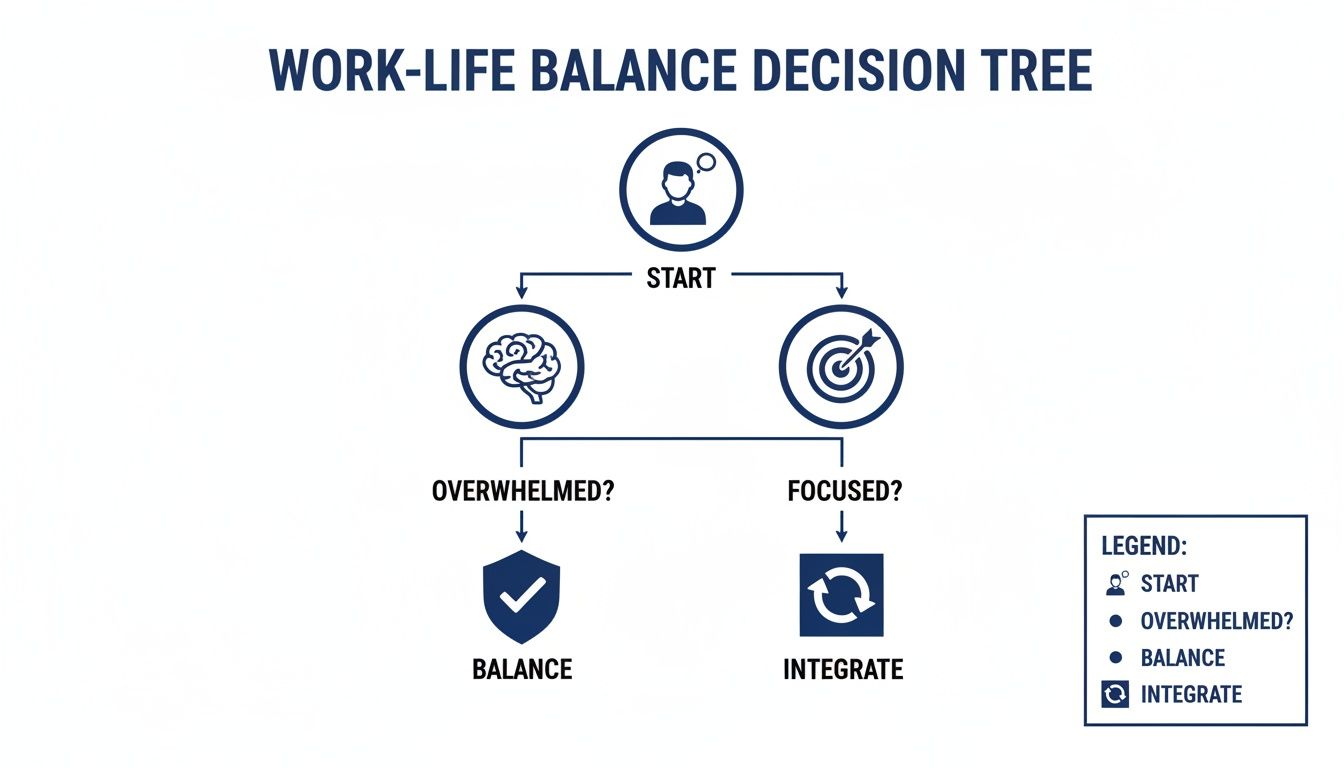
As you can see, if "overwhelmed" is your default setting, a balance-first approach might give you the structure you need. But if you’re feeling focused and in control, integration could be a great fit.
When to Choose Work-Life Integration
Work-life integration really shines for people who value autonomy and have the self-discipline to make it work. If the old 9-to-5 feels like a straitjacket or you're juggling major non-work responsibilities, integration offers the wiggle room you need to succeed.
Consider leaning into an integration model if you:
- Need High Flexibility: Maybe you’re managing caregiving duties, taking classes, or collaborating across multiple time zones. Integration lets you weave these commitments together without dropping professional balls.
- Are a "Night Owl" or "Early Bird": This approach lets you schedule deep work when you’re naturally at your sharpest, even if that’s well outside of traditional business hours.
- Thrive on Variety: You get a kick out of the dynamic flow of switching between different tasks and mental contexts throughout your day.
Integration works best when you see your life as one cohesive whole. It’s about creating a synergy where your professional and personal pursuits actually enrich each other, instead of just competing for your time.
This model is a natural fit for roles that are driven by results—think project management or entrepreneurship—where what you accomplish matters far more than the hours you clock.
When to Choose Work-Life Balance
On the flip side, a work-life balance approach is a powerful tool for anyone who needs that clean separation to protect their mental health and dodge burnout. If you find yourself stewing over work emails long after you’ve logged off or you struggle to be truly present with family and friends, those firm boundaries are non-negotiable.
A balance-oriented strategy is probably right for you if you:
- Are Prone to Burnout: You need a hard stop at the end of the workday to truly unplug, recharge, and keep chronic stress at bay. The structure of a balanced approach is a crucial defense for your well-being.
- Work in an Emotionally Demanding Role: For professionals in fields like user support or cybersecurity, the ability to mentally "leave work at work" is absolutely critical for sticking around long-term.
- Prefer a Clear Separation of Identities: You value having a distinct "work self" and "home self," and you find that this separation helps you stay focused and engaged in each domain.
Ultimately, the choice comes down to your personal approach for achieving success with professional and personal goals. By getting real about your own needs and tendencies, you can pick the framework that best supports both your career and your sanity. There’s no wrong answer—only the one that works for you right now.
How to Identify a Company's True Work Culture
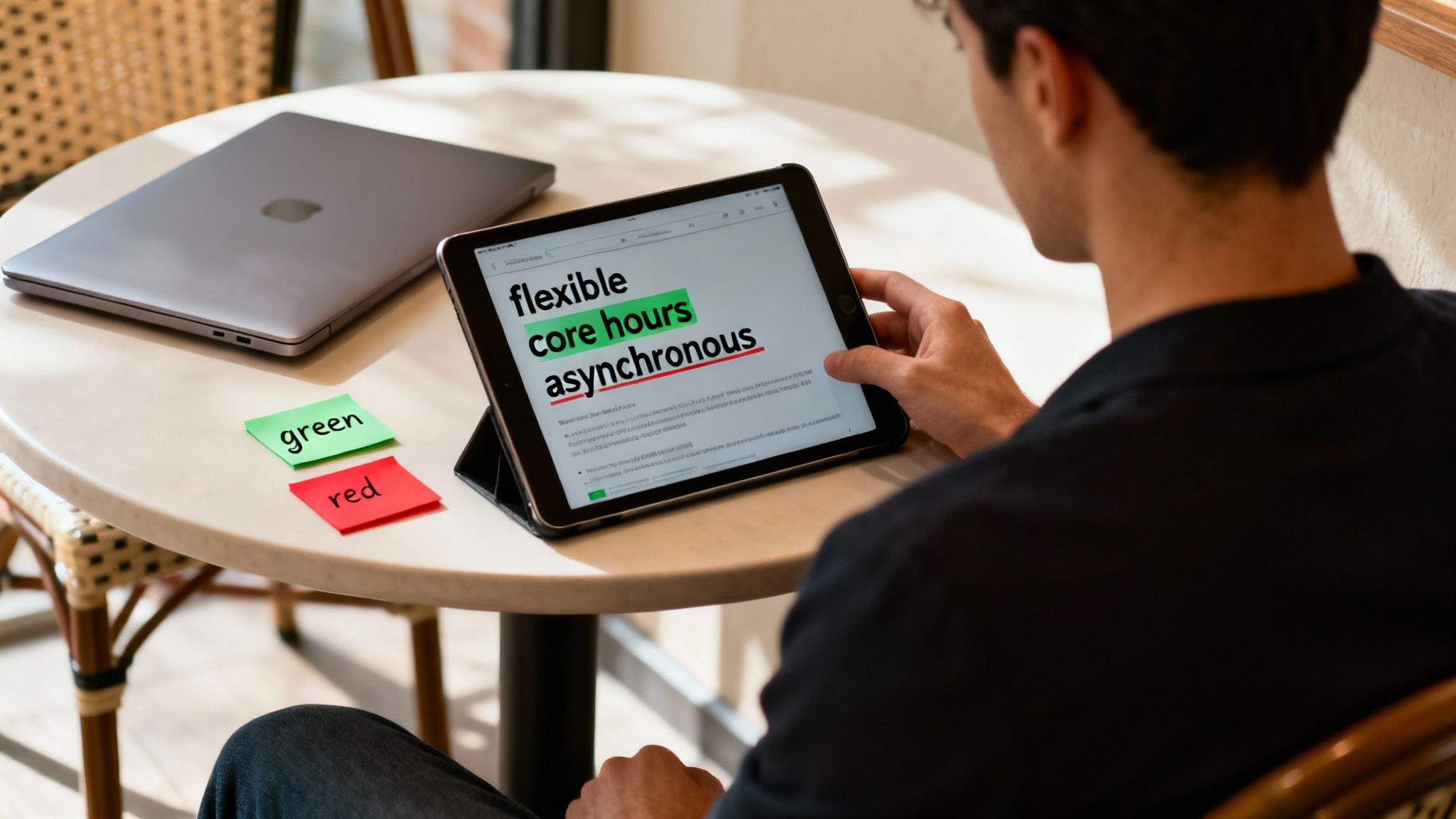
Job descriptions are more than just a list of duties; they're a peek behind the curtain at a company's real culture. Every organization will tell you they have a great work environment, but the specific words they choose reveal where they truly stand on the work life integration vs balance debate. Learning to read between the lines is critical to finding a role that actually fits you.
It’s not about finding a universally "good" culture. It's about finding the right one for your personality and lifestyle. Some people thrive with the clean separation of a balance-first setup, while others need the fluid, adaptable nature of integration. The key is knowing what to look for.
Green Flags for a Balance-Friendly Culture
Companies that are serious about work-life balance talk a lot about boundaries and structure. Their language is all about predictability and respecting your personal time.
As you scan job postings, keep an eye out for these positive signals:
- Mentions of 'Core Working Hours': This is a great sign. It means that while there's flexibility, there’s also a clear understanding of when you need to be online—and, just as importantly, when you’re expected to log off.
- Generous and Encouraged PTO: They don’t just state the number of days. They'll talk about a culture where you’re actively encouraged to use your vacation time to disconnect and recharge.
- Emphasis on Respect for Evenings/Weekends: Phrases like "we respect your downtime" or "no after-hours emails" are gold. They show the company is actively trying to protect your personal life.
A business that prioritizes balance measures performance within set hours, preventing work from bleeding into every waking moment.
A key sign of a healthy, balance-oriented culture is a clear focus on preventing burnout as a strategic priority, not just an HR talking point. They understand that sustainable performance requires genuine rest.
Green Flags for an Integration-Friendly Culture
A healthy integration-focused culture is built on a foundation of trust, autonomy, and genuine flexibility. The language you'll see is less about counting hours and more about delivering results.
Look for these clues:
- Emphasis on 'Flexible Schedules': This is more than just shifting your start time. It points to the freedom to weave personal and professional tasks together throughout your day as you see fit.
- Frequent Use of 'Asynchronous Communication': This is a huge green flag. It shows the company has built its operations around systems that don't force everyone to be online at the same time—a cornerstone of true integration.
- 'Results-Oriented Performance': Hunt for job descriptions that focus on what you will accomplish, not just the hours you need to put in. It shows they trust you to manage your own time to hit your goals.
Red Flags That Signal a Toxic Environment
Be careful. Some companies use the language of flexibility to mask a toxic, "always-on" culture. This is where you need to be most critical. Red flags often pop up as vague or overly demanding phrases that create ambiguity.
Watch out for terms like "comfortable with a fast-paced environment," "ability to wear many hats," or "available to handle urgent requests." Often, this is just code for an understaffed, overworked team where personal boundaries are an afterthought. This approach is part of a larger trend; the Remote Global Life-Work Balance Index recently ranked the US a dismal 59th out of 60 countries, largely due to a pervasive culture of long hours. You can dig into the full global life-work balance report for more details.
To avoid these traps, platforms like RemoteWeek can be invaluable. They vet the companies on their job board, which helps filter out the noise and connect you with organizations that genuinely invest in their teams' well-being.
Common Questions on Work-Life Models
Knowing the difference between work-life integration and balance is one thing, but actually putting them into practice? That's where the real questions come up. Let's tackle some of the most common ones that tech professionals grapple with when trying to design their workdays.
Can You Switch Between Balance and Integration?
Absolutely. Think of these models less as a fixed identity and more as tools in your toolkit. You’re not an "integrator" or a "balancer" for life.
You might find yourself leaning heavily on a work-life balance approach during a critical project with a tight deadline. Setting those hard boundaries is crucial for deep, uninterrupted focus. But once that project ships, you might shift back to an integrationist style, weaving personal appointments and work tasks together more fluidly during a slower period.
Life changes, projects evolve, and so should your work-life strategy.
The goal isn’t to pick one model and stick with it forever. The real skill is knowing which one to use and when. Adaptability is your greatest asset in managing your energy.
How Can Managers Support Both Work Styles?
Great managers build a culture where both styles can thrive, and it all starts with setting crystal-clear expectations around communication. Is that late-night Slack message a "read this tomorrow" heads-up or a "drop everything now" emergency? Your team needs to know the difference.
Here’s how managers can build that supportive environment:
- Focus on results, not screen time. Judge performance based on the quality of the work delivered, not on when someone’s Slack light is green.
- Lead by example. If you're firing off emails at 10 PM, you're sending a clear signal that your team should be online too. Model the healthy boundaries you want to see.
- Trust by default. Give your people the autonomy to manage their own schedules. This shows you have confidence in them to get the job done right.
Is One Approach Better for Certain Tech Roles?
It’s tempting to draw hard lines here, but personal preference almost always wins out. That said, we do see some general patterns.
Roles that demand long stretches of pure, uninterrupted focus—think security engineers, data scientists, or deep-system developers—often lean toward the strict boundaries of work-life balance. It’s about protecting that flow state.
On the other hand, highly collaborative roles like a product manager juggling stakeholders across multiple time zones might find an integration model far more practical. The lines have to blur to keep things moving. But again, it’s not a rule. I've known developers who love the flexibility of integration and managers who swear by strict balance to avoid burnout. The "best" approach is always the one that fits you.
Ready to find a company that actually gets it? On RemoteWeek, we only list remote tech companies with a real, proven commitment to employee well-being. Start your search for a healthier work environment today.