
Master the 2nd Follow Up Email After Interview and Get Hired
So, you’re staring at a silent inbox after a great interview. It’s a frustrating spot to be in, but don’t jump to conclusions. Sending a 2nd follow up email after an interview isn’t a sign of desperation—it's a smart, strategic move that shows you're persistent, professional, and genuinely interested in the role. When hiring managers are drowning in applications, this is how you stay on their radar.
Why a Second Follow Up Email Is Your Secret Weapon
The post-interview silence can be deafening, especially in the hyper-competitive remote job market. It's easy to assume the worst, but the reality is often much more mundane. Hiring managers at top remote companies are wading through hundreds of applications for just one position. Emails get buried, internal deadlines get pushed, and even the most memorable candidates can sometimes slip through the cracks.
This is exactly why sending a second follow-up isn't just okay—it's often essential.
Done right, a well-timed second email doesn't come across as pushy. Instead, it frames you as a proactive and organized professional. It’s a gentle nudge that reminds the hiring team of your conversation, your qualifications, and your genuine excitement for the opportunity. Think of it as simply bringing your name back to the top of their inbox and their mind.
Standing Out in a Crowded Inbox
When you're competing against a global talent pool, every small advantage counts. That second follow-up can be the very thing that sets you apart and finally gets you a response. In fact, data from sales outreach campaigns shows just how powerful multiple touchpoints can be. The response rate for a second follow-up email can jump to 6.94%—a significant bump from the first message—before it starts to dip on the third try. If you're curious, you can read the full research about these follow-up statistics to see the numbers for yourself.
A polite and professional second follow-up reinforces three critical traits that employers look for: resilience, strong communication skills, and a genuine commitment to the opportunity.
Of course, this strategy works best when you've nailed the basics from the start. Your first step should always be to craft the best follow-up email after an interview, as this sets a professional tone. It also helps to be confident in your interview performance, so brushing up on how to answer common remote job interview questions is always a good idea.
Before you hit "compose," let's break down exactly what your message should include. The table below gives you a quick roadmap to follow.
Anatomy of an Effective Second Follow Up Email
Here’s a quick summary of the essential elements to include in your second follow-up message.
| Component | Purpose | Quick Tip |
|---|---|---|
| Clear Subject Line | To be instantly recognizable and easy to find in a busy inbox. | Reply to your previous follow-up email to keep the context in one thread. |
| Polite Opening | To respectfully jog their memory and maintain a positive tone. | Start with a simple, friendly greeting like, "Hope you're having a great week." |
| Brief Context | To remind them who you are and which position you interviewed for. | Mention the job title and the date of your last conversation. |
| Value Add or Update | To provide a new reason to engage, not just to ask for an update. | Share a relevant article, a new portfolio piece, or a quick thought on a company milestone. |
| Call to Action | To gently prompt a response without being demanding. | Keep it low-pressure. "Any update you can share would be greatly appreciated." |
| Professional Closing | To end the email on a courteous and patient note. | Use a classic sign-off like "Best regards" or "Sincerely." |
Think of these components as your checklist for creating a message that's helpful, not a nuisance. It's all about striking the right balance.
Finding the Perfect Timing and Tone
Knowing when to send your follow-up and how it should sound is probably the trickiest part of this whole process. It’s a delicate dance. You want to show you're still keen on the role, but you definitely don't want to become a nuisance in the hiring manager's inbox.
Sending it too soon can come off as impatient. Waiting too long might look like you’ve lost interest. The sweet spot is what I call polite persistence—not pressure.
As a solid rule of thumb, give it about a week after your first follow-up. Hiring takes time. This buffer allows the team to sync up, discuss candidates, and deal with the inevitable internal curveballs. If they gave you a specific timeline, like "We'll let you know by Friday," hold off until at least the next business day has passed before you hit send.
Mastering the Tone of Your Message
Your tone needs to thread a needle: be professional and enthusiastic, but not desperate. You’re a confident candidate who remains genuinely interested in the opportunity, not someone demanding an answer right now.
Absolutely avoid any language that sounds accusatory ("You said you'd get back to me...") or overly needy ("I'm still waiting for an update...").
Instead, frame your email as a positive, helpful check-in. The goal is to gently pop back onto their radar and remind them of the value you bring. You’re just opening the door for an easy reply, not knocking it down.
A great follow-up email feels like a helpful check-in, not an impatient demand. Keep it light, professional, and focused on your continued interest in helping their team succeed.
Here are a few phrases I've seen work well to strike that perfect balance:
- "Just wanted to follow up on our conversation about the [Job Title] role..."
- "I’m checking in to reiterate my strong interest in the position..."
- "Hope you’re having a great week. I'm looking forward to any updates you can share..."
- "Is there any additional information I can provide to assist with the decision-making process?"
Remote Communication and Time Zone Strategy
When you're dealing with a remote role, timing gets an extra layer of complexity. If you're in New York and the hiring manager is in San Francisco, blasting out an email at 9 AM your time means it lands at 6 AM their time. Not ideal.
A much smarter move is to schedule your email to arrive at the start of their workday—think 8 or 9 AM in their local time zone. This simple bit of forethought boosts the odds of your message being right at the top of their inbox when they grab their morning coffee.
This small detail does more than just improve visibility. It subtly shows you’re already thinking about asynchronous work culture, which is a huge green flag for any remote team. Your 2nd follow up email after interview is just another chance to prove you’re a thoughtful, considerate pro.
Writing Subject Lines That Actually Get Opened
Let's be honest—your perfectly worded follow-up is worthless if it never gets opened. In a hiring manager's chaotic inbox, your subject line is the one thing that will make them pause and click. This is your first impression, so make it count.
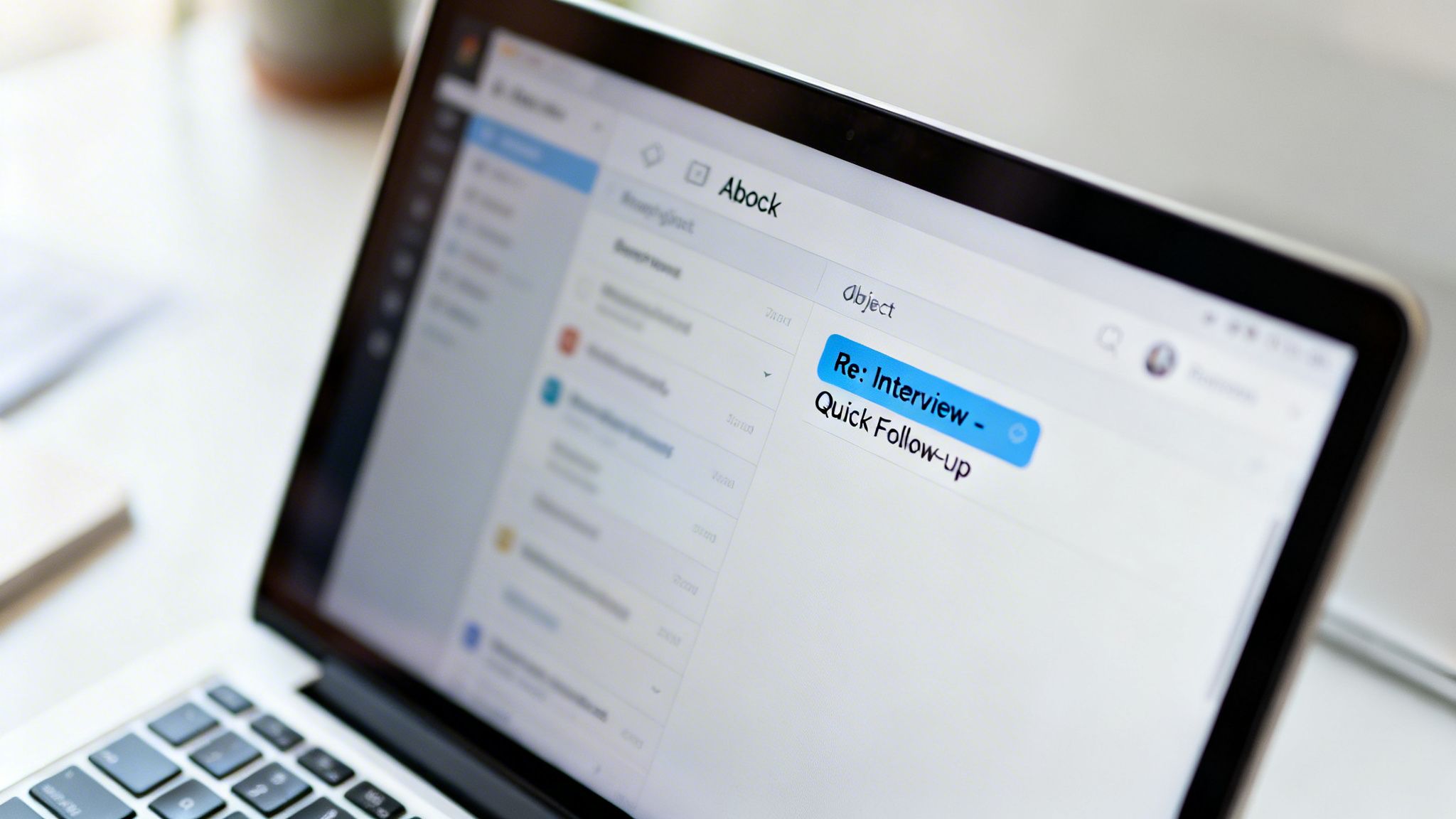
Often, the smartest move is also the easiest: just hit "reply" on your last email exchange. This keeps the whole conversation nested together, instantly giving the hiring manager context. The subject line will automatically populate with "Re: [Original Subject]," which immediately flags it as part of an ongoing dialogue.
If for some reason you need to start a fresh email, your goal is simple: be instantly recognizable. You want them to see your name and the job title and immediately know who you are and why you're reaching out.
Subject Line Examples That Work
You'll want to tweak your subject line based on your specific situation. Here are a few solid, field-tested options for a 2nd follow up email after interview that you can adapt.
- For a straightforward check-in: "Following up on the [Job Title] role"
- When you have something to add: "A quick thought on [Topic from interview] & follow-up"
- If you have an update from your end: "Update from [Your Name] regarding the [Job Title] position"
These examples are direct, professional, and tell the recipient exactly what to expect. They're not pushy, just clear. This helps them mentally slot your email into their "to-do" list instead of their "ignore" pile.
The best subject lines are clear, concise, and provide immediate context. Steer clear of vague one-liners like "Checking in" or "Follow-up." They sound generic and can easily get lost or mistaken for spam.
Getting your subject line right is a mix of art and science. For more ideas, you can find some great high-converting email subject line for follow up templates that are proven to grab attention. And if you really want to master the craft, our guide on how to write effective emails goes even deeper.
Subject Line Examples Weak vs Strong
Sometimes seeing a direct comparison makes all the difference. The small tweaks between a weak and a strong subject line can have a huge impact on whether your email gets read or archived.
| Weak Subject Line | Strong Subject Line | Why It Works Better |
|---|---|---|
| "Following Up" | "Following up re: Senior Product Manager interview" | The strong version is specific, immediately telling the reader which role and context this email is about. |
| "Checking In" | "[Your Name] - Following up on our conversation" | Including your name makes the email personal and easier to find, while "conversation" jogs their memory. |
| "Question about my application" | "Quick question about the [Job Title] timeline" | This is polite, specific, and sets a clear expectation that the email contains a focused inquiry. |
As you can see, specificity is your friend. A subject line that provides context and a clear purpose will always outperform a generic one. It shows respect for the hiring manager's time and makes their job just a little bit easier.
Follow-Up Email Examples You Can Actually Use
Staring at a blank screen, trying to figure out what to write in that second follow-up email, is tough. You want to show you're still interested without coming across as impatient or, even worse, a pest. The truth is, a generic "just checking in" message often does more harm than good. It’s forgettable.
The goal is to be politely persistent. Your message needs to be tailored to the situation. Think of it less as a template and more as a flexible script.
Here are a few real-world examples you can adapt. I’ve broken down why they work, so you understand the strategy behind the words. Remember to swap out the bracketed details with specifics from your interview—that's what makes it feel genuine.
The Simple and Professional Nudge
This is your go-to when the timeline they gave you has come and gone, and you just want to bring your name back to the top of their inbox. It’s light, direct, and respectful.
Subject Line: Re: Interview for [Job Title]
Hi [Hiring Manager Name],
Hope you're having a great week.
I’m just following up on my interview for the [Job Title] position back on [Date of Interview]. I really enjoyed our conversation, especially when we talked about [mention a specific, unique topic, e.g., the company's approach to user-centric design], and I'm still very excited about the chance to join the team.
I know how busy things can get, but I was hoping you might have a quick update on the hiring timeline.
Please let me know if there's anything else I can provide from my end.
Best regards,
[Your Name]
Here’s the strategy: This email feels light and positive. Starting with "Re:" keeps the email in the original thread, giving them instant context. Mentioning a specific detail from your chat jogs their memory and shows you were paying attention. The ask is soft, making it easy for them to fire back a quick reply without feeling cornered.
The "Value-Add" Follow-Up
This one is a game-changer. You use it when you have something new and relevant to share. Instead of just asking for an update, you're giving them another reason to be impressed. It shifts the entire dynamic.
Subject Line: A quick update & follow-up regarding the [Job Title] role
Hi [Hiring Manager Name],
Following up on our conversation about the [Job Title] position, something came up that I thought you might find interesting.
Since we spoke, I just wrapped up a project that felt really relevant to our discussion about [mention a challenge or goal they shared, e.g., streamlining the customer feedback process]. I actually [briefly describe what you did and a key result, e.g., built a new feedback dashboard that reduced response times by 15%]. I put together a quick one-page summary and attached it, in case you're curious.
My excitement for this role has only grown, and that project made me even more confident that my skills are a great match for your team's goals.
Looking forward to hearing from you.
Sincerely,
[Your Name]
Here’s the strategy: You're not just asking, you're giving. This immediately sets you apart. It shows you’re a proactive problem-solver who doesn't just sit around and wait. It’s a powerful way to reinforce your qualifications and demonstrate your continued engagement.
The Recruiter Check-In
Pinging a recruiter is a bit different from emailing the hiring manager. Recruiters are juggling dozens of candidates for multiple roles. Your email needs to be crystal clear and straight to the point so they can get you an answer in 30 seconds.
Subject Line: Following up on [Job Title] - [Your Name]
Hi [Recruiter Name],
Hope you're having a good week.
I’m just checking in on the status of the [Job Title] position. I interviewed with [Hiring Manager's Name] on [Date of Interview] and am still very interested in moving forward.
Could you let me know if there are any updates on the timeline for next steps?
Thanks for your time and help.
Best,
[Your Name]
Here’s the strategy: This is all about efficiency. The subject line gives them everything they need to find you in their system. The body of the email provides the key details (the role, the interviewer, the date) without any fluff. It’s professional, respects their time, and makes it incredibly easy for them to help you.
Navigating Silence and Other Tough Scenarios
You’ve sent your second follow-up, and all you’re hearing is… crickets. It’s a tough spot to be in, and it’s easy to let your mind wander. Did the interview go badly? Was my email off-putting?
This is where you need a game plan. Rather than getting stuck in that loop of uncertainty, it’s far better to anticipate the three most likely outcomes: they’re just slow and you get more silence, you receive a formal rejection, or you get ghosted completely.
Knowing how to handle each of these scenarios will help you keep your cool and act with professionalism, regardless of what comes next.
This flowchart can help you visualize the next steps, whether you're just checking in or have a specific update to share.
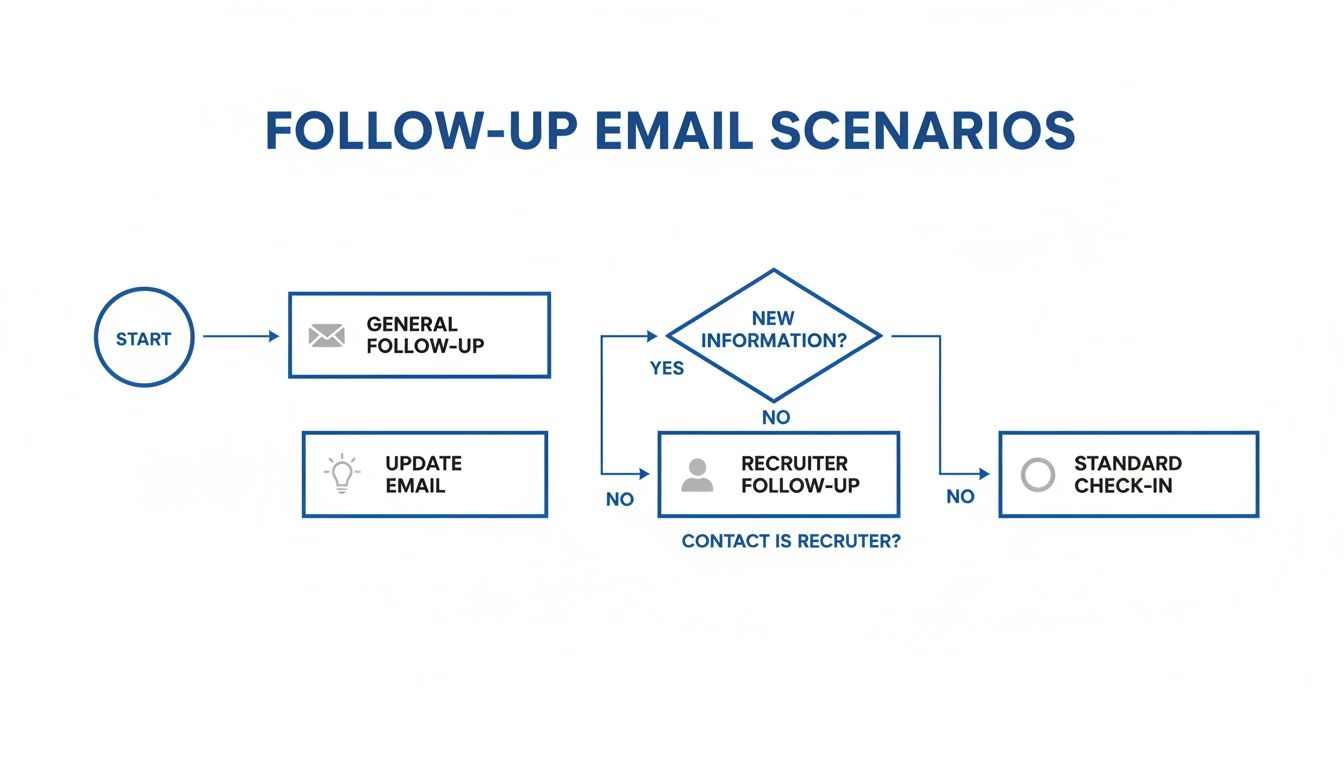
As you can see, the core idea is always to keep the interaction positive and professional, leaving the door open for future possibilities.
What to Do With Continued Radio Silence
Okay, so it’s been a few days since your 2nd follow up email after interview, and your inbox is still empty. What’s the next move?
Honestly, the ball is entirely in their court now. Pushing with a third follow-up is almost always a bad move—it can quickly shift from persistent to annoying.
The best thing you can do for your own sanity and career momentum is to mentally move on. Dive back into your job search, apply for other roles, and line up more interviews. Don't let one company’s slow process put your entire career on hold.
It's a hard truth, but at a certain point, no response is a response. It can even be a red flag—a company that doesn't respect candidates' time during the hiring process might not be a great place to work anyway.
How to Respond to a Rejection Email
Getting that "thanks, but no thanks" email is never fun. But how you react can make a big difference in your long-term network. Instead of just deleting or archiving it, take two minutes to write a short, gracious reply.
This isn’t about trying to get them to reconsider. It’s about being professional and leaving a fantastic final impression. You never know when another role might open up, and people remember the candidates who handle rejection with class.
Here’s all you need to say:
- Acknowledge and thank them. "Thanks for letting me know, and for the opportunity to learn more about the role."
- Reiterate your interest in the company. "I really enjoyed speaking with the team at [Company Name] and wish you all the best in finding the right person for the position."
- Keep the door open. "Please feel free to keep me in mind for any future openings that might be a good fit."
That's it. A simple, positive note closes the loop and keeps you on their radar in a good way.
The Frustrating Reality of Being Ghosted
It happens more than you'd think. One minute you're in active communication, the next... complete silence. Getting ghosted is incredibly frustrating, and it seems to be getting worse, especially in remote hiring where the lack of in-person contact makes it easier for recruiters to let things slip.
In fact, a staggering 61% of job seekers report being ghosted after an interview, a number that's climbed steadily over the past couple of years. It’s a widespread problem, and you can read more about the trends in candidate ghosting to see you're not alone.
If you think you've been ghosted, the best advice is to let it go. Your energy is a valuable resource, and it’s better spent on opportunities with companies that communicate clearly and value your time. This is also why it's so important to have good questions to ask recruiters about their communication timeline and process right from the start. Setting those expectations early can save you a lot of guesswork later on.
Common Questions About the Second Follow-Up Email
Trying to figure out the follow-up process can feel like you're walking a tightrope. It’s completely normal to have questions and even second-guess yourself. Let's tackle some of the most common worries so you can send that next message with confidence.
Can a Second Follow-Up Actually Hurt My Chances?
This is the big one, isn't it? It's the number one fear for most candidates, but honestly, the risk is incredibly low if you handle it well.
A polite, professional, and well-timed 2nd follow up email after an interview almost never hurts your chances. The only time it becomes a problem is if you sound demanding, impatient, or you're emailing them every other day.
Remember, hiring managers are juggling a dozen different things. They get that you're eager for an update. A gentle nudge is usually seen for what it is: a sign of your continued interest and good follow-through. You just have to be respectful of their time.
Who Should I Email: The Recruiter or The Hiring Manager?
When in doubt, the easiest and safest bet is to reply-all to the most recent email thread from the interview scheduling. This way, you keep everyone who was involved in the loop, and you don't have to guess.
But if you feel you need to choose one person, think about who your main point of contact has been.
- The Recruiter: If you've mostly been dealing with the recruiter, they're your best bet. They are the ones managing the timeline and logistics, so they're the right person for a status update.
- The Hiring Manager: If you built a really strong rapport with the hiring manager and have something genuinely valuable to add (like a quick note about a relevant new project you completed), then a direct email can make a great impression.
If you're still not sure, start with the recruiter. It’s their job to manage the process, and they can pass your message along if needed.
My rule of thumb is this: send logistical questions to the recruiter and value-add updates to the hiring manager. It shows you understand their different roles in the hiring dance.
What if the Job Posting Says "No Follow-Ups"?
This is one of the few hard and fast rules: you have to respect their wishes.
If a job posting explicitly says "no phone calls or follow-up emails," then that's your answer. Sending a message anyway can come across as you not being able to follow simple directions, which is a definite red flag. They're telling you upfront that they'll be in touch when they have an update.
It’s tough to wait, I know. But in this case, your best move is to channel that energy into other applications and let their process play out. Ignoring a direct request is one of the few ways a follow-up can truly backfire.
Is It Okay to Use LinkedIn for My Second Follow-Up?
Short answer: Stick to email.
LinkedIn is fantastic for networking, but it’s not the place for a formal interview follow-up. Sending a DM can feel a bit too casual or even invasive, especially if you've been communicating over email the whole time. Email is the standard, expected channel for this kind of conversation.
Plus, from a practical standpoint, your email is connected to your application in their system. A LinkedIn message is a separate thing that’s harder for them to track and file away. Keep it professional and keep it in one place—your email inbox.
Ready to find a remote job at a company that actually respects your time and communicates clearly? RemoteWeek exclusively lists roles from top-rated companies with strong workplace cultures. Find your next great opportunity at https://www.remoteweek.io.