
Discover 360 degree feedback sample: 8 Templates for Remote Tech Roles in 2026

In today's remote-first landscape, standard performance reviews are falling short. They often lack the nuance to capture the complexities of distributed work, leaving employees feeling misunderstood and managers without actionable insights. Effective feedback must be specific, multi-faceted, and tailored to the unique demands of each role. This is where a well-structured 360-degree feedback process becomes a game-changer, especially for companies fostering a transparent, high-growth culture.
This guide provides more than just a single 360 degree feedback sample; it offers a comprehensive blueprint with eight role-specific, downloadable templates designed for the modern tech workforce. We move beyond generic questions to deliver strategically crafted frameworks for roles ranging from Software Engineers to UX/UI Designers and Product Managers. Each template is built to uncover specific, role-relevant competencies that are often missed in traditional reviews.
Instead of just presenting examples, we will:
- Deconstruct the strategic purpose behind key questions.
- Provide actionable takeaways for delivering and receiving feedback.
- Offer clear guidance on interpreting results for meaningful development.
To ensure these feedback mechanisms are implemented consistently and support remote team growth, leveraging specialized tools is crucial for structured evaluation. Many organizations now rely on effective employee performance review software to automate the process, centralize data, and track progress over time. This guide will equip you with the foundational templates to build a culture of continuous, meaningful growth, no matter where your team is located.
1. Software Engineer/Developer 360-Degree Feedback Template
Evaluating software engineers requires a nuanced approach that balances technical prowess with collaborative spirit. This specialized 360-degree feedback sample is designed to assess the full spectrum of a developer's contributions, from code quality and problem-solving to their effectiveness as a team member, which is especially critical in remote or distributed environments. It gathers insights from managers, peers, and direct reports to paint a complete picture of performance.
This framework moves beyond simple code output metrics. It focuses on how an engineer contributes to the team’s velocity, mentors others, and upholds engineering standards through their work and communication.
Strategic Analysis & Breakdown
Companies like GitLab and Automattic have pioneered feedback cultures that thrive in asynchronous, remote-first settings. Their success hinges on decoupling performance evaluation from daily technical feedback (like code reviews) to maintain psychological safety. The goal isn't to critique a single pull request but to identify broader patterns in an engineer's work. To truly leverage 360-degree feedback for growth, it's essential to understand how to measure developer productivity effectively, beyond just the feedback itself. This template helps bridge that gap by focusing on behaviors that lead to sustained, high-quality output.
Key Insight: The most effective developer feedback separates the what (code output) from the how (collaboration, communication, and system-level thinking). This template emphasizes the "how" to provide a more holistic view of an engineer's impact on the team and the product.
Actionable Takeaways & Tips
To implement this feedback model successfully, consider the following tactics:
- Ask for Specific Examples: Instruct raters to cite specific commits, projects, or technical discussions. Instead of "writes clean code," a more helpful comment is, "The refactoring on the authentication module in Q3 simplified the logic and reduced bugs."
- Focus on Asynchronous Collaboration: Include questions about the engineer's communication effectiveness in tools like Slack, GitHub, or Jira. How clear are their written updates? How constructively do they participate in code review discussions?
- Separate Mentorship Evaluation: Add a specific section on their role in mentoring junior developers or sharing knowledge. This highlights contributions that don't always appear in commit histories but are vital for team growth.
- Ensure Anonymity for Peers: To encourage candid technical feedback, guarantee that peer reviews are anonymous. This allows fellow engineers to raise concerns about code quality or architectural decisions without fear of personal conflict.
2. Product Manager 360-Degree Feedback Template
Evaluating a product manager requires a unique lens, especially in a remote setting where influence is exercised through communication and documentation rather than physical presence. This specialized 360-degree feedback sample is designed to assess a PM’s core competencies, including strategic vision, stakeholder alignment, data-driven decision-making, and their ability to lead cross-functional teams across different time zones. It gathers insights from engineering, design, marketing, leadership, and sales to create a comprehensive performance overview.
This framework extends beyond feature shipment velocity to evaluate the why behind the product roadmap. It assesses how effectively a PM communicates the product vision, manages competing priorities, and fosters a collaborative environment where distributed teams feel heard and aligned.
Strategic Analysis & Breakdown
Companies like Slack and Intercom have built strong product cultures in distributed environments by emphasizing clear, asynchronous communication and transparent decision-making. Their feedback mechanisms focus on a PM's ability to create clarity and alignment without constant meetings. The goal is to evaluate their influence and strategic impact, not just their task management skills. Understanding the core responsibilities of a related role can provide further context; exploring common product owner interview questions reveals the key skills organizations look for, which this feedback template helps to measure and develop.
Key Insight: For remote PMs, the most critical feedback centers on their ability to create and communicate a compelling product narrative asynchronously. This template prioritizes evaluating their written communication, strategic documentation (like PRDs), and ability to drive decisions without being in the same room.
Actionable Takeaways & Tips
To effectively implement this 360-degree feedback sample for product managers, consider these tactics:
- Ask for Decision-Specific Examples: Prompt reviewers to cite specific product decisions or trade-offs. Instead of "good at prioritizing," a more useful comment is, "The decision to delay feature X to focus on technical debt in Q2 was well-communicated with clear data, which helped the engineering team stay motivated."
- Focus on Stakeholder Alignment: Include questions about how the PM communicates updates and decisions to distributed stakeholders in sales, marketing, and support. How effective are their written updates, async presentations, and feedback collection processes?
- Evaluate Documentation Clarity: Ask engineering and design teams directly about the quality and clarity of product requirement documents, user stories, and project briefs. Is the documentation sufficient to enable them to work autonomously?
- Assess Influence and Persuasion: Frame questions to gauge the PM's ability to build consensus and drive alignment on the product strategy, particularly when navigating conflicting opinions from different departments.
3. Marketing Manager/Content Strategist 360-Degree Feedback Template
Evaluating marketing managers and content strategists in a remote setting requires a focus on both creative output and data-driven results. This specialized 360-degree feedback sample is built to assess their ability to drive campaigns, uphold brand voice, and collaborate effectively across distributed teams. It gathers input from managers, peers, direct reports, and even cross-functional partners like sales or product.
This framework is designed to measure not just the quality of the content produced but also the strategic thinking behind it. It evaluates how a marketing leader uses data, manages complex projects asynchronously, and contributes to key business goals like lead generation and brand awareness.
Strategic Analysis & Breakdown
Companies renowned for their remote marketing engines, such as HubSpot, Zapier, and ConvertKit, understand that success depends on clear communication and data-informed strategy. Their feedback systems prioritize a marketer’s ability to document processes, align distributed team members, and pivot based on performance metrics. This approach ensures that marketing efforts are not just creative but also measurable and scalable.
This 360 degree feedback sample is less about critiquing a single blog post or social media campaign and more about understanding the marketer’s overall impact. It focuses on their capacity to build and execute a cohesive strategy that resonates with the target audience and delivers tangible results, all while fostering a collaborative remote environment.
Key Insight: For remote marketing roles, effective feedback must connect creative execution to strategic impact. This template is designed to uncover how a marketer’s decisions on content, channels, and campaigns directly influence key metrics like engagement, conversions, and brand sentiment.
Actionable Takeaways & Tips
To implement this feedback model successfully, consider the following tactics:
- Tie Feedback to Metrics: Instruct reviewers to link their comments to specific campaign results. Instead of saying "good content strategy," a better comment is, "The Q2 content series on AI integration increased our organic lead quality by 15% and improved our SERP ranking for key terms."
- Evaluate Asynchronous Project Management: Include questions on how the marketer manages distributed content calendars and communicates campaign updates. Assess the clarity of their creative briefs and editorial guidelines for remote contributors.
- Focus on Experimentation: Ask about the manager’s willingness to test new channels, formats, and messaging. Request examples of how they used data from a failed experiment to inform a more successful future initiative.
- Assess Cross-Functional Collaboration: Involve stakeholders from sales or product to provide feedback on how well marketing efforts align with their goals. This provides a holistic view of the marketer's ability to support broader business objectives.
4. Data Analyst/Business Intelligence Specialist 360-Degree Feedback Template
Evaluating data analysts and business intelligence (BI) specialists goes beyond the accuracy of their queries. This specialized 360-degree feedback sample assesses their ability to translate raw data into actionable business insights, communicate complex findings to non-technical stakeholders, and maintain analytical rigor in a distributed environment. It gathers feedback from managers, peers, and key business partners to form a comprehensive view of their impact.
This framework is designed to measure not just technical skill, but the analyst's influence on the company's data-driven culture. It examines how they support strategic decision-making, manage data quality, and empower others to use data effectively.
Strategic Analysis & Breakdown
Companies like Airbnb and Google have built their success on robust data cultures, where analytics is a core function, not just a service department. Their feedback models, like Google's HEART framework, emphasize the impact of analysis over the volume of reports generated. The goal is to understand how an analyst's work directly influences product, marketing, or operational decisions. Evaluating this impact requires input from the stakeholders who consume those insights. To hire individuals who excel in this area, it's crucial to ask the right questions from the start, which is why understanding top data analyst interview questions is so important for building a strong team. This template aligns feedback with hiring criteria by focusing on business impact.
Key Insight: For data roles, effective feedback must differentiate between technical execution (e.g., writing efficient SQL) and strategic influence (e.g., delivering an insight that changes a product roadmap). This template prioritizes the latter, measuring how well the analyst connects data to business outcomes.
Actionable Takeaways & Tips
To implement this feedback model successfully, consider these tactics:
- Request Specific Artifacts: Ask raters to reference specific dashboards, reports, or analyses. A comment like, "The Q3 customer churn analysis provided clear, actionable reasons for the user drop-off" is far more valuable than "Does good analysis."
- Evaluate Stakeholder Communication: Include questions for business partners about the clarity and usefulness of the data presented. Did the analyst successfully explain the limitations and caveats of their findings to prevent misinterpretation?
- Assess Prioritization Skills: Add a self-assessment component where the analyst reflects on how they prioritized high-impact work versus ad-hoc requests. This gauges their strategic alignment with broader company goals.
- Include Technical Peer Review: For fellow analysts or data scientists, include questions about the quality of the analyst's code, their approach to data modeling, and their contributions to maintaining data integrity and documentation.
5. UX/UI Designer 360-Degree Feedback Template
Evaluating a UX/UI designer involves more than just aesthetics; it requires assessing their empathy for the user, collaboration with cross-functional teams, and strategic thinking. This specialized 360-degree feedback sample is built to measure the full scope of a designer's impact, particularly in a remote setting where clear communication and documentation are paramount. It gathers input from managers, peer designers, developers, and product managers to create a holistic performance view.
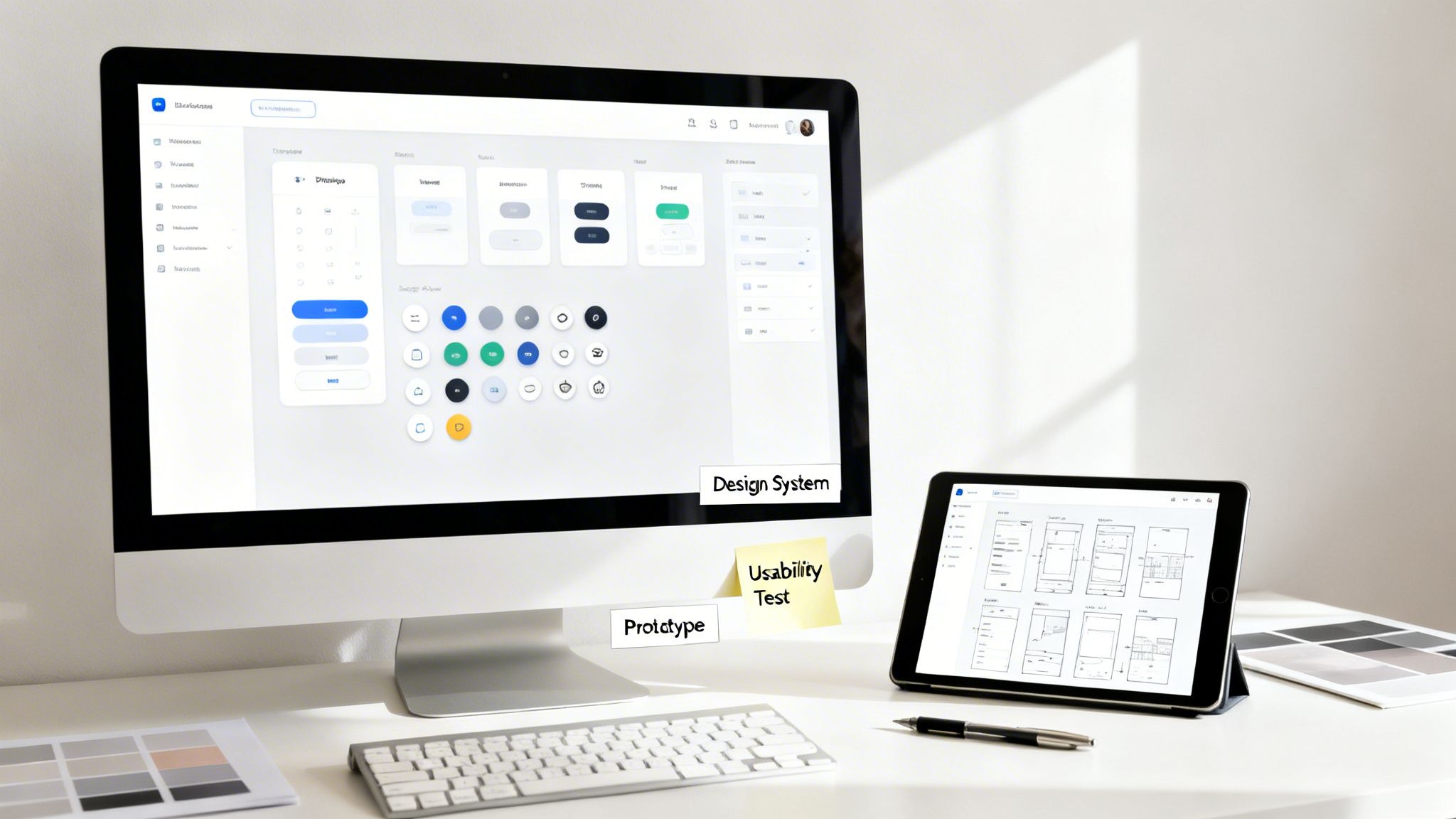
This framework is designed to move beyond subjective opinions on visual design. It focuses on the designer's ability to translate user research into intuitive interfaces, advocate for user needs, and contribute to a cohesive design system that accelerates product development.
Strategic Analysis & Breakdown
Leading design-centric companies like Airbnb and Stripe have built cultures where feedback is integral to the creative process. Their success relies on a shared understanding that design is a collaborative, iterative discipline, not an isolated act of creation. This template is inspired by their approach, focusing on how a designer integrates feedback, communicates their rationale, and improves the overall product experience through systematic thinking.
The goal is not to critique a single mockup but to understand the designer’s process. This includes how they incorporate user research, how effectively they collaborate with developers during handoff, and how they contribute to or leverage a design system for consistency and efficiency.
Key Insight: For designers, impactful feedback must balance craft and collaboration. This template separates the output (the final design) from the process (research, iteration, and teamwork), providing actionable insights into how the designer solves problems and elevates the team.
Actionable Takeaways & Tips
To get the most value from this feedback model, apply these specific tactics:
- Request Artifact-Specific Feedback: Ask reviewers to reference specific wireframes, prototypes, or user flows. Instead of "the design is confusing," a better comment is, "During the usability test of the V2 prototype, 3 out of 5 users struggled to find the settings menu."
- Evaluate the Handoff Process: Include questions for developers about the clarity of design specifications, asset delivery, and responsiveness to technical questions. A smooth handoff is a critical skill, especially in remote teams.
- Assess User Advocacy: Ask product managers and developers how effectively the designer champions user needs and uses data to support their design decisions during planning and review meetings.
- Focus on System Contributions: For designers working with a design system, add questions about their contributions, adherence to standards, and efforts to educate others on its use. This measures their impact beyond a single project.
6. Customer Success Manager/Support Lead 360-Degree Feedback Template
Evaluating a Customer Success Manager (CSM) or Support Lead goes beyond simple metrics like ticket response times. This specialized 360-degree feedback sample is designed to assess their ability to build and maintain strong customer relationships, drive retention, and lead a support team effectively, particularly in remote settings where empathy and clarity are paramount. It gathers insights from managers, peers, direct reports, and even incorporates customer sentiment.
This framework shifts the focus from purely reactive support to proactive success management. It measures how a leader not only resolves issues but also understands customer needs, advocates for them internally, and contributes to long-term loyalty and expansion revenue.
Strategic Analysis & Breakdown
Companies renowned for their customer-centric cultures, like Intercom and Zendesk, understand that customer success is a company-wide responsibility, not just a departmental one. Their feedback models often integrate qualitative customer input with quantitative performance data. The goal is to see beyond a single interaction and identify patterns in communication, problem-solving, and strategic account management. This 360 degree feedback sample helps connect the dots between a CSM's daily actions and high-level business outcomes like Net Promoter Score (NPS) and customer lifetime value.
Key Insight: Effective feedback for customer-facing leaders must blend internal perceptions with the external customer voice. This template is built to evaluate not just if a problem was solved, but how the customer felt throughout the process and how the leader empowered their team to deliver that experience.
Actionable Takeaways & Tips
To implement this feedback model successfully, consider these specific tactics:
- Integrate Customer Voice: Incorporate questions that reference direct customer feedback, such as NPS comments or satisfaction survey results. Ask raters how the leader uses this data to coach their team and improve processes.
- Focus on De-escalation Skills: Instruct raters to provide specific examples of how the leader handled a difficult customer situation or a complex technical escalation. The focus should be on their composure, problem-solving approach, and communication clarity under pressure.
- Measure Proactive Outreach: Include questions about the CSM's efforts in proactive account management. How do they identify at-risk accounts? What strategies do they use to drive product adoption and identify upsell or expansion opportunities?
- Assess Internal Advocacy: Evaluate how effectively the leader represents the customer's needs to other departments, like Product and Engineering. Ask peers for examples of when the leader’s input led to a valuable product improvement or bug fix.
7. Engineering Manager/Technical Lead 360-Degree Feedback Template
Evaluating an engineering manager or technical lead requires assessing a unique blend of technical acumen, strategic vision, and people leadership. This 360-degree feedback sample is designed for remote and distributed tech environments, focusing on the leader’s ability to foster a high-performing, psychologically safe team while driving technical projects to successful completion. It gathers feedback from direct reports, peers (including other managers and product leads), and their own manager.
This framework extends beyond project delivery metrics to uncover how a leader builds team culture, mentors engineers, and navigates cross-functional dependencies. It evaluates their effectiveness in asynchronous communication, their technical judgment, and their capacity to unblock their team.
Strategic Analysis & Breakdown
Companies like GitLab and GitHub have set a high bar for engineering leadership in remote settings. Their models emphasize that a manager's primary role is to act as a multiplier, amplifying their team's impact through clear communication, strategic delegation, and robust career development. This feedback process is not just about a performance review; it's a critical tool for developing leaders who can build and sustain world-class distributed teams. Effective feedback helps identify whether a manager is creating clarity or confusion, and whether they are empowering their team or micromanaging.
To get the most from this process, it's crucial to understand the unique challenges of remote leadership. For more insights, learn about how to manage remote teams effectively, as these principles are central to what this feedback template aims to measure.
Key Insight: The best engineering leaders are measured not by their own code contributions, but by their team’s velocity, morale, and growth. This 360-degree feedback sample focuses on these force-multiplying behaviors rather than individual technical output.
Actionable Takeaways & Tips
To implement this leadership feedback model successfully, consider these tactics:
- Request Specific Outcomes: Ask raters to provide concrete examples of how the manager's technical decisions or project management choices impacted a project's timeline or outcome.
- Focus on Asynchronous Clarity: Include questions about the manager’s ability to communicate expectations, project status, and team goals through written documentation (e.g., project briefs, RFCs) and tools like Slack.
- Evaluate Career Development: Ask direct reports specific questions about the quality of their 1-on-1s, the clarity of their career path, and the support they receive for their professional growth.
- Ensure Psychological Safety: Explicitly state the confidentiality rules to direct reports. Anonymity is key to receiving honest feedback about a manager’s impact on team culture and individual well-being.
8. DevOps/Infrastructure Engineer 360-Degree Feedback Template
Evaluating a DevOps or Infrastructure Engineer requires a unique lens that goes beyond traditional performance metrics. This specialized 360-degree feedback sample is crafted to assess the core competencies of roles that safeguard system reliability, automate processes, and manage critical infrastructure, often within remote and distributed teams. It gathers comprehensive feedback from managers, peer engineers, and application developers who rely on their work.
This framework shifts the focus from simple task completion to the engineer's impact on system stability, deployment velocity, and cross-functional collaboration. It measures how effectively they manage the complex interplay between development and operations, ensuring the company's technical foundation is both robust and scalable.
Strategic Analysis & Breakdown
Companies like Netflix and Stripe have set the standard for infrastructure excellence, emphasizing a culture of proactive reliability and effective incident response. Their success demonstrates that evaluating infrastructure roles is less about individual heroics and more about building resilient systems and processes. This 360-degree feedback sample is designed to identify patterns in an engineer's ability to automate, document, and respond to incidents, which are the cornerstones of a world-class DevOps culture.
The template moves beyond uptime percentages to explore the behaviors that create that uptime. It examines how an engineer contributes to key metrics like deployment frequency and mean time to recovery (MTTR), which are true indicators of a high-performing infrastructure team.
Key Insight: The best feedback for infrastructure engineers evaluates their impact on the entire engineering organization. It separates reactive work (like fixing outages) from proactive contributions (like building automation and improving documentation) that prevent future issues.
Actionable Takeaways & Tips
To effectively implement this feedback model for DevOps and Infrastructure Engineers, use these targeted tactics:
- Request Cross-Functional Feedback: Actively solicit input from application development teams. Ask them about the clarity of infrastructure documentation, the ease of using deployment pipelines, and the support they receive during incidents.
- Focus on Automation Impact: Instruct raters to provide specific examples of automation projects. Instead of "is good at automation," a more valuable comment is, "The CI/CD pipeline improvements in Q2 reduced deployment times by 40% for the mobile team."
- Evaluate Incident Response Calmly: Assess how the engineer performs under pressure during incidents. Do they communicate clearly? Do they follow the established process? Do they contribute effectively to post-incident reviews to prevent recurrence?
- Measure Proactive Improvements: Include a section for the engineer to self-assess proactive contributions, such as cost optimization initiatives, security hardening projects, or scalability enhancements that weren't tied to a specific incident.
360-Degree Feedback: 8 Role-Based Templates
| Role | 🔄 Implementation complexity | ⚡ Resource requirements | 📊 Expected outcomes | 💡 Ideal use cases | ⭐ Key advantages |
|---|---|---|---|---|---|
| Software Engineer/Developer | High — requires technical reviewers, code artifacts, and separation of code review vs evaluation | Dev peers + managers, PRs/commits, async tools (GitHub, Slack), time for code review examples | Identifies technical gaps, improves code quality and collaboration; measurable via PR quality and velocity | Performance reviews, promotions, coaching in remote engineering teams | Deep technical feedback; aligns coding standards and mentoring needs |
| Product Manager | High — cross-functional raters and subjective strategic measures complicate assessment | Stakeholders (eng, design, sales, marketing), roadmaps, customer feedback, documentation | Clarifies vision alignment, stakeholder gaps, decision-making effectiveness | Senior PM evaluation, strategy alignment, cross-functional leadership assessment | Holistic view of influence, prioritization and communication skills |
| Marketing Manager/Content Strategist | Medium — mixes creative evaluation with long-term metrics and attribution challenges | Campaign analytics, content samples, stakeholders, marketing tools and timelines | Surface campaign effectiveness, content quality, process/attribution issues (longer-term ROI) | Campaign reviews, content strategy, remote marketing operations | Balances creative critique with measurable marketing performance |
| Data Analyst/BI Specialist | High — needs technical validation and clear attribution of business impact | Peer analysts, dashboards, SQL/code review, stakeholder use cases, documented analyses | Improves data quality, insight relevance, prioritization of high-impact analyses | Analytics quality assurance, decision-support roles, BI deliverables review | Validates methodological rigor and clarity of insight communication |
| UX/UI Designer | Medium — subjective design quality plus artifact and usability evidence | Design artifacts (prototypes, wireframes), usability test results, developer feedback, Figma links | Improves usability, design consistency, and handoff clarity to engineering | Design reviews, design system contributions, hiring and mentorship | Combines user feedback with cross-functional perspectives on design |
| Customer Success Manager/Support Lead | Medium — incorporates external customer feedback and quantitative CX metrics | CSAT/NPS, retention/expansion data, customer testimonials, support logs | Better retention and satisfaction insights, identifies training and process gaps | Client-facing performance reviews, retention strategy, support leadership | Direct customer input and clear KPIs for customer health |
| Engineering Manager/Technical Lead | High — blends technical judgment, people management, and psychological safety concerns | Direct reports' feedback, peer reviews, delivery/retention metrics, examples of technical decisions | Reveals leadership and team development gaps, impacts delivery and morale | Manager development, promotion decisions, remote team health checks | Assesses both technical leadership and team-building effectiveness |
| DevOps/Infrastructure Engineer | High — requires incident histories, uptime metrics, and cross-team evidence | Uptime/MTTR metrics, runbooks, postmortems, deployment and monitoring data, cross-team feedback | Improves reliability, automation, incident response, and documentation quality | Operational reviews, reliability engineering, on-call performance evaluation | Quantitative reliability metrics combined with operational and documentation insights |
Turning Feedback into Fuel: Your Next Steps for Actionable Growth
Throughout this guide, we've dissected a diverse collection of 360-degree feedback samples, moving far beyond generic templates. We’ve explored role-specific frameworks for software engineers, product managers, marketing strategists, and more. The common thread is clear: effective feedback is not a one-size-fits-all solution. It must be tailored, contextual, and, most importantly, actionable.
The true value of any 360 degree feedback sample isn’t in the questions themselves, but in the structured conversation they initiate. It’s about creating a panoramic view of an individual's impact, combining self-perception with the crucial perspectives of peers, managers, and direct reports. This comprehensive view is the foundation for meaningful professional development.
From Sample to System: Key Takeaways
As you move forward, remember that these templates are your starting point, not the final destination. The goal is to build a sustainable feedback culture, not just to complete a survey.
Here are the most critical takeaways to internalize:
- Customization is Crucial: The most impactful feedback systems are tailored. Adapt the questions from our samples to align with your company's core values, specific team goals, and the unique competencies required for each role. A generic survey yields generic results.
- Context Over Content: Providing feedback without context is like giving a map without a "you are here" marker. Always encourage reviewers to provide specific, observable examples. Instead of "John needs to improve communication," a more helpful comment is, "In the Q3 project kickoff, John's presentation lacked clarity on key deadlines, causing confusion for the design team."
- Psychological Safety is Paramount: A 360-degree feedback process will fail without a foundation of trust. Participants must feel safe to provide honest, constructive criticism without fear of retribution. Anonymity (when appropriate) and clear communication from leadership about the process's developmental-only purpose are non-negotiable.
Your Action Plan for Implementation
Viewing a 360 degree feedback sample is the first step. Turning that insight into organizational change requires a deliberate plan. Here’s how to get started:
- Select and Adapt: Choose the template from this article that most closely matches your target role. Convene with key stakeholders (e.g., the team lead, a senior team member) to refine the questions, ensuring they reflect what truly matters for success in that position.
- Communicate the 'Why': Before launching any review cycle, clearly articulate the purpose. Emphasize that this is a tool for growth and development, not for performance evaluation or compensation decisions. This distinction is vital for encouraging honest participation.
- Train Your Raters: Don't assume everyone knows how to give good feedback. Provide brief training or guidelines on how to be constructive, specific, and empathetic. Remind them to focus on behavior and impact rather than personality traits.
- Facilitate the Debrief: The feedback report is just data. The real transformation happens in the follow-up conversation between the individual and their manager. This meeting should focus on identifying themes, celebrating strengths, and co-creating a tangible development plan with 1-3 specific growth goals.
Ultimately, mastering the art of 360-degree feedback is about building a more resilient, self-aware, and high-performing organization. It fosters a culture where constructive dialogue is the norm and personal development becomes a shared responsibility. By adapting these frameworks to your unique context, you create a system that not only measures performance but actively cultivates it, empowering every individual to reach their full potential.
Finding a company that invests this deeply in employee growth can be a game-changer for your career. RemoteWeek curates job listings from forward-thinking remote companies that prioritize strong feedback cultures and professional development. Explore opportunities at organizations that use tools like these to help you thrive by visiting RemoteWeek.