
A Developer's Guide to Landing High-Quality Coding Remote Jobs

Finding a great coding remote job isn't just about a change of scenery anymore; it's a smart career move. The tech world has changed for good, with more and more top-tier companies building distributed teams to tap into global talent and get more done. This guide is your roadmap to finding and landing a remote role that truly values your skills and helps you grow.
Why High-Quality Remote Roles Are Worth the Hunt

The dream of working from anywhere is real, but let's be honest—the job hunt can be a grind. We've all been there: scrolling endlessly through generic job boards, sending applications into a black hole, and trying to spot the scam listings from a mile away. It's a crowded, noisy market that can burn you out before you even get started.
That’s exactly why you need to zero in on high-quality opportunities. A genuinely good remote role is about so much more than just skipping the commute. It’s a sign of a company culture built on trust, autonomy, and a focus on results. These are the places that invest in solid async communication tools, document everything properly, and actually care about their developers' well-being.
The Distributed Workforce Is Here to Stay
The move to remote work isn't just some passing trend. It's a fundamental shift in how the tech industry operates. The market has absolutely blown up, with fully remote positions expected to jump from just 7% of all jobs in 2020 to a staggering 28% by 2025. That's a 300% increase. Companies finally get it: incredible talent isn't limited to a 30-mile radius around an office. If you're curious, you can discover more remote work hiring statistics and see just how much things are changing.
So, what's behind this massive shift? A few key things:
- Access to Specialized Talent: Companies can now hire the absolute best person for the role, whether they live in a major tech hub or a small town.
- A Boost in Productivity: Without the constant "shoulder taps" and noise of an open office, many developers find they can focus and be far more productive.
- Happier Engineers: Flexibility and autonomy are huge draws. Offering them gives companies a serious edge in attracting and keeping top talent.
The best remote companies don't just tolerate remote work; they are intentionally designed around it. They build systems and processes that empower every team member to do their best work, no matter where they are.
Cutting Through the Noise with Curated Platforms
With so much competition, the old "spray and pray" method of applying just doesn't work. The real key is to be selective. You want to target companies that are all-in on their remote culture.
This is where curated job boards like RemoteWeek are a game-changer. By vetting companies and filtering out sketchy or low-rated employers before you ever see the listing, they let you focus your energy on roles that are actually worth your time.
Instead of wading through thousands of questionable posts, you can apply with confidence to companies known for creating positive, supportive environments. It's a targeted approach that not only ups your odds of getting a response but also helps ensure you land in a place where you can truly build a career. It's all about working smarter, not harder, in your search for that perfect remote coding job.
Your Digital First Impression: Building a Brand That Shines Remotely
In the global hunt for remote coding jobs, your professional brand isn't just a bonus—it's everything. When a hiring manager can't shake your hand, your digital footprint has to do the heavy lifting. Your résumé, your GitHub profile, and your portfolio are your ambassadors. A generic application is just noise; a sharp, well-defined brand that proves you're "remote-ready" is what cuts through.
This goes way beyond just listing your tech stack. Remote-first companies are screening for a very specific set of skills and habits. They're looking for concrete proof that you can not only survive but thrive without a manager hovering over your shoulder. Can you communicate with precision? Can you collaborate effectively with someone nine time zones away? Your brand needs to answer these questions with a resounding "yes."
Tailoring Your Résumé for Remote-First Companies
First things first: you have to get past the initial screen. That means getting your résumé past both automated systems and human eyes that are scanning for specific keywords. To do that, you need to speak their language.
Sprinkle your résumé with terms that show you get the nuances of distributed work. Instead of a generic phrase like "team player," talk about your experience with asynchronous collaboration. Mention your comfort with distributed systems or the remote work tools you live in every day.
Think about including keywords like these:
- Asynchronous Communication: Go beyond just listing Slack or Jira. Briefly describe how you use them to keep projects on track without constant meetings.
- Time Zone Management: Have you worked with a team spread across continents? Make sure you mention it. This is a huge green flag for hiring managers.
- Self-Directed & Autonomous: Pull examples from past projects where you took ownership from conception to deployment with minimal hand-holding.
- Proactive Documentation: Emphasize your habit of writing clear, thorough documentation. In a remote setup, this isn't a nice-to-have; it's a core competency.
A remote-optimized résumé doesn’t just list your skills; it shows your work ethic. For every technical skill you mention, pair it with a remote-friendly behavior you can prove.
For a much deeper dive, our guide on crafting résumés for remote jobs is packed with more detailed examples and frameworks to help you get this right.
Turning Your GitHub into a Living, Breathing Portfolio
For a developer, a GitHub profile is so much more than a code backup. It’s your public workshop, and you can bet hiring managers will spend more time there than on your actual résumé. They aren't just looking for perfect, finished code—they want to see your process, your thinking, and your collaboration style in action.
A messy profile with a handful of private, undocumented projects just won't do. Your GitHub needs to tell the story of a disciplined and communicative engineer.
Here’s how to make your profile pop:
- Pin Your Greatest Hits: Feature 3-4 of your proudest projects right at the top. Try to show a mix—some solo projects that highlight your initiative and a few collaborative ones to show you play well with others.
- Write Fantastic READMEs: Every single public project needs a detailed README.md file. What does the project do? What problem does it solve? What tech did you use? How can someone else get it running? This is a direct reflection of your communication skills.
- Show Your Work: Your commit history is a timeline of your thought process. Avoid lazy messages like "fix bug" or "update." Instead, write clear, descriptive messages like "Feat: Implement user authentication with JWT." It screams professionalism.
- Contribute to Open Source: Nothing says "I can collaborate with strangers asynchronously" better than open-source contributions. Even small things—fixing a typo in documentation, triaging an issue, or submitting a tiny bug fix—show you’re a proactive team player.
This isn’t just about showing off code; it’s tangible proof that you have the self-discipline and communication chops to excel from anywhere.
Crafting a Personal Website That Tells Your Story
Finally, a personal website or blog is the glue that holds your entire brand together. This is your turf. You control the narrative, showcase your personality, and let your passion for technology shine through. It’s where you can move beyond bullet points and tell a compelling story about your work.
Don't just list your projects; turn them into case studies. For each one, outline the challenge, explain the solution you built, and describe the impact it had. Use screenshots, code snippets, and links to live demos to bring it to life. This storytelling approach is infinitely more memorable than a dry list of accomplishments.
To really make your mark in the remote job market, you have to consciously build a strong personal brand that shows exactly what you bring to the table. It’s about proving not only that you’re a great developer, but that you have the mindset and skills to be a phenomenal member of a distributed team.
4. Smarter Strategies for Your Job Search
The old spray-and-pray approach to job applications is a surefire way to burn out. When you're looking for coding remote jobs, you have to be more intentional. Success isn't about volume; it’s about focusing your energy on high-quality opportunities and making genuine connections.
Think of it this way: you'll get far better results by deeply researching and customizing applications for ten companies you actually want to work for than you will by shotgunning your résumé out to a hundred random listings. This shift turns your job hunt from a frustrating numbers game into a targeted, professional campaign.
Your résumé, GitHub, and portfolio are the three pillars of your professional brand. They need to work together to tell a cohesive story to hiring managers.
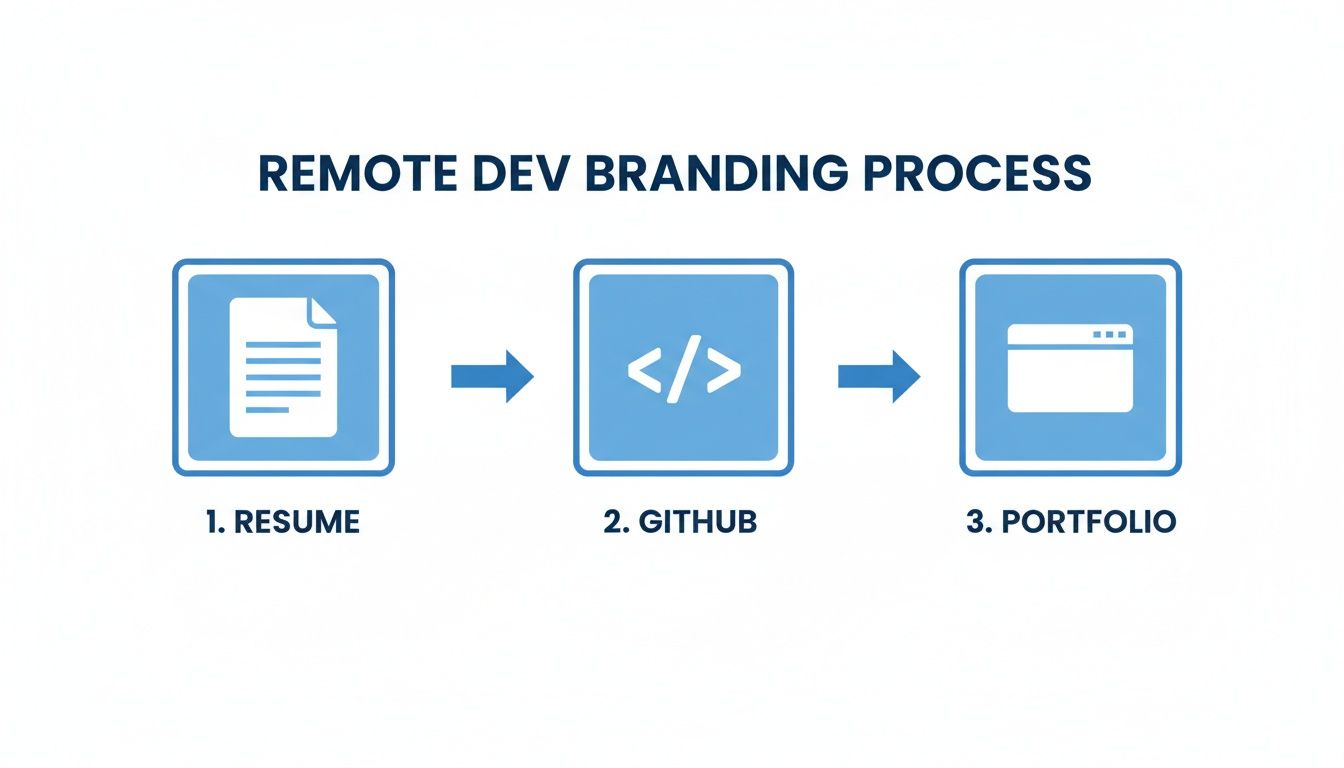
As the visual shows, each piece builds on the last, creating a powerful narrative that makes it easy for a recruiter to say "yes."
Go Beyond Generic Job Boards
Big job boards have their place, but the real gold is often found on specialized, curated platforms. These niche sites cut through the noise for you, filtering out low-quality listings and connecting you directly with companies that are serious about hiring remote talent. It's on these boards where you’ll find some of the most compelling remote software developer jobs out there.
Platforms like RemoteWeek, for instance, are laser-focused on quality. By only listing companies with a Glassdoor rating of 3.5 or higher, it saves you from wasting time on companies with toxic work cultures or questionable practices. This pre-vetting is invaluable.
The demand for quality remote roles is through the roof—a staggering 87% of job seekers are looking for remote options. Companies are catching on, with 59% hiring internationally to tap into a global talent pool. Even the big players are all-in; 97 of the top 100 companies for employee satisfaction now offer remote or hybrid work.
Comparing Remote Job Search Platforms
To find the best fit, you need to understand the landscape. General boards are vast but noisy, while niche boards offer focus. A curated platform like RemoteWeek takes it a step further by vetting for quality, ensuring you're only seeing opportunities at companies known for treating their employees well.
| Platform Feature | General Job Boards (e.g., Indeed, LinkedIn) | Niche Remote Boards | RemoteWeek (Curated) |
|---|---|---|---|
| Volume of Listings | Extremely High | Moderate to High | Low to Moderate (Focused) |
| Quality Control | Minimal (Prone to spam/scams) | Basic (Filters for remote-only) | High (Vets company culture, e.g., Glassdoor > 3.5) |
| Signal-to-Noise Ratio | Low | Medium | High |
| Competition Level | Very High | High | Moderate (Targets a specific audience) |
| Best For | Casting a wide, general net | Finding remote-specific roles | Finding high-quality, pre-vetted remote tech roles |
Ultimately, a curated board saves you the time and emotional energy of sifting through hundreds of questionable listings, letting you focus your efforts where they'll have the most impact.
Engage Where Developers Gather
Sometimes your next job won't come from a formal application. It'll come from a conversation in a developer community. Getting active in niche Slack and Discord servers is a fantastic way to build your network and hear about roles before they even hit the job boards.
Find communities that revolve around your tech stack or interests.
- Contribute First: Don't just show up and ask for a job. Jump in, answer questions, and share helpful resources. Establish yourself as a knowledgeable peer.
- Build Real Connections: Talk to people. Genuine interactions are memorable. People are far more likely to recommend someone they know and respect.
- Keep an Eye on #jobs Channels: Most of these communities have dedicated channels where companies post high-quality roles directly to a hyper-targeted audience.
This strategy positions you as a helpful expert, not just another résumé in the pile. Hiring managers and senior devs are always lurking in these channels, looking for people who are passionate and engaged.
A single, well-thought-out answer in a niche Discord channel can be more powerful than a dozen generic applications. It shows off your expertise and personality in a way a résumé simply can't.
The Power of Proactive Outreach and Contributions
Don't just be a passive applicant—get proactive. Contributing to open-source projects is one of the best ways to prove your skills in a real-world, collaborative environment.
You don't have to write a huge new feature to make an impact. Fixing a small bug, improving documentation, or helping triage issues are all incredibly valuable. These small acts get your name and your code in front of other developers. There are even stories of developers landing incredible jobs while in prison, purely because their obsessive open-source contributions got them noticed. It’s a powerful testament to how public proof-of-work can open doors.
And don't shy away from thoughtful outreach on LinkedIn. Pick a few remote-first companies you admire, find an engineering manager or a senior dev on the team, and send a personalized connection request. Mention a specific project of theirs you found interesting or a recent tech talk they gave. A direct, respectful approach can put you on their radar long before a job is even posted.
Navigating the Virtual Interview Gauntlet
The interview process for a remote coding job is a completely different ballgame. It's not just about what you know—it's about proving you have the skills, self-discipline, and communication chops to thrive without someone looking over your shoulder.
From that first screening call to the final technical deep dive, every interaction is a test. They're not just checking if you can code. Companies are digging for proof that you can collaborate asynchronously, manage your own time, and communicate with absolute clarity. These aren't just nice-to-haves; they're essential when your team is scattered across the globe.
Setting the Stage for Success
Your interview setup says a lot about you before you even open your mouth. A messy background or bad audio can send the wrong message, suggesting you're not taking the opportunity seriously. You need to control your environment so your skills—not your surroundings—are what the interviewer remembers.
Think of it like you're creating your own mini broadcast studio. The goal is to wipe out any potential distraction on both ends of the call.
- Audio is King: A crackling, echoing microphone is the quickest way to kill an interview's momentum. You don’t need a professional podcasting setup, but a decent headset or an external mic is a smart investment. Your voice needs to be crisp and clear.
- Lighting Matters: Face a window or a simple lamp. Whatever you do, avoid having the main light source behind you, which instantly turns you into a shadowy figure. Good lighting helps you look engaged and professional.
- A Clean Background: Keep it simple and uncluttered. A tidy bookshelf, a plain wall, or a tasteful virtual background all work great. It just needs to be something that doesn't pull focus away from you.
A well-prepared interview space shows respect for the interviewer's time and a fundamental understanding of remote professionalism. It's your first, unspoken answer to the question, "Are you ready for this?"
Answering Remote-Specific Questions
Get ready for questions that go beyond the usual "tell me about a time when..." behavioral prompts. Hiring managers need to be sure you're a self-starter who won't vanish into the ether. They're really testing your autonomy and how well you communicate in writing.
Expect to hear things like:
- "How do you manage your time and stay motivated when you're working on your own?"
- "Walk me through a time a miscommunication happened over Slack or email. How did you fix it?"
- "What's your approach to documenting your work so that other developers can easily pick it up?"
Your answers need to be packed with real examples. Talk about specific situations where you demonstrated self-discipline, proactive communication, and a commitment to being transparent. For more ideas, our complete guide on how to nail the virtual interview has you covered.
Conquering the Technical Assessments
The tech interview for a remote role usually comes in one of two flavors: a live pair programming session or a take-home project you complete on your own time. Each one is designed to test different, but equally critical, skills.
Live Pair Programming
This is as much a communication test as it is a coding test. The interviewer wants to see your thought process unfold in real-time. They’re watching how you collaborate, how you think on your feet, and how you take feedback.
The key here is to think out loud. Talk through your plan before you start typing. Explain why you're choosing a specific algorithm or data structure. If you're stuck, ask clarifying questions. This running commentary shows you're a collaborator, not just a lone coder.
Asynchronous Take-Home Projects
A take-home assignment is a direct simulation of the job. It's a test of your ability to work independently, manage a small project, and deliver a polished solution without hand-holding.
To really stand out, you need to nail these three things:
- Follow the Instructions to the Letter: Read the prompt, then read it again. Make sure you've hit every single requirement and respected all constraints.
- Write Clean, Readable Code: This is your chance to show off your professional habits. Your code should be so well-structured that another developer could understand it without you there to explain it.
- Provide Top-Notch Documentation: A detailed README isn't optional; it's mandatory. Explain your design choices, how to get the project running, and how to execute the tests. This proves you get how vital clear documentation is for a remote team.
To polish your approach even further, check out these 5 tips for a remote job interview. Master these elements, and you’ll prove you have both the technical chops and the remote-ready mindset to be a huge asset to any distributed team.
How to Vet Companies and Negotiate a Great Offer

So, you’ve got an offer in hand. Fantastic! Pop the champagne, but don't sign on the dotted line just yet. Getting the offer is a huge win, but what comes next—vetting the company and negotiating the terms—is where you truly secure a great remote coding job.
This is your chance to make sure the company is everything it seemed to be during the interviews. A killer salary can't make up for a toxic remote culture or nonexistent support. It's time to do your due diligence, ask the tough questions, and make sure this role is the right move for you.
Red Flags to Watch For
Before you even start thinking about salary, you need to be on high alert for warning signs. A slick interview process can easily hide a dysfunctional reality. Keep your eyes open.
Here are a few things that should give you pause:
- Inconsistent Communication: If the hiring process felt chaotic—slow responses, conflicting information, last-minute changes—that’s not a good sign. How they treat candidates is often how they treat employees.
- Vague Answers on Remote Culture: You ask about their remote setup, and they hit you with, "Oh, we're really flexible." That's a non-answer. A truly remote-first company has clear, documented policies they’re proud to share. Push for details.
- High-Pressure Tactics: Watch out for the "exploding offer" that gives you 24-48 hours to decide. A company that values you will respect your need to make a considered choice. Rushing you is a major red flag.
A company's hiring process is a direct reflection of its internal culture. If it feels disorganized, disrespectful, or chaotic, that’s a massive red flag about what your day-to-day experience will be like.
Digging Deep into Company Culture
Now, the tables have turned. It's your turn to interview them. Your goal is to get a real, unvarnished look at how their distributed team actually functions day-to-day.
Don't just wing it. Go into your final calls with a list of specific questions about their remote operations. This shows you're a pro who understands what it takes to succeed outside of a traditional office. It also helps you spot the difference between companies that just allow remote work and those that are built for it.
Here are a few killer questions to get you started:
- How does your team handle documentation? Can you give me an example of what that looks like in practice?
- Walk me through the onboarding process for a new remote hire. Who is my main point of contact?
- When a manager can’t see someone at their desk, how is performance actually measured?
- What’s the team's philosophy on async vs. sync communication? What tools do you use for each?
- How are important decisions made and then shared with people across different time zones?
Their answers—or lack thereof—will tell you everything you need to know about their commitment to a healthy remote environment.
Negotiating an Offer Tailored for Remote Work
Once you're confident the company is a solid cultural fit, it's time to talk money and perks. Negotiating for a remote role is a bit different; you have to think beyond just the base salary.
The compensation discussion can get tricky. Some companies still use location-based pay, which adjusts your salary based on your local cost of living. Others have moved to a location-agnostic model, where the pay is for the role, no matter where you are. You need to know which philosophy they follow from the get-go.
Remember, base salary is just one piece of the puzzle. The total package is what counts.
Here’s a quick checklist for your remote negotiation:
- Understand Their Compensation Model: Ask them directly: "Is compensation for this role based on my location, or is it benchmarked to a national or global standard?" This question sets the stage for the entire salary talk.
- Advocate for a Home Office Stipend: A good remote company knows you need a proper setup. Ask for a one-time or annual stipend for your home office. This can cover an ergonomic chair, a good monitor, or even a better internet plan.
- Clarify "Flexible Hours": This term means different things everywhere. Get specific. Ask, "Are there core hours I need to be online, or is the schedule truly asynchronous as long as my work is done?"
- Discuss Benefits and Perks: Dig into the details of their health insurance, retirement plans, and any unique remote perks. Do they offer a co-working space membership or a wellness allowance? These can add thousands of dollars in value.
By taking the time to vet the company and negotiate your offer thoughtfully, you’re doing more than just taking a job. You’re building the foundation for a career you can thrive in, on your own terms.
Got Questions About Remote Coding Jobs? Let's Get Them Answered.
Diving into the remote job market can feel like navigating a maze. I get it. Over the years, I've seen countless developers grapple with the same set of questions when they start looking for a remote role. This is where we tackle those head-on.
Think of this as a straight-to-the-point FAQ, built from real-world experience. We’ll cover everything from cutting through the noise in a crowded applicant pool to figuring out what your paycheck should look like when your office is your living room.
How Do I Even Get Noticed With All This Competition?
Simple: Stop being a generalist. To stand out, you have to become a specialist and prove you were born to work remotely. Don't just list a dozen technologies on your résumé. Instead, showcase deep expertise in a niche that’s actually in demand—whether that's a specific cloud platform like GCP, a modern framework like Svelte, or an industry like HealthTech.
Your application itself needs to be a testament to your remote-readiness. Don't just tell them you have the skills; show them.
- Show off your writing skills: Start a blog. Write a detailed post breaking down a complex problem you solved. This is your proof that you can articulate technical ideas clearly in writing, which is 90% of the job in a remote setting.
- Prove you're a self-starter: Contribute to an open-source project. This is a massive signal to hiring managers that you can manage your own time and collaborate asynchronously without someone looking over your shoulder.
- Speak the remote language: Make sure your résumé explicitly mentions your fluency with tools like Jira, Asana, and Slack. It shows you can plug right into a distributed team’s workflow from day one.
Are There Really Any Entry-Level Remote Jobs?
Yes, but you have to know where to look. While senior roles are everywhere, the number of junior-friendly remote jobs is definitely growing. The trick is to target companies that already have a mature remote culture and have invested in mentorship. These are the places that know how to set up new developers for success.
When you're scanning job descriptions, keep an eye out for keywords like "pair programming," "mentorship opportunities," or talk of a structured onboarding process. Also, don't underestimate the power of networking in online developer communities on Discord or Slack. You'll often find junior roles there that never make it to the big job boards. And for any junior developer, a polished GitHub with a few well-documented projects isn't just nice to have—it's your ticket in.
What Are the Actual Downsides of Working Remotely?
Anyone who tells you it's perfect is lying. The three biggest hurdles I see developers face are communication breakdowns, a creeping sense of isolation, and the struggle to maintain a work-life boundary. The good news? You can get ahead of all of them.
You have to become an intentionally clear and proactive communicator, especially in writing. To fend off the loneliness, make a real effort to join virtual coffee chats or schedule non-work-related video calls with your teammates. And to keep your sanity, create a dedicated workspace and set hard start-and-stop times for your day. Burnout is real, and a physical separation from "work" helps a ton.
A pro tip for your interviews: When they ask about challenges, bring these up. Mentioning that you're aware of these specific pitfalls—and that you already have strategies to manage them—shows a level of maturity and self-awareness that hiring managers love.
Do I Have to Take a Pay Cut to Work Remotely?
You need to adjust your expectations, but that doesn't automatically mean a pay cut. Remote compensation is all over the map. Some companies will pay a top-tier salary based on their HQ in San Francisco, no matter where you live. Others use a location-based model that adjusts to your local cost of living. A growing number are thankfully moving toward standardized national pay bands.
Before you even think about negotiating, do your homework. Use salary comparison sites to get a solid baseline for your role, experience level, and location. When you negotiate, anchor the conversation around your skills and the value you bring to the market, not how much you're saving on gas. And remember to look at the total compensation package—a generous home office stipend, amazing health benefits, or company equity can easily make a seemingly lower salary the better offer.
Finding a role at a company that truly values its team is the most important step. RemoteWeek makes this easier by curating job listings exclusively from companies with high employee satisfaction ratings, so you can apply with confidence. Discover your next great opportunity.