
How to Hire Remote Developers a Proven Playbook

The secret to successfully hiring great remote developers isn't about where you post the job ad; it starts way before that. It’s about being crystal clear on what you actually need. Forget just listing skills—the real first step is creating a detailed role scorecard that focuses on measurable outcomes and the specific qualities a person needs to succeed.
Get this right, and you’ll attract candidates who are a perfect fit from day one.
Defining the Role Before You Start Searching
So many hiring managers make the same mistake: they jump straight into writing a job description. That’s like trying to build a house without a blueprint. Sure, you might end up with something that stands, but you'll almost certainly waste time and money fixing mistakes later.
The best developers aren’t just looking for a laundry list of technologies. They want a compelling challenge. They want to know exactly how they’ll make an impact. This is where a role scorecard becomes your most powerful tool. It forces you to stop thinking about "what skills do they have?" and start focusing on "what will this person actually achieve?"
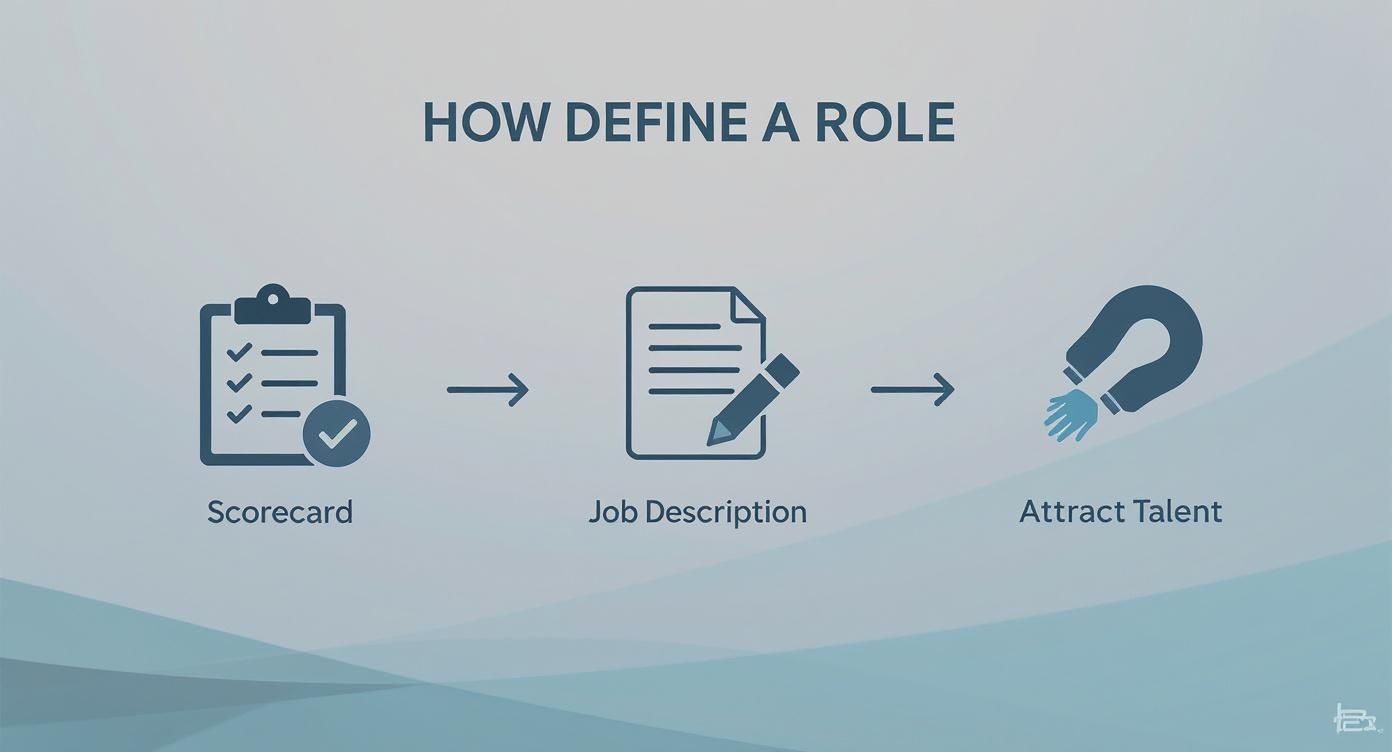
This simple workflow shows how the scorecard is the foundation. Nail that, and the job description and talent attraction become much, much easier.
Building Your Role Scorecard
Before anyone even drafts a job post, your leadership and engineering teams need to sit down and build this scorecard together. It’s an internal document that gets everyone on the same page.
A solid scorecard answers a few key questions:
- Mission: What’s the core purpose of this role in a sentence or two?
- Key Outcomes: What specific, measurable things must this person accomplish in their first 90 days?
- Core Competencies: What technical and soft skills are absolutely non-negotiable?
- Experience Profile: What kind of background has set someone up for success in a role just like this one?
Going through this process turns a vague idea like "we need a senior developer" into something concrete: "a senior backend engineer who will reduce API latency by 15% and mentor two junior developers within the first six months." That level of clarity is a magnet for top performers. For a deeper dive into this entire process, check out this guide on how to hire remote developers like a pro.
To get you started, here's a simple template you can adapt for your own needs.
Remote Role Scorecard Template
Use this template to align your team on the core requirements of the role before you write a single word of your job description.
| Mission | Key Outcomes (First 90 Days) | Core Competencies | Experience Requirements |
|---|---|---|---|
| To architect and build a scalable new data processing pipeline from the ground up. | 1. Deliver the production-ready v1 of the pipeline. 2. Reduce data processing time by 20%. | • Expert in Python & SQL • Strong experience with AWS (S3, Lambda) • Proactive communication • Mentorship skills | • 5+ years in backend development • Proven experience building and deploying data-intensive applications at scale in a startup. |
Filling this out ensures that when you finally write the job description, you're not just listing tasks—you're selling a clear, compelling opportunity.
From Scorecard to Job Description
With a completed scorecard in hand, writing the job description is a breeze. You’re no longer just listing responsibilities; you're articulating a mission and showing candidates the tangible impact they can have. You’re selling a career-defining opportunity, not just trying to fill a seat.
The market data backs this up. The game has changed for remote hiring. A staggering 76% of remote jobs get 2.5 times more applications than on-site ones. Even better, 89% of those applications come from outside your company’s home city, opening up a massive global talent pool.
Most importantly, 56% of these applicants are passive candidates—talented people who are already employed but are keeping an eye out for a truly great opportunity. These are exactly the kind of high-caliber professionals you want, and they’re more likely to stick around long-term.
Finding Top Developers in a Global Talent Pool
Now that you have your role clearly defined, it's time to cast the net. The best part about hiring remote developers is that your ideal candidate isn't limited to a 30-mile radius around your office. They could be anywhere. This simple fact completely changes the game, meaning you need a sourcing strategy that goes way beyond posting on a few traditional job boards.
Think about it: the best developers are almost always passive candidates. They aren't scrolling through job listings because they're too busy building great products. To get their attention, you have to meet them where they are. This requires a shift from a reactive "post and pray" approach to a proactive, multi-channel sourcing strategy.

Go Beyond Standard Job Boards
Sure, the big platforms have their place, but the real gems are often found in niche communities where top developers actually hang out. Relying solely on general job boards is like fishing in the ocean with a tiny net; you might catch something eventually, but it's incredibly inefficient. A focused strategy gets you better results, faster.
- Developer Communities: Places like GitHub and Stack Overflow are so much more than code repositories—they're bustling communities. I've found incredible talent by looking for developers who contribute to open-source projects relevant to our tech stack or who consistently provide sharp answers to complex problems. Their activity is a living, public portfolio of their skills and passion.
- Specialized Remote Platforms: Websites built specifically for remote work naturally attract candidates who are already bought into the distributed model. Curated job boards are especially effective. If you want to see what top remote companies are offering, check out some current remote software developer jobs to get a feel for the market.
By 2028, an estimated 73% of all departments will have remote workers. This isn’t a fleeting trend; it’s a fundamental shift in how high-performing teams are built. Sourcing globally has moved from a nice-to-have to a competitive necessity.
Master the Art of Proactive Outreach
Engaging a passive candidate is a delicate art. A generic, copy-pasted LinkedIn message is a one-way ticket to the trash folder. Your outreach has to be personal, concise, and laser-focused on what’s in it for them.
Show them you’ve done your homework. I always make it a point to reference something specific—a cool project on their GitHub, a talk they gave, or an insightful blog post they wrote. This small bit of effort shows genuine interest and I've seen it dramatically increase response rates. For niche roles like AI, there are even more specific strategies, and this guide on How to Hire Remote AI Developers offers some great tailored advice on that front.
Choosing Your Sourcing Channels
Your strategy will likely be a mix of direct sourcing and using curated talent marketplaces. From my experience, each has its distinct pros and cons.
| Sourcing Channel | Pros | Cons |
|---|---|---|
| Direct Sourcing (LinkedIn, GitHub) | • Complete control over the process • Direct access to passive candidates • Builds a long-term talent pipeline |
• Highly time-consuming • Requires significant research • Success depends on outreach skill |
| Curated Marketplaces (e.g., Toptal) | • Access to pre-vetted talent • Faster time-to-hire • Reduces screening burden |
• Higher cost-per-hire • Less control over candidate pool • May not fit every budget |
| Niche Remote Job Boards | • Attracts relevant, motivated candidates • Cost-effective • Filters out non-remote candidates |
• Smaller talent pool than large boards • Volume of applicants can vary |
Ultimately, a balanced approach works best. Use niche boards to attract active job seekers, lean on curated marketplaces when a role is urgent, and consistently use direct outreach to build relationships with top-tier talent who aren't even looking yet. This multi-pronged strategy ensures a steady, diverse flow of qualified candidates, turning your hiring process into a serious competitive advantage.
Running Technical Assessments That Predict Success
You've got a pipeline of promising candidates. Now comes the hard part: figuring out who can actually do the job. Assessing technical skills from afar isn't just about checking boxes on a resume. It’s about predicting how someone will perform on your team, solving your real-world problems. Get this wrong, and you either filter out fantastic talent or, even worse, get a false positive on a candidate who can't deliver.
The biggest mistake I see companies make is relying on abstract brain teasers or academic algorithm puzzles. These rarely reflect the day-to-day work of a developer. Your goal should be to create an evaluation that feels like a slice of the actual job. This gives you a much clearer picture of their skills, respects the candidate's time, and offers them a genuine preview of what it's like to work with you.

Choosing the Right Assessment Method
There's no one-size-fits-all test here. The right method really depends on the seniority of the role, the specific skills you need to see, and how much time your team can commit to the process. Honestly, the most effective strategies usually blend a couple of different formats to get a well-rounded view.
Here are the three methods we've found most effective:
- Take-Home Coding Challenges: These are small, self-contained projects that candidates work on in their own time. They're perfect for seeing how a developer builds something from the ground up—you get a feel for their coding style, attention to detail, and problem-solving process without the pressure of someone watching over their shoulder.
- Live Pair-Programming Sessions: This is where a candidate and one of your developers jump into a shared coding environment to tackle a problem together. The goal isn't necessarily to find the perfect solution on the spot. It's about seeing how they think, communicate, and collaborate in real-time.
- System Design Interviews: This is a must for senior or lead roles. It’s more of a strategic conversation where you ask the candidate to whiteboard the high-level architecture for a complex system. You’re testing their ability to think about scalability, trade-offs, and the big-picture implications of their decisions.
For most remote roles, a combination works best. Start with a short take-home challenge as an initial filter. Then, for your top candidates, schedule a pair-programming session to dive into their collaboration skills.
Designing a Realistic and Fair Challenge
The best technical tests are direct reflections of the work. Generic algorithm quizzes are a classic misstep because they don't measure the practical skills needed to build and maintain real-world software.
Instead, try something like this:
- For a Frontend Developer: Give them a basic design mock-up and ask them to build a small, interactive component using your primary framework (like React or Vue). Provide a simple API endpoint they can use to fetch data.
- For a Backend Developer: Hand them a small dataset and a list of business requirements. Their task is to build a simple REST API with a few endpoints to query and manipulate that data.
- For a DevOps Engineer: Provide a sample application with a
Dockerfile. Ask them to write a simple CI/CD pipeline script to build, test, and deploy it.
A well-designed technical assessment is your best tool for reducing bias. When every candidate completes the same practical task under the same conditions, you can evaluate their work on its merits, creating a more objective and equitable hiring process.
Implementing a Standardized Scoring Rubric
To keep things fair and remove subjectivity, you need to evaluate every assessment against a pre-defined scoring rubric. This forces your interviewers to be consistent and to focus on the criteria that actually matter for the role.
Your rubric should go beyond a simple "does it work?" check. Break it down into several key dimensions.
| Evaluation Category | What to Look For |
|---|---|
| Code Quality | Is the code clean, well-organized, and easy to read? Does it follow best practices? |
| Problem Solving | Did the candidate understand the requirements? Is their solution logical and robust? |
| Testing | Did they include unit or integration tests? Do the tests provide good coverage? |
| Communication | How clearly did they document their code and explain their decisions (in the README)? |
This structured approach turns the assessment from a pass/fail quiz into a rich source of data, helping you make a decision you can feel confident about. With U.S. tech employment projected to hit 7.1 million by 2034, making your hiring process efficient and accurate has never been more critical. For a closer look at the data, you can read more about remote developer hiring trends. By investing time in a thoughtful assessment process, you're not just finding another developer—you're building a stronger, more capable remote team.
You've screened the résumés and the candidate crushed the technical assessment. Now for the hard part. While solid coding skills are the price of entry, they don't guarantee success in a remote role. The most gifted developer can become a bottleneck if they can't operate effectively in a distributed environment.
This is where your interview process needs to get strategic. You're not just hiring for technical prowess; you're looking for a self-sufficient collaborator who can thrive without constant oversight. Your goal is to find someone who is truly remote-ready, not just technically proficient.
Are They a Master of Asynchronous Communication?
In a remote team, clear, concise writing isn't a "nice-to-have"—it's the foundation of everything. You can't just tap someone on the shoulder to ask a quick question. Ambiguous Slack messages, sparse pull request descriptions, and poorly documented code can grind productivity to a halt.
You need to actively screen for this. Forget generic questions and dig into their actual communication habits.
- "Tell me about a time you had to explain a complex technical issue to a non-technical person using only written communication. How did you make sure they understood?"
- "Walk me through how you document your work on a new feature. What do you consider essential for your teammates to know?"
The best candidates won't just say they "write things down." They'll talk about their process—using screenshots or Loom videos to clarify points, writing detailed commit messages, or proactively summarizing a thread for clarity. They show a deep sense of empathy for the person on the other end of the screen.
Can They Work Without a Boss Looking Over Their Shoulder?
Autonomy is the superpower of a great remote employee. Micromanagement is a killer of morale and efficiency in any setting, but it's completely unsustainable across different time zones. You need to hire people who take ownership, manage their own time, and push through roadblocks without waiting to be told what to do next.
A candidate's ability to self-manage is the single most important predictor of their success on a remote team. Your interview process must be designed to rigorously test for this trait, as it’s far more difficult to teach than any technical skill.
To see this in action, put them in a realistic scenario:
- "Imagine you're given a ticket with unclear requirements, and your team lead is offline for the next 8 hours. What do you do?"
- "Describe a project where you realized you were falling behind. How did you catch it, what steps did you take to get back on track, and when did you communicate it to the team?"
A passive developer will say they'd wait for the lead to come back online. A proactive one will describe how they’d explore the codebase for clues, document their assumptions in a shared channel, and maybe pivot to another high-priority task in the meantime. They find a way to move forward. For a deeper dive, check out the core skills or qualities every remote worker needs to truly succeed.
Will They Be a Good Team Player?
Finally, you need to know if this person can gel with your team's culture and workflow. Remote collaboration has to be intentional. It’s built on trust, respect, and a shared commitment to shipping great work, even when you disagree.
Ask questions that reveal how they navigate team dynamics from a distance:
- "How do you handle a technical disagreement with a colleague when you're working in different time zones?"
- "Tell me about your experience with code reviews, both giving and receiving them. What separates a helpful review from a frustrating one?"
You’re listening for an ego-free, constructive mindset. The best answers will focus on understanding other perspectives, offering feedback with kindness, and putting the project's goals ahead of being "right." That's the kind of person who makes the entire team better.
To help structure this part of your process, we’ve put together some targeted questions you can use.
Remote Developer Interview Questions
This table offers a starting point for questions designed to uncover the essential competencies needed for successful remote work.
| Competency | Sample Behavioral Question | What to Listen For |
|---|---|---|
| Asynchronous Communication | "Walk me through the process of how you would hand off a complex project to a teammate in another time zone." | Look for a structured approach: detailed documentation, clear status updates, and anticipating potential questions. |
| Autonomy & Proactivity | "Tell me about a time you identified a problem in the codebase or a process that wasn't part of your assigned tasks. What did you do?" | Listen for initiative. Did they just report it, or did they investigate, propose a solution, or even create a proof-of-concept? |
| Time Management | "How do you prioritize your tasks when you have multiple competing deadlines and minimal direct supervision?" | Strong answers will mention specific systems: using tools like Jira or Asana, time-blocking, or communicating priorities to stakeholders. |
| Collaboration | "Describe a situation where you had to work with a teammate whose working style was very different from yours. How did you adapt?" | Look for empathy, flexibility, and a focus on the shared goal rather than forcing their own process onto others. |
Remember, the goal isn't just to fill a role, but to add a member to your team who will thrive in your specific remote environment. Tailor these questions to reflect your company’s culture and the daily realities your team faces.
Crafting a Global Offer That Actually Closes
You've done the hard work. You sifted through applications, ran the interviews, and finally found the one. They crushed the technical challenge and clicked with your team. Now comes the moment of truth: making an offer.
When you're hiring developers across borders, this isn't just about throwing a number out there. You have to think about global pay scales, tricky legal stuff, and what makes an offer feel genuinely compelling to someone thousands of miles away.
One of the first big questions you'll face is how to even set the salary. Do you pay everyone the same for the same role, or do you adjust based on where they live? There's no single magic answer here; it really boils down to your company's philosophy and what your budget can handle.
Global Rate or Local Pay? Deciding on Your Philosophy
This is a foundational decision. How you approach it will shape your company culture, your hiring budget, and your ability to attract the right people.
A global standard rate is exactly what it sounds like: you pay everyone in the same role the same salary, whether they’re in San Francisco or São Paulo. It’s a powerful statement about fairness and equal pay for equal work, and it definitely simplifies your compensation planning.
The other route is a localized compensation model, where you tailor salaries to the local market rates and cost of living. This strategy can make your offers incredibly competitive in certain regions and lets you stretch your budget to hire more people.
Here’s a look at the trade-offs:
| Compensation Strategy | Why You Might Love It | What Might Bite You |
|---|---|---|
| Global Standard Rate | • Champions fairness; no one feels underpaid because of their address. • Makes payroll and budgeting way simpler. • You can attract the best talent from literally anywhere. |
• Might not be enough to attract candidates in very expensive cities. • You could be significantly overpaying in lower-cost areas. • A high global rate might mean you can't hire as many people. |
| Localized Compensation | • You get more bang for your buck, budget-wise. • Your offers are always sharp and competitive for that specific market. • Lets you build a larger team for the same cost. |
• Can create a feeling of pay inequality within the team. • It's a lot more work to manage and requires constant research. • You're always playing catch-up with market data. |
What I’ve seen work well is a hybrid model. Companies will set global salary bands for a role but build in adjustments for a few notoriously high-cost locations. It’s a nice middle ground that keeps things fair while acknowledging market realities.
Employee vs. Contractor: Getting the Legal Stuff Right
Next up is the legal relationship. This is a big one. Deciding whether to hire someone as a full-time employee or an independent contractor has massive legal and financial consequences. Get it wrong, and you could be facing hefty fines, back taxes, and a legal mess you don't want.
Bringing someone on as an independent contractor is often faster and less of an administrative headache. It gives you flexibility. The trade-off is that you have less control over their day-to-day work, and they don't get company benefits.
Making them a full-time employee means they are truly part of the team, woven into your company culture with the security and benefits that come with it. The catch? You’re now responsible for navigating their country’s specific labor laws, payroll taxes, and mandatory benefits.
Let's be honest: international labor law is a minefield. For most companies, trying to manage global payroll and stay compliant on your own is a huge, unnecessary risk. This is exactly where an Employer of Record saves the day.
The Smart Way to Hire Globally: Using an Employer of Record
An Employer of Record (EOR) is a service that acts as the legal employer for your team members in other countries. Think of them as your international HR department. They handle all the messy, complicated parts of global employment for you, including:
- Compliance: Making sure every contract, holiday, and termination process follows local laws to the letter.
- Payroll: Managing salaries, taxes, and social security contributions in the correct currency and format.
- Benefits: Setting up and administering required benefits like health insurance, pensions, and paid leave.
Partnering with an EOR like Deel or Remote lets you hire incredible talent anywhere in the world, quickly and legally, without the nightmare of setting up your own legal entity in every single country. It’s how you get all the benefits of a full-time global team without the administrative brain damage. For any company serious about scaling remotely, it's less of a luxury and more of a necessity.
Onboarding for Long-Term Success and Retention
Getting that signed offer letter back feels like crossing the finish line, but it’s not. It's the starting gun for what is arguably the most critical phase of the entire process: onboarding your new remote developer.
If the first few weeks are clumsy or chaotic, you can undo all the hard work you just put in. Your new hire will feel isolated, confused, and likely question their decision to join. A thoughtful, structured onboarding process, on the other hand, is the single best way to ensure they stick around and do great work.
The goal here is much bigger than just getting them logged into Slack. You have to be intentional about building connection, creating clarity, and fostering confidence from the moment they say "yes." This is even more crucial in a remote environment where you can't just rely on casual coffee-maker chats to build a sense of belonging.
Before Day One: The Pre-Boarding Checklist
A world-class onboarding experience actually starts before their official first day. This "pre-boarding" window is all about sorting out the logistics and, just as importantly, building excitement. You want them to feel welcomed and prepared, not scrambling to figure out administrative details.
- Gear and Access: Get their laptop, monitor, and any other essential hardware shipped out so it arrives a few days early. Nothing says "we're not ready for you" like a developer with no machine. Make sure all their core accounts—email, Slack, Jira, GitHub—are set up and waiting for them.
- The Welcome Packet: Put together a digital welcome packet. This can include some company swag, a simple org chart so they know who's who, a rough schedule for their first week, and a quick guide to your team's communication tools and norms.
- A Personal Touch: A simple, personal welcome email from their direct manager a few days before they start can make a huge difference. It closes the awkward gap between accepting the offer and their first day, making them feel like they're already part of the team.
The First 30 Days: Setting the Foundation
The first month is all about integration and giving them a clear path forward. This is where a 30-60-90 day plan is your best friend. It takes the guesswork out of their first few months and prevents that dreaded "what should I be doing now?" anxiety that can hit new remote hires hard.
A great remote onboarding process is an exercise in empathy. It anticipates the questions and anxieties a new person will have and proactively provides the answers and support they need to feel secure, connected, and capable.
This plan gives them an immediate sense of purpose and helps them see exactly how their first projects fit into the bigger company goals.
For a complete playbook covering every step, our remote employee onboarding checklist provides a detailed template you can easily adapt for your own team.
Nurturing Engagement for the Long Haul
Onboarding isn’t a one-and-done event that stops after 30 days. The same principles of clarity, connection, and growth need to be baked into your team's culture to keep your best developers engaged for years to come.
- Build Psychological Safety: You have to create an environment where people feel safe enough to ask questions, admit they broke something, or pitch a crazy new idea without being shot down. This is the absolute bedrock of any high-performing remote team.
- Set Crystal-Clear Communication Norms: Document everything. Define your expectations for response times on Slack versus email. Outline how you run meetings effectively and what the process is for giving asynchronous feedback on pull requests.
- Offer Real Growth Opportunities: A study by Upwork found that 77% of remote employees report being more productive. Don't let that talent stagnate. Give them clear career paths, access to mentorship programs, and a dedicated budget for professional development.
When you invest in a solid onboarding and retention strategy, you're doing more than just filling a seat. You're building a sustainable, high-performing engineering team that can thrive no matter where they are in the world.
Common Questions About Hiring Remote Developers

What's the Real Cost of Hiring a Remote Developer?
This is the classic "it depends" question, but I can give you some real-world numbers. The cost to bring on a remote developer can swing wildly, from $25 to over $150 per hour.
What causes such a big gap? It comes down to a few key factors:
- Experience Level: A senior architect is going to command a much higher rate than a junior developer just starting out.
- Tech Stack: Niche or high-demand skills (like specialized AI or blockchain) will always be more expensive.
- Location: Rates in Eastern Europe are very different from those in Silicon Valley.
To get a realistic estimate for your budget, you need a crystal-clear project scope and a detailed list of the skills you absolutely need.
What's the Best Way to Test a Remote Developer's Skills?
Forget brain teasers and abstract whiteboard problems. The most reliable way to know if someone can actually do the job is to see them do a version of the job.
I've found the most effective method is a two-part practical assessment. First, a small, paid take-home challenge that’s a slice of a real task they’d work on. Then, a live pair-programming session to review their code and work through a small extension of it together. This combo shows you not just their technical chops but also how they communicate, collaborate, and handle feedback.
How Can I Actually Manage Different Time Zones?
The secret isn't about finding people who will work your hours; it's about getting really good at asynchronous communication. If you nail this, time zones become a massive advantage, not a hurdle.
Start by documenting everything—processes, decisions, and project updates. Set clear expectations for response times (e.g., "within 24 hours") and make sure there are a few hours of overlap each day for any critical, must-have meetings. This gives your team the autonomy to work when they're most productive, which is a huge part of making remote work work.
Ready to attract the best remote talent out there? At RemoteWeek, we connect great companies with skilled professionals actively looking for their next move. You can post unlimited jobs and find candidates who are a perfect match for your team. Start hiring on RemoteWeek today.