
how to improve glassdoor ratings: quick optimization

Improving your Glassdoor rating isn't about quick fixes or damage control. It’s a real strategy. The best game plan involves digging into your current profile to see what's really going on, fostering a culture where people feel safe giving honest feedback, and then actually showing everyone you're listening and making changes.
When you do this right, your Glassdoor profile stops being a liability and turns into one of your strongest recruiting assets.
Why Your Glassdoor Rating Matters More Than Ever
If you think your Glassdoor score is just an HR problem, you're missing the bigger picture. In today's tight talent market, that rating is a critical business metric. It's a public report card on your culture, your leadership, and what it’s really like to work at your company.
Let's get real: nearly half of all job seekers check Glassdoor during their search. For in-demand roles in tech and other competitive fields, that number is even higher. Top candidates are judging you long before your recruiter ever sends that first email. A low score doesn't just look bad; it actively shrinks your talent pool and makes hiring more expensive and time-consuming.
The Business Impact of a Public Scorecard
The fallout from a poor rating doesn't stop at recruiting. Your Glassdoor page is a huge part of your online presence, often one of the first things that pops up when someone Googles your company. That means it’s not just candidates who are looking.
- Brand Reputation: Potential clients and partners absolutely check out a company's culture before signing a contract. A wall of negative reviews can signal instability or internal chaos, making them think twice.
- Sales Conversations: Believe it or not, prospects in B2B sales sometimes glance at your rating. A high score is a subtle trust signal, suggesting your organization is healthy and well-run.
- Employee Retention: When current employees see you openly engaging with feedback—the good and the bad—it proves their voices matter. That alone can be a powerful boost for morale and loyalty.
A company's average rating on Glassdoor is 3.7 out of 5 stars. If you're sitting below that benchmark, it's a clear sign you're falling behind the competition and likely losing great people to companies with better employer brands.
Ultimately, your rating is just a mirror reflecting your internal reality. Ignoring it means you're ignoring free, valuable advice on how to fix what's broken. This playbook will give you a proactive strategy to not just manage your score, but to build a better workplace by genuinely listening to your team. And it's worth remembering, there are many sites like Glassdoor that candidates use to get the inside scoop.
Auditing Your Glassdoor Profile for Actionable Insights
Before you can even think about improving your Glassdoor score, you need a brutally honest look at where you stand right now. It's tempting to jump straight into asking for new reviews, but that’s like painting over a cracked wall—it might look better for a minute, but the underlying problems will bleed through eventually. A proper audit is what turns that raw, often emotional feedback into structured data your leadership team can actually act on.
Forget just glancing at your overall star rating. The real gold is buried in the patterns, trends, and recurring words inside the individual reviews. This is where you uncover the specific friction points in your employee experience, moving from vague complaints to a clear diagnosis of what needs fixing.
This workflow breaks the whole process down into three core phases.
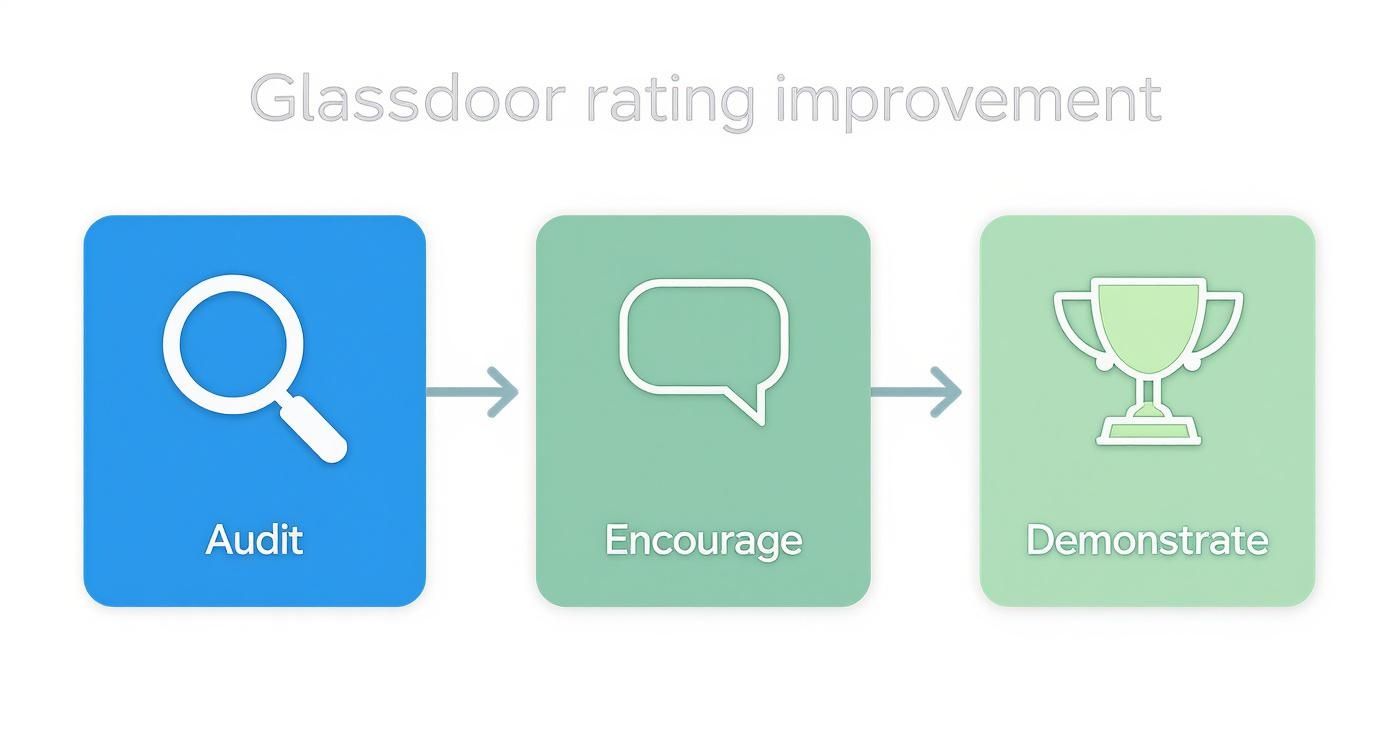
It all starts with a deep-dive audit to diagnose the real issues. That diagnosis then informs how you encourage authentic feedback and, finally, what meaningful improvements you need to demonstrate.
Identifying Recurring Themes and Keywords
Your first move is to put on your data detective hat. Fire up a simple spreadsheet and start logging every review from the past 12-18 months. Create columns for the date, overall rating, pros, cons, and advice to management. As you read, you’ll quickly start noticing the same words and phrases popping up again and again.
Is "micromanagement" a constant in the cons section? Does "no advancement" appear every few reviews? These are your red flags. Create another column in your spreadsheet to categorize each review with simple tags like #ManagementIssues, #CareerGrowth, or #WorkLifeBalance.
After you've gone through 20-30 reviews, you'll have a powerful, data-backed snapshot of your company's biggest challenges from the people living them. This isn't just anecdotal evidence anymore; it’s a tangible report you can put in front of your leadership team. For example, if 60% of negative reviews in the past year mention poor communication from senior leaders, you’ve found a systemic problem that needs real attention.
Analyzing Sentiment Trends Over Time
An overall rating is just a snapshot. To get the full story, you need to track how your score has trended over time. Did your ratings suddenly dip after a big reorganization or a change in a major company policy?
Plot your average monthly rating on a simple line graph. This kind of visualization can reveal critical insights at a glance:
- A sudden drop could be linked to a specific event, like layoffs or a particularly rough quarter.
- A gradual decline might signal a slow erosion of culture or burnout quietly spreading through your teams.
- A steady increase can prove that the positive changes you're implementing are actually starting to work.
This historical context is crucial. It helps you connect the dots between your business decisions and their impact on employee sentiment, giving you a clear narrative for why your rating is what it is today.
Don’t just read the reviews—quantify them. Transforming qualitative feedback into hard data (e.g., "micromanagement was mentioned in 12 of the last 20 negative reviews") is the secret to getting leadership to buy into making real changes.
Benchmarking Against Your Competitors
No company exists in a vacuum. Every single day, your Glassdoor profile is being compared to those of your direct competitors for talent. The final piece of your audit puzzle is seeing how you actually stack up.
Put together a simple competitive analysis matrix. List your top three to five talent competitors and track their:
- Overall Rating: The obvious place to start.
- Specific Category Scores: How do you compare on metrics like Culture & Values or Work/Life Balance?
- Common Positive Themes: What are they consistently praised for? Is it great benefits, strong leadership, or exciting projects?
- Common Negative Themes: Where are their weaknesses? Their pain points could be your opportunity to stand out.
This analysis gives you much-needed perspective and helps you set realistic goals. If your main competitor has a 4.5 rating thanks to their amazing remote work policies, and you know that’s a sore spot for your team, you’ve just identified a strategic priority.
During this audit, if you find content that seems misleading or violates Glassdoor's terms of service—on your page or a competitor's—understanding your Glassdoor content removal options can be a crucial tool. With this complete audit in hand, you’re no longer guessing. You’re ready to build a targeted strategy for improvement based on solid evidence.
Get a Steady Stream of Authentic Reviews
Let's be honest, improving your Glassdoor score is a numbers game. But it’s not about manipulating the system. It’s about making sure your company’s profile reflects the full spectrum of employee experiences, not just the loudest voices from a few unhappy people.
The goal is to generate a consistent, steady flow of authentic reviews. This gives prospective candidates a balanced, accurate picture of what it's really like to work for you.
To do this right, you have to ditch the generic, company-wide email blasts begging for reviews. They feel impersonal and can come across as desperate, which often backfires. A much smarter approach is to be strategic about when and how you ask.

Stop thinking, "We need more reviews," and start asking, "When are our employees most likely to feel positive and engaged?" The answer is almost always tied to key moments in their journey with your company.
Time Your Requests for Maximum Impact
Think about the natural high points in someone's career. These are the moments when they feel valued, successful, and genuinely connected to the company. Asking for feedback at these times feels natural and is far more likely to result in a positive, detailed review.
Try integrating a gentle prompt to share their experience during events like these:
- Promotions and Internal Moves: Someone who just accepted a promotion is likely feeling recognized and optimistic about their future with you.
- Successful Project Launches: After a big win, the whole team is usually riding a wave of shared accomplishment and pride.
- Work Anniversaries: Milestones like a one-year or five-year anniversary are natural points for reflection on their growth and journey.
- Positive Performance Reviews: When an employee has just received encouraging, constructive feedback, they're often in a great frame of mind.
This approach respects the employee’s experience and frames the request as a chance to share their success story with others.
Build a Culture of Continuous Feedback
Asking at the right time is a great start, but it's not the whole story. The most sustainable way to improve your Glassdoor presence is to build a workplace where giving feedback is a normal, healthy part of the culture.
When employees feel genuinely heard internally, they're far more likely to share balanced perspectives externally.
Create safe and accessible channels for internal feedback. You want people to feel completely comfortable sharing honest opinions. A great way to do this is with a truly anonymous system, like the ones discussed in this guide to anonymous feedback forms for teams. When people know their constructive criticism is valued internally, they don't feel like venting on a public platform is their only option.
Crucial Rule: Never, ever incentivize reviews. Offering gift cards, bonuses, or any other reward for posting on Glassdoor is a direct violation of their terms of service. It completely destroys trust, can get your profile flagged, and undermines the very authenticity you're trying to build.
Active engagement on the platform sends a powerful signal. Did you know that 70% of job seekers are more likely to apply to companies that are active on Glassdoor? In fact, consistent engagement builds so much trust that when a candidate views your company's profile five or more times, they become five times more likely to apply.
Ultimately, you want to shift the dynamic. Providing feedback shouldn't feel like a favor to HR; it should feel like a contribution to the company's growth. Frame your requests around this idea: "Your perspective helps us understand what we're doing right and where we can get better. By sharing your experience, you help future team members find the right fit."
This approach positions your employees as valued partners in building a better workplace—and that’s the most reliable path to a rating you can be proud of.
Responding to Reviews in a Way That Builds Trust
Think of your public responses on Glassdoor as a live demonstration of your company culture. Every reply is a signal to potential hires, current employees, and even customers about how you treat people—especially when the conversation gets tough. Ignoring reviews entirely screams that you don't care. On the other hand, defensive or copy-paste responses can do even more damage.
The goal here isn't to win an argument or dispute every negative comment. It's about building trust through transparency, professionalism, and a clear commitment to action. Mastering this is a powerful way to show, not just tell, what your company is all about.

Crafting a Constructive Response to Negative Feedback
That one-star review stings, doesn't it? It can feel like a personal attack, but your response must stay professional and constructive. A well-crafted reply can actually neutralize the negative impact and, believe it or not, turn a bad review into a net positive for your employer brand.
I've found the best approach follows a simple, three-part framework: acknowledge their experience, thank them for their honesty, and detail what you're doing about it. This structure keeps you from getting defensive and immediately pivots the conversation toward solutions.
- Acknowledge Their Experience: First things first, validate their perspective. Phrases like, "We're sorry to hear your experience didn't meet your—or our—expectations," or "Thank you for taking the time to share this. We take this feedback very seriously," go a long way. This simple step shows respect and immediately de-escalates the situation.
- Thank Them for Their Honesty: It takes guts to post critical feedback. Show you recognize that. Something like, "We appreciate your candor, as it helps us identify exactly where we need to improve," reframes their criticism as a gift, not an attack.
- Detail Concrete Next Steps: This is where the magic happens. Vague promises like "we'll look into it" are useless. Get specific. For instance, "Feedback like yours about workload management is exactly why we've launched a new training program for all managers focused on capacity planning and burnout prevention."
This approach shows you're not just listening; you're acting. It transforms an individual complaint into a public commitment to get better.
Responding Without Violating Confidentiality
One of the trickiest parts of responding is how to address specific claims without crossing legal or ethical lines. You have a duty to protect both the reviewer's anonymity and the company's confidential information.
Crucial Guideline: Never, ever try to unmask or identify an anonymous reviewer in your public response. This is a massive breach of trust, violates Glassdoor's policies, and will backfire spectacularly. Your response should always address the issue, not the person.
Here are the non-negotiable rules I always follow:
- Avoid Personal Details: Never mention specific employee names (unless it's a C-suite executive), teams, or projects. Keep the conversation focused on policies, processes, and culture.
- Generalize the Issue: Instead of saying, "We're talking to the marketing team manager about this," shift to something like, "We are reinforcing our communication protocols with all department leads to ensure expectations are clear."
- Take It Offline: For highly specific or sensitive issues, your best move is to invite a private conversation. A great closing line is, "We would appreciate the opportunity to discuss this further. Please feel free to reach out to our People team at [email address]."
This protects everyone involved and shows you have a professional, by-the-book approach to resolving conflict.
Amplifying Positive Reviews with Smart Responses
Responding to positive reviews is just as important, but so many companies drop the ball with a generic "Thanks for the feedback!" A thoughtful response is a golden opportunity to reinforce your company's values and amplify what makes it a great place to work.
Don't just say thanks. Connect their positive comments back to your company's mission or a specific cultural initiative you've worked hard on.
| Reviewer's Positive Comment | Generic Response | Amplifying Response |
|---|---|---|
| "Great work-life balance and remote flexibility." | "Thanks for the review!" | "We're thrilled you're benefiting from our flexible work policies! We truly believe great work happens when our team has the autonomy to balance their professional and personal lives." |
| "Management is really supportive and invests in growth." | "Glad you're happy here." | "Thank you! Supporting our team's growth is a core value, and we're so glad you're feeling that through our mentorship and development programs." |
See the difference? These amplified responses turn a single positive review into a mini-advertisement for your employer value proposition. It proves that the values on your careers page are real and lived by your team every day. This kind of thoughtful engagement is a cornerstone of any strategy for how to improve Glassdoor ratings for good.
Turning Employee Feedback Into Real Workplace Improvements
A high Glassdoor rating isn't the real goal—it's just a symptom of a healthy, thriving workplace. Once you’ve audited your profile, encouraged honest reviews, and started responding, the real work begins. This is where you close the feedback loop and turn all that raw data into tangible improvements that your team can actually see and feel.
Let's be clear: just acknowledging feedback isn't enough. Lasting change only happens when you dig in and fix the underlying issues that sparked those negative reviews in the first place. It’s the only way to genuinely, and sustainably, improve your ratings for the long haul.
Translating Recurring Complaints into Action Plans
Your audit probably uncovered a few recurring themes. Don't get bogged down by every single comment; instead, focus on those big, persistent patterns. Think of them as a strategic roadmap for improving your culture and operations.
For example, if you see multiple reviews mentioning a "lack of career growth," that’s a massive red flag. This isn't just one person’s frustration—it's a systemic problem that's likely costing you top talent.
Here’s how you can turn that specific feedback into a concrete plan:
- Pilot a mentorship program. Pair high-potential employees with senior leaders to give them guidance and a clearer path forward.
- Build out transparent career frameworks. People need to see what's next. Create and publish clear career ladders so employees know exactly what skills and accomplishments are needed to reach the next level.
- Invest in a real learning & development budget. Offer stipends for courses, certifications, or conferences that align with both the company's goals and an employee's desired career path.
When you tackle the root cause, you don’t just solve a problem. You create a powerful new story to tell both your current team and future candidates.
Addressing Widespread Issues Like Burnout
What if the most common complaint is something trickier, like "poor work-life balance"? This is a thorny issue that points to deeper problems with how work gets done—workload management, team culture, and leadership expectations. A quick fix won't cut it.
Addressing burnout has to be a multi-faceted effort.
Tackling the root causes of employee feedback is the most powerful employer branding strategy you have. When employees see their concerns lead to real change, they become your most authentic and credible advocates.
A company might try implementing "no-meeting Fridays" to give everyone more focus time. But if managers are still pinging their team for immediate responses at 7 PM, the core problem hasn't changed. A much more effective approach involves systemic shifts:
- Train your managers. Equip your leaders with the skills to accurately scope projects, manage their team's capacity, and spot the early signs of burnout before it gets out of hand.
- Rethink your flexible work policies. Offer genuine flexibility, whether that means establishing core working hours, trying out compressed workweeks, or better supporting your remote team. This is a critical piece of building a strong remote working culture where people feel trusted and respected.
- Conduct headcount audits. Use the feedback from Glassdoor as hard evidence to justify hiring for overstretched teams. Show leadership that chronic understaffing is costing the business more in attrition and lost productivity than a new hire would.
The Growing Importance of Employee Well-Being
The conversation around employer branding is shifting toward holistic employee support, and the data backs this up. Since 2019, access to mental health care benefits has jumped by 18 percentage points.
Even so, nearly half (48%) of employees say it's harder to prioritize their mental health at work now than it was five years ago. That gap represents a massive opportunity for companies to stand out. Some organizations are even using AI sentiment analysis to better understand review data, improving their employee Net Promoter Score (eNPS) by an average of 15%. You can discover more insights about these workplace trends from Glassdoor's research.
By truly investing in your team's well-being—and communicating that commitment clearly—you address a critical need for today's workforce. When you make your company a genuinely better place to work, the positive reviews will follow. This proactive approach turns your Glassdoor profile from something you have to manage into an authentic reflection of a culture people can't wait to join.
Handling Difficult Situations Like Layoffs
Layoffs and other major restructures can feel like a gut punch to your employer brand. One day you have a solid rating, and the next, a wave of negative reviews threatens to undo years of hard work. But navigating these moments isn't just about damage control; it's about handling a tough situation with transparency and compassion.
How you manage the message is everything. Your first, and most important, job is to be direct and empathetic with the people being let go. Vague corporate jargon and leaders who go into hiding will only pour gasoline on the fire, leading to a flood of justifiably angry reviews. A well-managed, humane offboarding process is your first line of defense.
Managing the Inevitable Fallout
Let's be realistic: even if you handle layoffs perfectly, you should brace for a dip in your ratings. It’s almost unavoidable. In fact, a detailed analysis revealed that layoffs trigger an average drop of 0.13 stars in a company's overall rating. Interestingly, the reviews from remaining employees often show an even bigger decline in sentiment. The recovery isn't quick, either; ratings often stay low for a year or more. You can read the full research about layoff impacts on Glassdoor to get a better sense of the long-term ripple effects.
When those reviews start rolling in, your response strategy is critical. Empathy has to be your north star.
- Acknowledge Their Experience: Before anything else, validate their feelings. A simple, direct "We are truly sorry for the impact this decision had on you" shows you're listening and that a human is on the other side of the screen.
- Don't Get Defensive: This is not the time or place to justify the business rationale. Trying to defend the decision in a public reply comes off as tone-deaf and will only make things worse.
- Gently Pivot to the Future: You can briefly mention the company's commitment to its mission or future, which helps reassure current employees and prospective candidates who are watching closely.
Your response during a crisis sends a powerful message to everyone—your current team, your alumni network, and future talent. Handling immense pressure with grace and accountability is a true test of leadership and a crucial part of improving your Glassdoor rating when the chips are down.
This approach won’t make the negative reviews disappear, but it shows your company leads with integrity, even when things are tough.
And don't forget about the people who remain. They've just watched their colleagues leave and are likely feeling uncertain. For them, especially if they're part of a newly restructured or remote team, consistent and clear communication is essential. To keep morale and productivity from tanking, take a look at our guide on how to manage remote teams through periods of significant change.
Got Questions? We've Got Answers
When you start getting serious about your Glassdoor presence, a few practical questions always pop up. Let's tackle the ones I hear most often from HR leaders trying to get this right.
"How Long Until We Actually See Our Rating Go Up?"
This is the big one, and the honest answer is: it takes time. You're playing the long game here.
If you’re consistent with encouraging reviews and responding thoughtfully, you might see some small positive bumps within a few months. But for a real, meaningful shift in your overall score? You should be thinking in terms of 6-12 months.
Remember, a better rating isn't just a numbers game. It’s the result of making genuine improvements that your team starts to feel and, eventually, write about.
"Can We Just Get Rid of a Really Bad Review?"
The short answer is no, you can't just delete a review you don't like.
However, you do have one option. If you come across a review that you believe is blatantly false, defamatory, or breaks Glassdoor's community guidelines (like naming specific employees who aren't senior leaders or using threatening language), you can flag it.
Glassdoor’s content moderation team will investigate and make the final call. But your best move, and the one you can control, is to post a calm, professional public response. It shows you're listening and taking the feedback seriously.
"Is It Okay to Offer Gift Cards for Reviews?"
This is a hard no. Never, ever offer incentives for reviews.
Giving employees anything—gift cards, extra PTO, a bonus—in exchange for leaving a review is a direct violation of Glassdoor's rules. They see it as "review manipulation," and the consequences can be pretty severe.
They might remove the reviews and could even slap a public warning on your company profile, letting everyone know you tried to game the system. The only way to win on Glassdoor is to earn it by building a company people genuinely want to talk about positively.
Ready to attract top talent that values a great workplace culture? RemoteWeek is a curated job board that connects employee-focused tech companies with skilled remote professionals. We only feature companies with a Glassdoor rating of 3.5 or higher, ensuring you stand out to candidates who prioritize a healthy work environment. Find your next great hire at https://www.remoteweek.io.