
How to Maintain Work Life Balance in a Remote World

To truly maintain a healthy work life balance, you can’t just hope it happens. You have to be deliberate about it. It’s all about creating a hard stop between your professional duties and your personal life with structured routines and firm boundaries.
This means designing a clear "off switch" for your brain at the end of the day, prioritizing your own time without feeling guilty, and being crystal clear about your availability with your team. Get this right, and you'll find yourself replacing that creeping feeling of burnout with sustainable productivity and a genuine sense of well-being.
The Remote Work Paradox: Reclaiming Your Personal Time

The pitch for remote work sounds amazing, right? A perfect blend of getting things done while having the freedom to live your life. The reality, though, is often a bit messier. When your living room is also your office, the lines between your job and your life can get dangerously blurry.
Let's move past the myth that simply working from home automatically creates better balance. It doesn't. Instead, we're going to focus on the intentional, practical strategies you need to actually thrive in a remote career, not just get by. It all starts with recognizing that "always-on" culture for what it is—a trap—and building your defenses against it.
This guide will walk you through the core strategies that make a real difference. We've broken them down into four key pillars.
| The Four Pillars of Remote Work Life Balance | ||
|---|---|---|
| Pillar | Core Action | Primary Benefit |
| Structured Routines | Establishing consistent start/end times and daily rituals that separate work from personal life. | Creates a psychological "off switch" to prevent work from spilling over. |
| Firm Boundaries | Setting and communicating clear limits on your availability and workspace. | Protects your personal time and reduces mental fatigue. |
| Smart Communication | Using clear, asynchronous communication methods and scripts to manage expectations. | Minimizes interruptions and the pressure to be constantly available. |
| Intentional Disconnection | Actively scheduling and protecting time for non-work activities and mental health checks. | Fights burnout and improves overall well-being and happiness. |
By focusing on these four areas, you can build a sustainable framework that works for you. Let's dive into why this matters so much right now.
Why Intentional Balance Matters More Than Ever
The desire for a better work-life blend isn't just a nice-to-have; it's a huge factor in the career choices people are making. The data backs this up in a big way. A staggering 91% of employees say they want to work remotely specifically to improve this balance.
And it’s not just wishful thinking—the positive impact is real:
- A full 67% of people reported a better work-life balance after they started working remotely.
- On average, remote workers are 22% happier than their colleagues who commute to an office every day.
This shift proves that achieving balance isn't just about where you work, but how you work. It’s about building a structure that protects your mental health and personal time.
This guide is your roadmap. We’ll get into the nitty-gritty of daily routines, boundary-setting techniques, and even communication scripts you can use. And if you’re feeling completely swamped by a packed schedule, looking into how virtual personal assistant services can help might be a game-changer for reclaiming your time and dialing down the stress.
Designing Your Day for Success, Not Stress
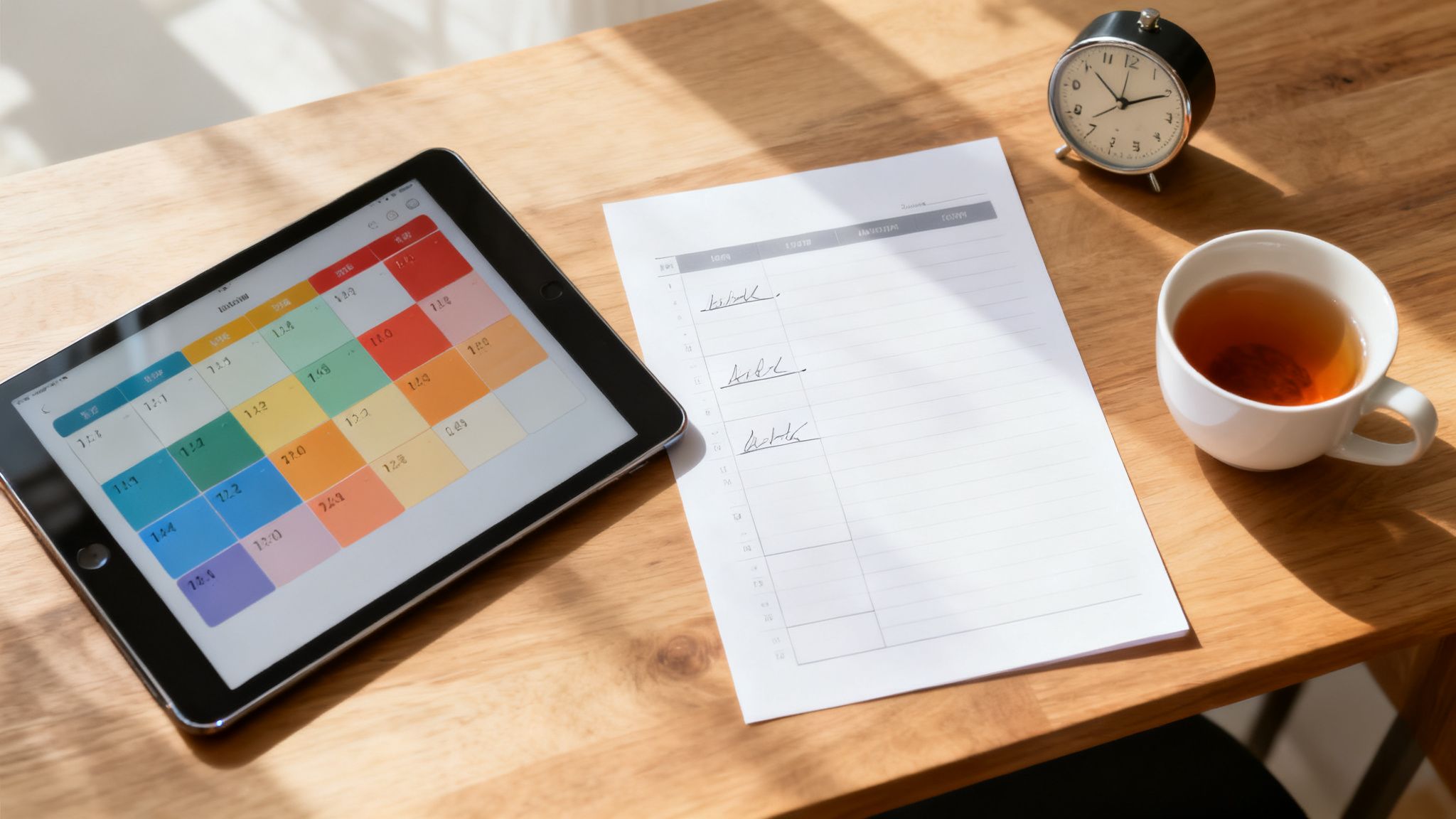
A productive remote day doesn't just happen by accident. It's designed. Without the natural bookends of a commute or the clear separation of an office, your schedule can easily blur into a chaotic mess. The trick is to build a framework for your day that actively protects your personal time, putting you in the driver's seat.
It all starts with a routine that signals to your brain when it’s time to work and—just as importantly—when it’s time to clock out for good.
Create Your "Digital Commute"
Love it or hate it, the old daily commute served a real purpose. It was a built-in buffer, a mental transition between your work self and your home self. Recreating that transition is a surprisingly powerful way to start and end your remote workday, preventing tasks and worries from creeping into your evenings.
Your "digital commute" doesn't have to be some elaborate ceremony. It's just a simple, consistent ritual you do right before starting work and immediately after you finish.
Your Morning "Commute": Before you even think about opening your laptop, maybe you take a quick 15-minute walk around the block, listen to the same daily podcast, or do ten minutes of stretching. This simple action tells your brain, "Okay, the workday is officially starting now."
Your Evening "Commute": When your scheduled end-of-day alarm goes off, close all the work tabs. Turn off the Slack notifications. Step away from the desk. You could change out of your "work clothes," spend five minutes tidying your desk for the next day, or just head straight to the kitchen to start dinner. This provides a sense of closure.
This isn’t just about forming a good habit; it’s about setting a psychological boundary. A survey of desk workers actually found that those who logged off at a consistent time were 20% more productive than colleagues who let their work spill into the evening. A clear end-of-day ritual makes that possible.
Time Blocking for Your Specific Role
Most scheduling advice is one-size-fits-all, which is why it rarely sticks. A developer’s ideal day looks nothing like a marketing manager’s. That's where time blocking comes in—it’s all about dedicating specific chunks of time to specific types of tasks.
A software developer, for instance, might block off a solid four-hour chunk in the morning for deep, uninterrupted coding. During that "focus block," all notifications are off. Their afternoon can then be opened up for things like code reviews, team meetings, and catching up on messages.
Meanwhile, a marketing manager’s day is built around collaboration. Their calendar might have a morning block for team syncs and campaign planning, an early afternoon slot for focused content creation, and a late afternoon block for digging into analytics and clearing out their inbox.
By giving every part of your day a job, you slash decision fatigue and make sure your high-priority work actually gets done. You stop reacting to whatever pops up and start proactively managing your focus.
The best way to get started is to look at a few templates and see what clicks. We've got a whole guide with more examples of a work from home schedule designed for different remote jobs.
Having this structure also makes it way easier to handle the unexpected. When an urgent request lands on your plate, you can just look at your blocked-out schedule and make a smart call about where it fits, without letting it torpedo your entire day.
Setting Digital and Physical Boundaries That Stick
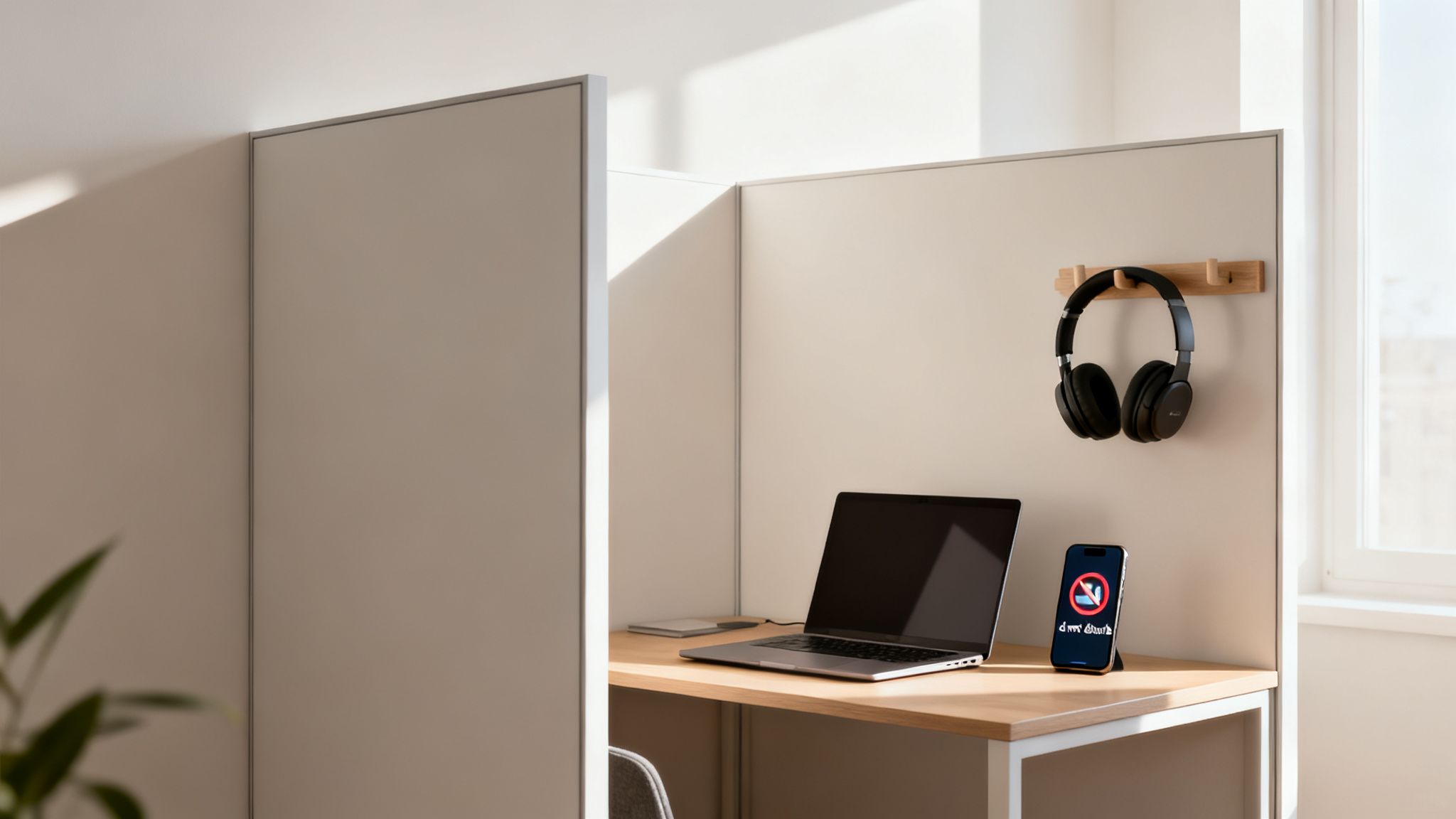
A perfectly planned schedule is one thing, but it’s completely useless without strong boundaries to protect it. Think of boundaries as the clear lines you draw around your time, energy, and availability. They are the absolute bedrock of a sustainable remote career.
Without them, you’re basically leaving your personal time exposed to every "urgent" request and late-night notification that comes your way. This isn't about being difficult; it's about being clear and consistent. It’s how you teach your colleagues and your manager how to work with you effectively.
Define Your Physical Workspace
When your home is your office, creating a physical distinction between the two is incredibly powerful. The goal is to have a space that signals to your brain, "this is where work happens." When you leave it, work mentally stays behind.
You don’t need a dedicated home office with a door you can shut. Even a small corner of a room can do the trick if you're intentional about it.
- Designate a Spot: Choose a specific chair at the dining table or a small desk in the guest room. Make it your official "workstation."
- Set It Up and Tear It Down: At the start of your day, arrange your laptop, notebook, and headphones. At the end, pack them away. This simple ritual acts as a powerful physical "off switch."
- Avoid the Couch and Bed: Working from where you relax is a recipe for burnout. It blurs the lines and makes it nearly impossible for your brain to disconnect and recharge.
Communicate Your Availability Loud and Clear
In a remote world, you can't rely on visual cues like seeing a colleague pack up their bag for the day. You have to be explicit about your working hours and response times, especially when working with teammates across different time zones.
Setting clear expectations upfront prevents misunderstandings and eases the pressure to be "always on." Your team will appreciate the clarity, and you’ll protect your personal time from being constantly chipped away.
This shift toward prioritizing balance is becoming a major movement. In fact, 61% of workers now see work-life boundaries as a top priority when job hunting, a trend largely driven by Gen Z and millennials who are reshaping what we expect from our employers. The 2025 Deloitte Global Gen Z and Millennial Survey has some fascinating data on this.
Make Technology Your Ally
Your digital tools can be a source of constant stress or a powerful ally in protecting your time. It’s all about how you use them. Leverage built-in features to automate your limits and communicate your status without having to type a single word.
- Schedule "Do Not Disturb" Mode: Set apps like Slack and Microsoft Teams to automatically silence notifications outside of your working hours.
- Use Your Calendar Intentionally: Block off your lunch break and your hard stop at the end of the day. This makes your unavailability visible to anyone trying to book your time.
- Craft a Real Out-of-Office Reply: When you take time off, write an OOO message that clearly states you won't be checking emails and directs people to an emergency contact. Don't be vague.
These small, consistent actions are what reinforce your boundaries day after day. For a deeper dive, check out our complete guide on how to set boundaries at work.
Finding a Company Culture That Champions Balance
Let's be honest: all the time-blocking and boundary-setting in the world won't matter if your company’s culture is actively working against you. Personal habits are crucial, but they can only get you so far.
The real game-changer is finding a company where balance isn't just a buzzword in a job description—it’s baked into how they operate. When you join the right employer, you stop fighting an uphill battle against an "always-on" mentality.
This means you need to look beyond your own routines and start evaluating the organizational systems you'll be a part of. Remember, when you're interviewing for a new remote role, you are also interviewing them. Your mission is to figure out if they genuinely walk the walk on employee well-being or just pay it lip service.
Spotting the Green Flags
A company that truly gets it will leave clues. These are the positive signs—the green flags—that signal a healthy, supportive workplace built on trust, flexibility, and a focus on results, not hours clocked.
Here’s what to look for:
- Asynchronous-First Communication: Does the company default to async tools for updates and collaboration, rather than endless back-to-back meetings? This is a huge sign of respect for different time zones and the need for deep, uninterrupted work.
- Outcome-Based Performance Metrics: Are you evaluated on the quality and impact of what you produce, or are you judged by your Slack status or how fast you reply to emails? Cultures that prioritize balance care about what you achieve, not just that you're online.
- Explicit Policies on Time Off: Look for clear, encouraging language around taking vacations and mental health days. Some of the best companies even have minimum vacation policies to make sure people actually disconnect and recharge.
When you see these signs, you’re likely looking at a culture where balance is a feature, not a favor.
A supportive culture is the ultimate work-life balance hack. It creates an environment where employees are empowered to prioritize their well-being without fear of judgment, leading to higher engagement and sustainable productivity.
Uncovering Red Flags in the Interview Process
Just as important as spotting the green flags is learning to recognize the red ones. These are the warning signs that a company’s culture might be toxic or unsustainable, no matter what the job ad promised.
Pay close attention to the language used to describe their work style and expectations. Vague answers or a heavy emphasis on "hustle culture" can tell you everything you need to know.
For instance, be cautious if your interviewers:
- Glorify Long Hours: If they share stories celebrating employees who "go the extra mile" by consistently working late or on weekends, that’s a major red flag.
- Can't Define Their Meeting Culture: A vague or hesitant answer to, "What's your approach to meetings?" usually translates to a calendar packed with unnecessary calls.
- Use Phrases Like "Work Hard, Play Hard": This old cliché can be code for a culture that expects constant availability and happily blurs the lines between your professional and personal life.
It's also worth remembering that cultural norms vary wildly across the globe. Recent workplace research reveals huge differences in work-life balance from country to country. New Zealand currently tops the charts with a balance index score of 86.59, while the Netherlands has the shortest average workweek at just 30.5 hours. Diving into these global life-work balance findings can give you great context on regional expectations.
Interview Questions to Vet Company Culture
The interview is your best chance to dig deeper and get real answers. Don't be afraid to ask direct questions that reveal how a company truly operates. Here are a few to get you started.
| Topic Area | Question to Ask | What to Listen For (Green Flag) |
|---|---|---|
| Working Hours | "What are the typical working hours for the team? How does the company handle work that needs to be done after hours?" | A clear definition of core hours, respect for personal time, and emphasis on planning to avoid last-minute rushes. |
| Communication | "Could you walk me through the team’s communication cadence? How much is async versus real-time meetings?" | They default to async communication (e.g., Notion, Slack threads) and reserve meetings for genuinely collaborative sessions. |
| Performance | "How is success measured in this role? What does a successful first six months look like?" | The answer focuses on specific, measurable outcomes and project impact, not on hours worked or availability. |
| Time Off | "What's the company's philosophy on taking vacation time? How does the team support colleagues who are out of office?" | They encourage unplugging completely, have clear processes for coverage, and leaders model this behavior themselves. |
| Flexibility | "Can you give me an example of how the company supports employees with personal commitments or appointments?" | They mention trust and autonomy, allowing employees to manage their schedules without micromanagement. |
Asking these questions shows you're a serious candidate who understands what it takes to succeed long-term in a remote role. The answers you get will be invaluable in making your decision.
Ready to find a company that’s already been vetted for a healthy culture? Check out the hand-picked, balance-focused companies hiring on RemoteWeek.
Sustaining Balance with Proactive Mental Health Checks

Here’s the thing about work-life balance: it's not a one-and-done achievement. You can’t just set it up and walk away. It’s more like tending a garden—it needs consistent, mindful attention to truly flourish over the long haul. That means proactively checking in with your mental and emotional state.
It's easy to ignore the quiet whispers of stress until they're screaming at you. When you work remotely, the lines are already fuzzy, making self-awareness your most critical tool for a sustainable career. Think of your mental health less as a problem to solve and more as a core metric for your professional life.
Your Quick Self-Assessment Checklist
Try this: set aside just five minutes every Friday to do a quick, honest reflection on your week. This isn't about beating yourself up. It's simply about spotting patterns before they turn into major issues.
Run through these questions and see what comes up:
- Energy Levels: Did I end most days feeling completely zapped or reasonably energized?
- Focus & Engagement: Was I actually in my work, or just mechanically going through the motions?
- Personal Time: Did I carve out real, uninterrupted time for myself, my hobbies, or the people I care about?
- Boundaries: How many times did I actually log off when I said I would this week?
- Mood & Outlook: What was my general vibe—upbeat and optimistic, or more cynical and irritable?
Being straight with yourself here is what gives you the insight to make small tweaks that can completely change the feel of the following week.
Strategies for Managing Digital Fatigue
Being perpetually online is draining. The constant ping of notifications and the endless grid of faces on video calls add up to a heavy mental load. Tackling this "digital fatigue" head-on is a non-negotiable part of remote work.
A simple but powerful tactic is scheduling dedicated "no-screen" breaks. I’m not talking about swapping your laptop screen for your phone screen. Get up and walk away from your desk for 10-15 minutes, a few times a day. Take a walk, do some stretches, or just stare out the window. It’s a crucial reset for your brain and your eyes.
Truly disconnecting, even for short bursts, is where recovery happens. Research has shown that people working more than 55 hours a week have a significantly higher risk of anxiety and depression, and a lot of that comes from never fully unplugging.
Another game-changer is how you handle your vacation time. When you're off, be off. Put up a clear out-of-office message, log out of Slack and email on your phone, and fight that impulse to "just check in quickly." Protecting that time allows you to genuinely recharge. If you find this part especially tough, our guide on how to avoid burnout at work has some great techniques.
Juggling a heavy workload can make all of this feel impossible, but learning how to manage multiple projects without burning out can give you the breathing room you need. By taking your mental health seriously, you're not just avoiding burnout; you're building the resilience for a long and rewarding remote career.
Common Questions About Work-Life Balance
Even with the best game plan, navigating work-life balance in a remote job can throw some curveballs. You're going to run into situations that really test the boundaries you've set. Here’s some straightforward advice for handling the tricky questions that pop up most often.
How Do I Say No to Extra Work Without Sounding Like I'm Not a Team Player?
Ah, the classic dilemma. The secret here is to understand that saying "no" isn't about refusing to help—it's about clearly communicating your current capacity. You want to turn it into a conversation about priorities, which shows you're thinking strategically while still protecting your time.
Instead of a hard "no," try framing it like this: "I can definitely help with that. Right now, I'm fully focused on getting Project X over the finish line for its deadline. To give this new task the attention it deserves, could we figure out if my current tasks should be re-prioritized, or should I plan to tackle this next week?"
This little script does a few powerful things all at once:
- It acknowledges the request and shows you're willing to pitch in.
- It reminds everyone (gently) about your existing commitments.
- It puts the ball back in your manager's court to decide what's most important.
You're not turning down work; you're just making sure it gets done right, without sacrificing your other responsibilities or your sanity. It positions you as a thoughtful, responsible member of the team.
What if My Manager Messages Me After My Working Hours?
The absolute most important thing you can do here is set a clear precedent from the get-go. And then, you have to stick to it. Unless the building is metaphorically on fire, the right move is to simply not respond until you're back on the clock.
When you do log in the next day, a simple "Good morning, just seeing this now" at the start of your reply does the trick. It's a low-key, non-confrontational way of reinforcing your working hours.
If it keeps happening, though, it might be time for a more direct chat.
You could say something like, "To make sure I'm focused and doing my best work, I make it a rule to fully disconnect after 6 PM to recharge. Going forward, can we try to keep non-urgent messages within my working hours so I can give them my full attention the next day?"
This frames your boundary as a direct benefit to the company. After all, a rested employee is a productive one. It shows you’re serious about your performance, not just about clocking out.
I Feel Guilty Taking Breaks When I Know My Team Is Still Working
This feeling is so common, especially when you can't physically see your colleagues getting up to grab coffee or lunch. But that guilt is a productivity killer. You have to start thinking of breaks not as a personal indulgence, but as a non-negotiable part of your professional strategy.
A great first step is to literally schedule them in your calendar, just like a meeting. Block out 15 minutes here, 30 minutes there. It makes them feel official. If you're comfortable, a quick status update can help too: "Heads up, I'll be offline for lunch until 1 PM."
Remember, plowing through the day without a pause is a one-way ticket to burnout. Study after study shows that people who skip breaks are less productive and make more mistakes. A burnt-out employee is far less valuable than one who takes the time to recharge. Your breaks are a smart investment in your long-term performance.
Of course, the ultimate career hack is finding a company that already gets this. RemoteWeek is all about connecting you with vetted, employee-first companies that actually champion a healthy work-life balance from the top down. Find your next supportive remote role today.