
A Modern Playbook for Your Remote Job Search

Finding a great remote job is less about luck and more about strategy. It's a different ballgame than looking for an in-office role, and success means understanding the new playing field—which industries, roles, and company cultures have truly gone all-in on remote work.
Understanding the Modern Remote Job Market
Let's get one thing straight: remote work isn't a passing fad. While you'll see a constant tug-of-war in the news about a full return to the office, the reality on the ground is far more settled. Flexible work is here to stay, and knowing where to look is your first major advantage.
Some industries were just built for this. Tech and IT are the obvious leaders, but professional services and finance aren't far behind, even if they often lean more towards hybrid setups. It just makes sense. The work is digital, collaborative, and can be done from anywhere with a good internet connection. If you're new to the concept, you can learn more about what is a remote job in our detailed guide.
Key Shifts in the Job Market
The move towards remote work has fundamentally changed a few things you need to keep in mind:
- A Truly Global Talent Pool: Companies aren't just hiring from their own backyard anymore. This is a double-edged sword. You have access to way more opportunities, but you're also up against a much larger, more diverse pool of candidates.
- Emphasis on Asynchronous Skills: It’s no longer just about what you can do, but how you do it independently. Can you communicate with crystal clarity in writing? Can you manage your own schedule without someone looking over your shoulder? These are the skills that really matter now.
- Culture Is More Intentional: Great remote companies don't just let culture happen. They build it with purpose through fantastic documentation, virtual hangouts, and open communication. Your goal is to find one of these companies.
The Data Behind the Change
The numbers don't lie. A 2025 analysis of U.S. job postings revealed that about 24% of all new professional jobs were hybrid, with another 12% being fully remote. That’s a huge slice of the pie.
Unsurprisingly, tech leads the pack, with some reports showing that nearly two-thirds of tech workers are primarily remote. For you, the job seeker, this is a clear signal: focus your search on these high-adoption industries, and you'll immediately boost your chances.
The smartest remote job seekers aren’t just looking for a job. They’re looking for a specific type of company—one that is remote-first by design, not by accident. They target organizations where everything from communication to project management is built for a distributed team.
This is the approach that turns a long, frustrating search into a successful one. If you want to dive deeper into how technology is shaping the job market, check out the insights from Parakeet AI's blog.
Finding and Vetting Genuine Remote Opportunities
A successful remote job search isn’t about carpet-bombing applications everywhere. It's about being strategic. Forget endlessly scrolling through massive job boards; a focused, multi-channel approach will save you a ton of time and connect you with much better opportunities.
The world of work has fundamentally changed. The share of remote job listings in the U.S. shot up from around 4% before 2020 to over 15% by 2025—that's more than a three-fold increase. At the same time, companies are thinking globally. One 2025 report found that over half of business leaders plan to hire internationally to find the right skills.
What does this mean for you? More remote roles are out there, but you need a smarter way to find the good ones.
Look Beyond the Mega Job Boards
Big platforms with a "remote" filter are a starting point, but they’re also noisy. You're competing with a massive pool of applicants for every single role. Your time is much better spent on platforms where the signal is stronger.
Remote Job Search Channel Comparison
Choosing the right channel can make or break your job search. Some are built for volume, while others are all about quality and community. Here’s a quick breakdown to help you decide where to focus your energy.
| Channel Type | Best For | Potential Downsides | Example |
|---|---|---|---|
| Niche Remote Job Boards | Finding pre-vetted, high-quality remote roles from remote-first companies | Fewer listings than massive boards, can be competitive | We Work Remotely |
| Company Career Pages | Targeting specific companies you admire and want to work for | Time-consuming to check individual sites regularly | A company’s own website |
| Online Communities | Tapping into the "hidden job market" and networking with insiders | Jobs are often posted informally and can be hard to track | A professional Slack group |
| General Job Boards | Casting a wide net and seeing a large volume of available positions | High competition, risk of scams, many low-quality listings | LinkedIn, Indeed |
Diving into these more focused channels puts you in a much stronger position.
Go Where the Best Remote Jobs Are
- Niche, Remote-First Job Boards: These sites are your secret weapon. They only feature remote work, meaning every company posting there is already committed to a distributed culture. For a handpicked list, check out our guide on the best remote job search sites.
- Company Career Pages: Got a dream list of remote-first companies? Go straight to the source. Checking their career pages directly helps you bypass the noise and competition on public job boards.
- Online Communities: Don't sleep on this. Join Slack channels, Discord servers, or professional forums in your industry. I've seen countless hiring managers post openings in these groups to find engaged people who are already part of the community.
This flowchart can help you visualize which path makes the most sense for you based on your goals.
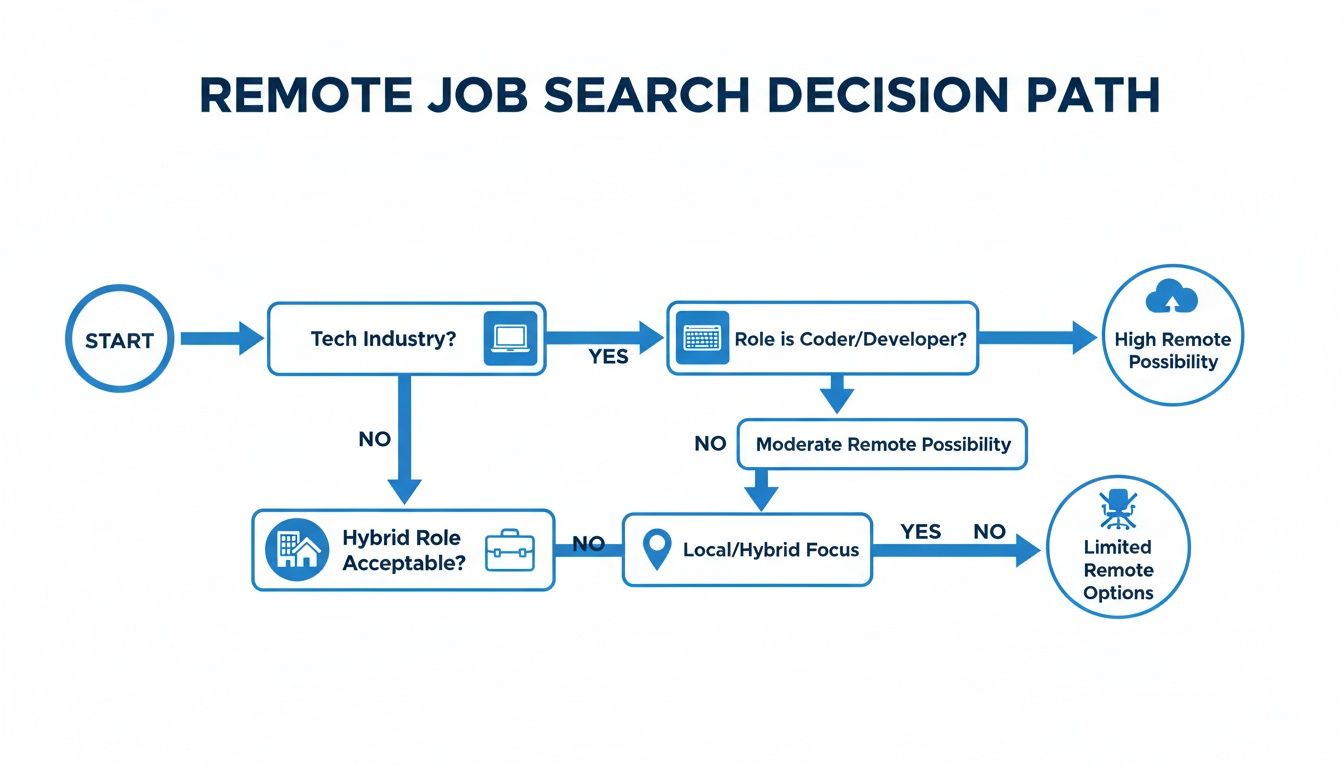
As you can see, your industry and whether you're aiming for fully remote or hybrid work should really guide where you spend your time.
How to Spot and Avoid Job Scams
Unfortunately, the boom in remote work has brought a boom in sophisticated job scams. A healthy dose of skepticism is your best defense.
A legitimate company will never ask you for money or sensitive financial details like your bank account number during the application or interview process. This is the biggest red flag you will ever see.
Be suspicious of any "employer" who creates a false sense of urgency or makes promises that are clearly too good to be true, like a massive salary for an entry-level role.
A Quick Vetting Checklist
Before you sink time into an application, run the opportunity through this quick mental checklist. A few minutes of due diligence now can save you hours of headaches later.
- Vague Job Descriptions: Real jobs have clear responsibilities. Scams often use generic, fluffy language that could describe almost anything.
- Unprofessional Communication: Are the emails coming from a personal address (@gmail.com) instead of a company domain? Is the message riddled with typos and grammar mistakes? Big warning signs.
- They Ask for Money: If they ask you to provide bank details, credit card numbers, or buy your own equipment with a promise to reimburse you, it's a scam. Full stop.
- The Interview Process Feels Off: Did they offer you the job after a brief text exchange without ever hopping on a video call? Real companies have a structured hiring process that involves talking to real people.
By combining a targeted search with careful vetting, you stop playing the lottery and start running a structured, effective campaign. You’ll be focusing your energy where it counts: on genuine opportunities with great companies that truly value their remote teams.
Making Your Application Stand Out in a Remote World

When you’re going for a remote job, your resume and cover letter do more than just list your skills—they’re your first and best ambassadors. They have to prove you can thrive on your own, without a manager looking over your shoulder.
A generic, one-size-fits-all application just gets lost in the noise. To stand out, you need to show a hiring manager you have the chops for distributed work. This means highlighting your knack for clear written communication, your self-discipline, and your ability to collaborate with people you only see on a screen.
Showcasing Your Remote-Ready Skills
Hiring managers for remote positions are hunting for specific qualities that go beyond your technical skills. Your job is to make those qualities impossible to ignore.
Think of it as looking at your past experience through a new lens—a remote work lens.
- Asynchronous Communication: Talk about how you keep projects moving forward with clear, concise updates without constant meetings. Did you rely on project management tools or detailed email threads? Mention that.
- Proactive Problem-Solving: Point to times you spotted a problem and fixed it without being told. This is gold to remote employers because it shows true autonomy.
- Time Management & Self-Discipline: Highlight projects you owned from start to finish, hitting every deadline along the way. This is concrete proof that you can manage your own time effectively.
This isn’t about making things up. It’s about reframing what you’ve already accomplished to speak directly to the demands of a remote role.
Instead of saying, "Responsible for team projects," try something like this: "Independently managed a 3-month project, coordinating with a 5-person team across different departments using Asana and Slack to ensure all milestones were met 10% ahead of schedule."
See the difference? The second version is packed with proof. It names the tools, quantifies the success, and practically shouts, "I'm a responsible self-starter."
Weaving Remote-Friendly Language into Your Resume
Every inch of your resume is valuable real estate, so make every bullet point count. A great place to start is by sprinkling in the names of the tools and platforms that make remote work possible.
Do you spend your day in Slack? Are you a pro at organizing Trello boards or navigating Jira tickets? These aren't just minor details; they're hard evidence that you’re fluent in the language of remote work. For a much deeper dive, our guide to building resumes for remote jobs is loaded with more examples and frameworks.
Your LinkedIn headline is another powerful tool. A well-crafted one can instantly flag you as an ideal remote candidate.
This headline, for example, is effective because it immediately signals a specialization in remote team leadership and names specific, relevant technologies. It gives recruiters everything they need to know at a single glance.
Don’t Sleep on the Cover Letter
A lot of people treat cover letters as an afterthought, but for a remote job search, they're a secret weapon. This is your chance to connect the dots and tell the story your resume can't.
Use your cover letter to speak directly to the unique challenges and benefits of working remotely. Show that you get it—that you understand what it takes to succeed without a shared office. This demonstrates a level of self-awareness that hiring managers love.
A simple structure like this works wonders:
- The Hook: State the remote role you want and share your genuine excitement for the company’s work.
- The Proof: Connect your top skills to the job description, pulling one or two key achievements from your resume.
- The Remote Showcase: This is crucial. Dedicate a paragraph to how you’ve thrived in autonomous roles or on distributed teams before. Talk about your communication style and the collaboration tools you prefer.
- The Close: Reiterate your interest and propose a clear next step, like scheduling a video call to chat further.
Following this approach turns your cover letter from a boring summary into a powerful argument for why you’re the perfect person for the job. By tailoring every piece of your application to the realities of remote work, you give yourself a massive advantage.
Acing Your Remote Interview and Negotiation

The remote interview is where all your hard work pays off. This isn't just a Q&A about your skills; it's a real-time audition to see if you can be a productive, connected member of a distributed team. Success really boils down to two things: nailing the technical setup and mastering the human element of a video call.
You have to show them you’re a polished professional who is completely at home in a digital-first environment. That means treating this video call with the same seriousness you would an in-person meeting, right down to the details.
Mastering the Video Interview
Your interview space sends a powerful message before you even say a word. Think about it: a messy, distracting background can suggest a lack of professionalism, while a clean, quiet space shows you're serious and organized.
Your main goal here is to stamp out any potential distractions—both for you and for the interviewer.
- Test Your Tech: At least a day beforehand, do a full run-through. Test your camera, microphone, and the specific video platform the company uses (Zoom, Google Meet, etc.). A last-minute tech scramble is a terrible first impression.
- Set the Scene: Pick a spot with a simple, neutral background. A clean wall or a tidy bookshelf works perfectly. A big mistake is sitting with a window directly behind you, which will turn you into a dark silhouette.
- Look the Part: Dress exactly as you would for an in-office interview. It’s not just for them; it puts you in a professional headspace and shows you respect their time.
- Manage Your Environment: This is critical. Make sure you won't be interrupted. Let family or roommates know your schedule, and if you have pets, put them in another room for the duration of the call.
These small preparations aren't just for show; they make a huge difference in how you're perceived and how confident you feel.
Answering Remote-Specific Questions
Interviewers hiring for remote roles are looking for specific traits. They need to know you have the self-discipline, communication chops, and autonomy to get things done without someone looking over your shoulder.
So, expect questions designed to test your remote readiness. You'll likely hear things like, "How do you stay motivated when working alone?" or "Describe a time a miscommunication happened with a colleague over Slack. How did you fix it?"
Your answers should always be grounded in concrete examples. Instead of just saying, "I'm a great communicator," describe a system you actually used. For instance, talk about how you sent daily progress summaries on a past project to keep everyone aligned.
This approach gives them tangible proof of your abilities, not just empty claims.
Navigating the Remote Negotiation
Once that offer comes through, the conversation shifts. For remote jobs, negotiation is about much more than just the salary. You need to get crystal clear on the total compensation package and the company's real expectations for its remote workforce.
The jump to remote work has been a massive structural change. By 2025, it’s estimated that 48% of the global workforce will be working remotely at least some of the time—a huge leap from just 20% in 2020. This shift means more companies now have structured policies for their distributed teams, which you can learn more about in this data-backed report on the durable reconfiguration of the modern workforce on yomly.com.
When you get to the negotiating table, think about the full picture:
- Salary and Location: Be ready to discuss your salary expectations. Some companies adjust pay based on your cost of living, while others have a single pay scale for everyone, no matter where they are. Find out their policy and do your homework on market rates for your role and location.
- Home Office Stipend: This is becoming standard. Many remote-first companies offer a stipend to help you set up an effective home office. This can cover things like a good ergonomic chair, a desk, or an internet upgrade. It’s a common perk, so don’t be afraid to ask.
- Flexible Hours: "Remote" doesn't automatically mean "flexible." You need to clarify the company’s core working hours and expectations for when you need to be online. If you need a specific schedule, this is the time to bring it up.
- Benefits and Perks: Dig into the benefits that are especially valuable for remote employees. Ask about things like health and wellness allowances, co-working space memberships, or budgets for professional development.
Approaching the negotiation with these kinds of thoughtful questions shows you’re thinking like a long-term, committed employee. Nail both the interview and the negotiation, and you won’t just look like a qualified candidate—you'll look like a strategic partner ready to hit the ground running.
Thriving in Your First 90 Days as a Remote Employee
Getting the job offer is a massive win, but don't pop the champagne just yet. The real work starts now. Your first 90 days in a new remote role are your chance to prove you were the right hire and set the stage for a successful, long-term career with the company.
This isn't about being perfect from day one. It's about being proactive, asking the right questions, and intentionally building connections when you can't just bump into people at the coffee machine. Think of it as your foundation-building period.
The First 30 Days: Learn and Connect
Your first month is going to feel like drinking from a firehose. New tools, new processes, new names and faces. Your main job isn't to be a superstar performer—it's to be a sponge. Absorb everything you can about the company's culture, your team's rhythm, and the specifics of your new role.
A great first move is to schedule quick, 15-minute introductory video calls with everyone on your immediate team. Keep it casual. The goal isn't to talk shop; it's to get to know them. Ask what they do, what they love about the company, and if they have any tips for someone just starting. This small effort builds a surprising amount of goodwill.
Next, dive into the company's internal documentation. Seriously. Great remote companies run on their wikis and guides. This is where you'll find the answers to most of your questions and start to understand the "unwritten rules" of how things get done.
Your manager is your most important ally during this time. Get on the same page early. Ask them to help you define what success looks like for your first month, with clear, measurable goals. This gives both of you a shared benchmark for your progress.
Once you land a remote role, it's also smart to understand what your manager is looking for. Getting familiar with the best practices for managing remote teams gives you a peek behind the curtain, helping you align your efforts with their expectations right from the start.
The Next 30 Days: Contribute and Collaborate
Okay, you've got your bearings. Month two is when you pivot from just learning to actively contributing. It’s time to start taking ownership of smaller tasks and looking for places where you can add real value. This is how you start building trust and showing your team what you can do.
Look for a small, low-risk project you can volunteer for. Or maybe you see a teammate who’s buried in work—offer to help. This kind of initiative speaks volumes in a remote setting and shows you're a team player, not just an island.
Remember, visibility is everything when you're remote. Out of sight can quickly become out of mind.
- Share Proactive Updates: Don’t wait to be asked. Post clear progress updates in your team's Slack channel or project management tool.
- Speak Up in Meetings: Don't just be a face in a box. Show up prepared with a question or an idea to share.
- Communicate Your Wins: Finished a tricky task or solved a nagging problem? Share it with the team. It’s not about bragging; it’s about communicating your impact.
This kind of proactive communication is your way of saying, "Hey, I'm here and I'm getting things done," without anyone having to look over your shoulder.
The Final 30 Days: Optimize and Grow
By the time you hit the 90-day mark, you should feel much more settled and be working with a good degree of autonomy. This final stretch of your onboarding is about fine-tuning your process, getting feedback, and starting to think about your future at the company.
Don't wait for your formal review—ask your manager for a feedback session. Be direct. Ask what's going well and where you can improve. This shows you're serious about your growth and committed to the role.
This is also the perfect time to optimize your personal setup for the long haul.
- Refine Your Workspace: Is your chair actually comfortable for 8 hours a day? Is your internet connection solid? Make the tweaks now to create a sustainable, productive home office.
- Solidify Your Boundaries: Are you logging off at a reasonable time? Set and stick to clear start and end times to avoid burnout, which is a real risk in remote work.
- Build Your Network: Start reaching out to colleagues in other departments. Understanding how your work fits into the bigger company picture is crucial for making a strategic impact later on.
By the end of your first three months, you should feel less like the "new hire" and more like a true part of the team. A structured approach like this is the best way to get there.
To help you stay on track, I've put together a simple checklist for your first 30, 60, and 90 days. Think of it as a roadmap to help you navigate your onboarding and make a great impression.
Remote Onboarding Success Checklist
| Timeframe | Key Action | Goal |
|---|---|---|
| First 30 Days | Schedule 1:1s with all team members & key stakeholders. | Build personal connections and understand team dynamics. |
| First 30 Days | Master the core tools (Slack, Asana, etc.) and read all documentation. | Become self-sufficient and reduce dependency on others for basics. |
| First 30 Days | Clarify 30-day goals and expectations with your manager. | Align on what a successful first month looks like. |
| Next 30 Days | Volunteer for a small, low-risk project or task. | Demonstrate initiative and start contributing tangible value. |
| Next 30 Days | Proactively communicate progress and wins in public channels. | Increase visibility and build trust with your manager and team. |
| Next 30 Days | Contribute at least one idea or thoughtful question in a team meeting. | Establish yourself as an engaged and active participant. |
| Final 30 Days | Proactively schedule a feedback session with your manager. | Show commitment to growth and identify areas for improvement. |
| Final 30 Days | Optimize your home office setup and work-life boundaries. | Create a sustainable and healthy long-term remote work routine. |
| Final 30 Days | Connect with at least one person outside your immediate team. | Begin building a broader internal network within the company. |
Following these steps will help you move from being an outsider to becoming a trusted, essential member of the team. You've got this
Got Questions About Finding a Remote Job?
Let's be honest, searching for a remote job comes with its own unique set of head-scratchers. It’s totally normal to wonder about things like juggling time zones or how your zip code might impact your paycheck. Getting these questions answered upfront will not only boost your confidence but make your entire search a lot smoother.
Here, we'll walk through some of the most common uncertainties that pop up when you're hunting for a job that isn't tied to an office.
How Do I Handle Time Zone Differences?
This is a big one, and the best policy is clarity from the get-go. A simple trick is to add your time zone right next to your location on your resume and LinkedIn profile—something like "Denver, CO (MST)". This small detail immediately gives recruiters the context they need.
When you're actually applying, read the job description carefully. Many companies will list required time zones or specify core working hours. If they’re looking for someone to work 9 AM to 5 PM CET and you're on the West Coast of the US, it’s probably not the right fit unless the role is clearly marked as asynchronous.
Be ready to talk about this in an interview. You can show you're proactive by saying something like, "I see the team is based in New York. I'm in the Mountain time zone, and I'm an early riser, so overlapping with your core hours won't be an issue."
Should My Salary Expectations Change Based on Location?
The short answer? It completely depends on the company's philosophy on pay. This is something you absolutely have to ask about during the interview process.
Some companies, often startups or tech firms, have a single pay scale. A software developer in rural Nebraska earns the same as one in New York City. It's straightforward and location-agnostic.
But the more common model is location-based pay, where your salary is adjusted for the cost of living where you are. There's no right or wrong approach, but you need to know which system a potential employer uses. Use salary research tools to see what your role typically pays in your specific city, so you walk into the negotiation with real data.
Don't guess a company's pay strategy. Just ask them directly. A simple, professional question like, "Could you tell me a bit about your compensation philosophy? Are salaries adjusted based on location?" shows you're thinking ahead.
What Should I Ask About a Company’s Remote Culture?
In a remote environment, company culture isn't just a buzzword—it's everything. A bad remote culture can feel incredibly isolating, while a great one makes you feel connected and motivated, even from miles away. You need to be a detective during your interviews.
Ditch the generic questions. Asking "What's the culture like?" will just get you a canned, rehearsed answer. Instead, try digging deeper with more specific questions that reveal how they really operate:
- How do you help the team build genuine connections when you're not seeing each other in person?
- What does the onboarding process look like for a new remote hire in their first 30 days?
- How do you make sure remote employees have the same visibility and opportunities for promotion?
- What's your team's approach to communication? Is it mostly real-time chat, or do you lean on asynchronous tools?
Their answers—or lack thereof—will tell you all you need to know. A truly great remote company has already thought through these challenges and will have detailed, impressive answers ready to go.
Finding a company that has already mastered remote work is the key to a great experience. RemoteWeek only lists jobs from companies with proven track records of high employee satisfaction, so you can skip the guesswork. Start your search for a better remote job today.