
Resumes for Remote Jobs That Actually Get Noticed

Landing a remote job isn't just about having the right skills; it's about proving you can thrive without someone looking over your shoulder. Your resume needs to do the heavy lifting, showcasing your tech-savviness, self-discipline, and ability to communicate clearly when you're not in the same room. It’s a completely different ballgame than writing a resume for an in-office role.
Rethinking Your Resume for a Remote-First World
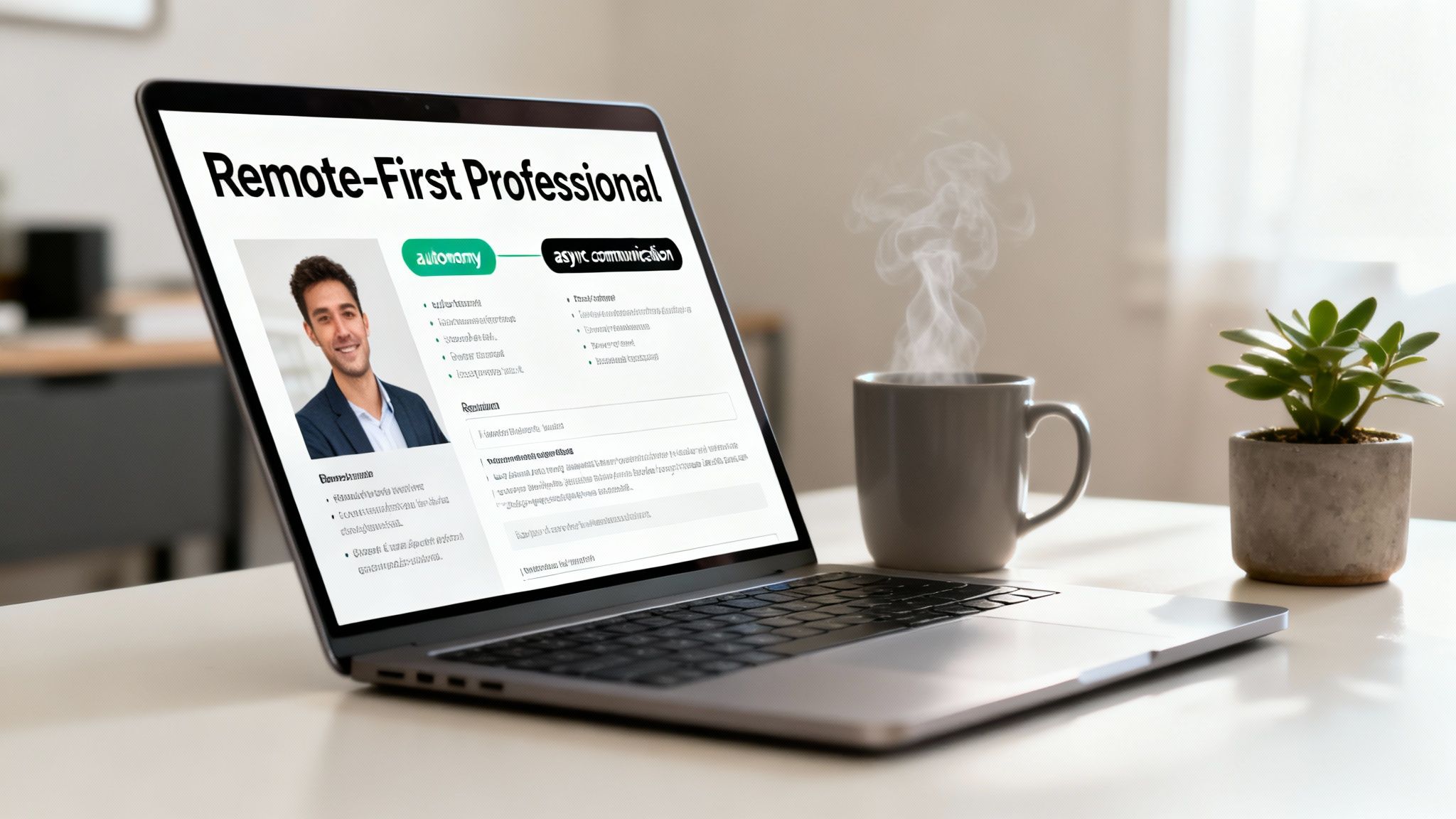
Time to forget the old rules of resume writing. When your first impression is entirely digital, your resume has to be more than a dry list of past jobs—it has to tell a story. The story is that you're a self-starter who excels in a distributed environment.
Simply adding the word "remote" to your skills section won't cut it. This is about a fundamental shift in how you frame your entire career. Remote-first companies are looking at candidates through a unique lens, and they prioritize qualities that are non-negotiable for a successful distributed team.
"Candidates who mention managing deadlines autonomously, organizing and prioritizing their own workload, or using tools like Asana, Trello, or Notion to track productivity stand out."
So, what are these companies really looking for? They're digging for clues that prove you have the specific traits needed to succeed from a home office, a coffee shop, or halfway across the world.
The Remote-First Mindset
Think of your resume as an advertisement for your remote work ethic. It needs to preemptively answer the hiring manager's biggest questions: Can this person manage their own time? Are they a proactive communicator? Do they know their way around the tools we use to collaborate?
To get this right, you need to weave in evidence of:
- Autonomy and Self-Management: Talk about projects you owned from start to finish with minimal hand-holding.
- Tech Fluency: Show, don't just tell. Mention the specific collaboration tools you're proficient in, like Slack, Asana, Jira, or Microsoft Teams.
- Asynchronous Communication: Give concrete examples of how you used clear documentation or written updates to keep teammates in the loop across different time zones.
- Proactive Problem-Solving: Describe a time you spotted a problem, took initiative, and solved it on your own.
And remember, your resume is just one piece of the puzzle. It’s critical to understand the impact of your digital footprint on job opportunities, because you can bet they’ll look you up online. Your online brand, especially on LinkedIn, needs to back up the story you're telling.
Make sure everything is aligned. For more on this, our guide on how to optimize your LinkedIn profile at https://www.remoteweek.io/blog/how-to-optimize-linkedin-profile can help you create that cohesive professional image.
Building a resume that speaks this language from the very first line is your ticket to getting noticed. Let's break down exactly how to build a document that screams "I'm ready for remote work."
Getting Past the Robots with Smart Keyword Optimization
Before your resume ever lands in front of a human, it has to get past the digital gatekeeper: the Applicant Tracking System (ATS). I've seen countless qualified candidates get screened out simply because their resume wasn't speaking the right language for these automated systems.
It can feel like you're just guessing what the machine wants to see, but there's a reliable strategy here. It’s not about keyword-stuffing; it’s about thoughtfully mirroring the language in the job description you're actually applying for.
And for remote jobs, this is non-negotiable. Remote postings often get 2.5 times more applications than in-office roles, so recruiters lean heavily on the ATS to manage the sheer volume. Your first audience is a robot, so you need to write for it.
Decoding the Job Description for Keywords
Think of the job description as your cheat sheet. The company is literally telling you what they're looking for. Your job is to listen.
I always tell my clients to start by dissecting the "Responsibilities" and "Qualifications" sections. Go through them with a fine-tooth comb and pull out any recurring words or phrases. You're hunting for specific skills, software, and terms related to remote work.
- Hard Skills and Tools: What specific platforms are they calling out? Look for names like Asana, Jira, Slack, or Notion.
- Soft Skills: What language do they use to describe the ideal remote employee? You'll probably see phrases like "asynchronous communication," "self-motivated," "time management," or "virtual collaboration."
- Company-Specific Jargon: Do they use unique terms? Maybe they call themselves a "distributed team" or a "remote-first environment." Write those down.
You're not just guessing what might be important. You're building a targeted list of the exact vocabulary the ATS is programmed to find. This is about being systematic, not psychic.
Once you have this list, the real work begins. Don't just dump them into a skills section at the bottom of your resume—that’s a rookie mistake. You need to weave them naturally into the narrative of your professional experience.
Weaving Keywords into Your Experience
The best place to embed these keywords is within your achievement-focused bullet points. This does double duty: it satisfies the ATS bots and shows the human hiring manager how you've actually applied those skills.
Let's walk through a quick before-and-after for a project manager position.
Before:
- Responsible for managing team projects and deadlines.
This is okay, but it’s generic. It could describe almost any project manager.
After:
- Managed a fully distributed team using Asana to track project milestones, ensuring clear asynchronous communication across multiple time zones.
See the difference? The second version is packed with value. It hits on crucial keywords ("distributed team," "asynchronous communication") and a specific tool ("Asana"). It’s instantly more compelling and far more likely to get flagged as a match by the ATS.
To be absolutely sure your resume is formatted correctly and won't get garbled by the machine, it's always a good idea to run it through an ATS resume checker. It gives you that final piece of mind before you hit "submit."
How to Structure Your Resume to Prove Remote Readiness
Your resume's layout is your first chance to prove you’re organized and clear-minded—two skills that are absolutely essential for any remote role. A messy, confusing resume can immediately signal that you might struggle with the kind of clear, asynchronous communication that makes remote teams work. We need to build a framework that instantly tells a hiring manager you’re a top-tier remote candidate.
This isn’t just about listing your jobs from oldest to newest. It’s about being strategic, placing the most important information where it will have the biggest impact. The whole point is to guide a recruiter’s eye to the exact evidence that proves your remote readiness in just a few seconds.
Start With a Punchy Professional Summary
Ditch the old-school, generic objective statements. Your professional summary is the most valuable real estate at the top of your resume. Think of it as your three-to-four-sentence elevator pitch, and it needs to scream "remote-ready."
Lead with your years of experience, but immediately pivot to your remote work background. Saying you have 4+ years of experience in fully distributed environments is so much more powerful than just stating your job title. This is also the perfect spot to sprinkle in high-level keywords like "asynchronous collaboration" or "virtual team leadership."
Pro Tip: Your summary is the trailer for your career movie. Keep it concise, highlight the most exciting parts (your remote skills and biggest wins), and make the reader want to stick around for the full story.
Once your summary is locked in, you need to create dedicated sections that make your remote capabilities impossible to miss. This is where you go beyond the standard resume format and build something that’s genuinely tailored for the roles you're after.
Create a Dedicated Remote Tech Stack Section
Hiring managers for remote roles need to know you can hit the ground running with their tools. Don't bury your software skills at the bottom of the page. Instead, create a distinct section right up top called something like "Remote Collaboration & Tech Stack."
This move does two things at once: it makes your technical skills instantly scannable and shows you understand which tools are critical for distributed teams.
I always recommend organizing this section into logical categories. It just looks more professional.
- Project Management: Asana, Trello, Jira, Notion
- Communication: Slack, Microsoft Teams, Zoom
- Document Collaboration: Google Workspace, Confluence, Dropbox
This simple structure proves you’re not just listing every piece of software you’ve ever touched. It shows you have a deep understanding of the remote work ecosystem. It's a subtle but incredibly powerful way to demonstrate your fluency.
Traditional Resume vs Remote-Optimized Resume
Adapting your resume for remote work isn't about starting from scratch. It's about shifting the focus. You need to take the standard sections and re-angle them to highlight the skills and experiences that matter most in a distributed setting. Here's a quick comparison to show you what I mean.
| Resume Section | Traditional Focus | Remote-Optimized Focus |
|---|---|---|
| Professional Summary | General career goals and experience. | Remote-specific experience, key tech skills, and autonomous work habits. |
| Experience | Duties and responsibilities of the role. | Quantifiable achievements driven by self-management and collaboration tools. |
| Skills Section | Broad list of technical and soft skills. | A dedicated "Remote Tech Stack" with categories for collaboration, PM, etc. |
| Education/Certs | Degrees and standard professional certifications. | Includes remote-work-specific certifications (e.g., remote project management). |
As you can see, the core components are the same. The difference is in the details—the language you use and the achievements you choose to emphasize. It’s all about explicitly connecting your background to the unique demands of working from anywhere.
Reframe Your Experience With the STAR Method
When you get to describing your past roles, remember that every bullet point is an opportunity to provide concrete proof of your remote competence. The STAR method (Situation, Task, Action, Result) is a fantastic framework for this, but for remote roles, it needs a little twist.
For each accomplishment, frame it through the lens of working independently or with a distributed team. Did you manage a project across multiple time zones? Did you use a specific tool to boost team efficiency by 15%? Did you solve a complex problem without any direct supervision?
The key is to always tie your actions back to quantifiable results. That's a core principle of good resume writing for any job, but it’s doubly important for remote positions where managers value proven outcomes over perceived effort. This process is all about identifying what matters, weaving it into your story, and backing it up with numbers.
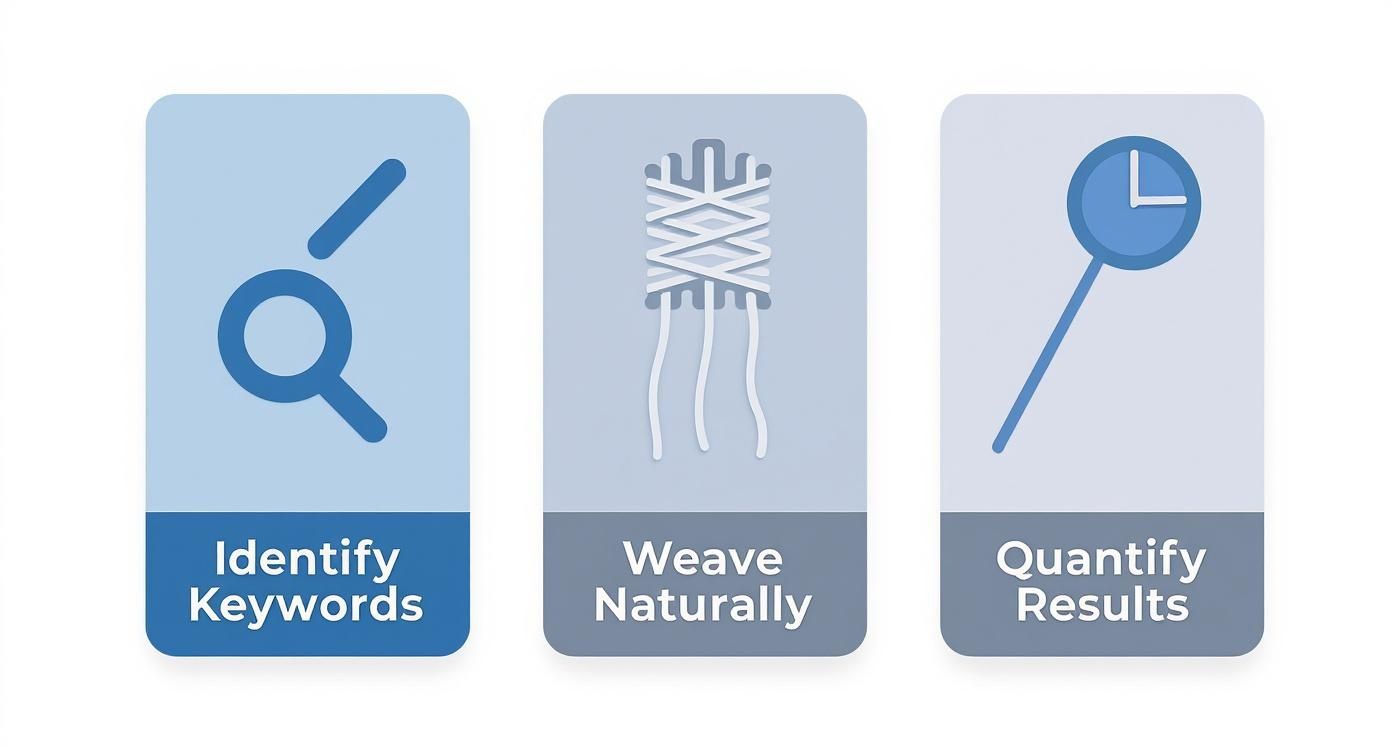
This really brings it home: proving your value isn't just about listing keywords. It's about connecting them to measurable outcomes that a hiring manager can immediately understand and appreciate.
Demonstrating the Soft Skills That Matter Most
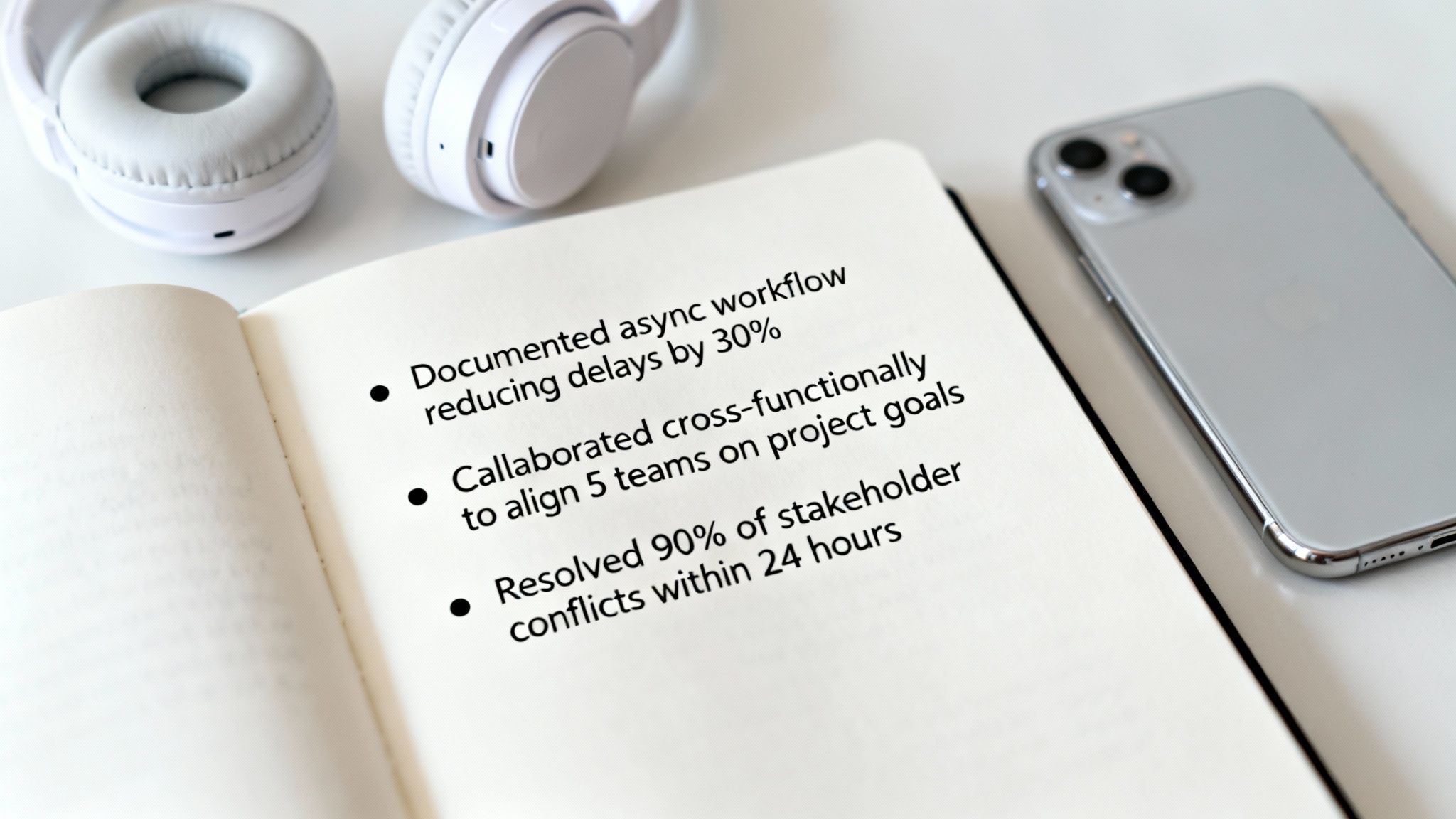
When you're working remotely, skills like communication, autonomy, and time management aren't just a bonus—they're the glue holding the entire operation together. Anyone can slap "strong communicator" on their resume, but a seasoned remote hiring manager has seen that a thousand times. They're looking for proof.
They need to see evidence that you can be trusted to deliver high-quality work without someone constantly looking over your shoulder. Your job is to translate these abstract qualities into tangible achievements. You need to shift from listing responsibilities to showcasing results that happened specifically because you’re a proactive, self-sufficient professional.
Proving Your Proactive Communication
Great remote teams run on clear, intentional communication. A lot of it is written and asynchronous, which means you have to be deliberate. The goal is to show you’re not just responsive but that you actively take the lead in keeping everyone on the same page, even when you're scattered across time zones.
Don't just say you "participated in team meetings." Instead, describe how you facilitated them. Did you set the agenda? Did you document key decisions and follow up on action items to make sure nothing fell through the cracks? These are the details that turn a bland claim into a compelling story.
Here’s what I mean:
- Weak Example: Good communication skills.
- Strong Example: Proactively managed project communications for a distributed team using Slack and Asana, resulting in a 15% reduction in missed deadlines by ensuring all stakeholders were consistently informed of progress and potential blockers.
Showcasing Self-Discipline and Time Management
Without the built-in structure of an office, your ability to manage your own time is everything. A hiring manager needs to feel confident you can stay productive and hit your deadlines without direct supervision. The only way to build that trust is with a solid track record.
Think back to a time you were juggling multiple high-stakes projects. How did you stay organized? Did you use a particular system or tool to keep things on track? That's the gold you want to put on your resume.
A common mistake is just listing "time management" in your skills section. To really stand out, you have to connect that skill to a measurable business outcome. Show them how your talent for organizing and prioritizing directly contributed to a project's success.
For example, instead of a vague statement like "managed multiple projects," get specific. Quantify how your organizational skills made a real difference, like finishing a project ahead of schedule or under budget. Our guide on the difference between remote work skills or qualities can help you dig deeper into which traits to highlight.
Turning Experience into Evidence
Let’s get practical. The real trick is to reframe your past actions into compelling proof that you're built for remote work. Don't just list a skill; illustrate it with a mini-story condensed into a powerful bullet point.
Here are a few before-and-after examples to get your gears turning:
| Soft Skill | Generic Bullet Point | Remote-Optimized Bullet Point |
|---|---|---|
| Problem-Solving | Resolved customer issues. | Independently identified and troubleshooted a recurring software bug, documenting the solution in our shared Confluence space to reduce future support tickets by 20%. |
| Adaptability | Learned new software quickly. | Rapidly onboarded to a new project management system (Jira) and trained two team members, ensuring a seamless project transition with zero downtime. |
| Collaboration | Worked with the marketing team. | Collaborated asynchronously with a global marketing team to launch a multi-channel campaign, coordinating efforts across three time zones to achieve a 30% increase in lead generation. |
See the difference? Each optimized example provides a mini-case study of that skill in action. This approach doesn't just tell them you have the skill—it proves your value and paints a clear picture of exactly how you’ll contribute to their team from day one.
Costly Mistakes That Get Your Remote Resume Ignored
https://www.youtube.com/embed/pjqi_M3SPwY
You've done the hard work of building your remote resume—you’ve highlighted your best skills and woven in the right keywords. The last thing you want is a simple, easy-to-avoid mistake to land your application in the 'no' pile.
Think of this as your final pre-flight check. In the race for top remote jobs, even tiny errors can disqualify you. Let's walk through the common pitfalls I see all the time so you can steer clear of them.
Sending a One-Size-Fits-All Resume
This is, without a doubt, the cardinal sin of job applications. Firing off the same generic resume for every single opening is a surefire way to get ignored. Trust me, recruiters can spot a boilerplate application from a mile away, and it screams, "I'm not that interested."
A resume tailored to the role, however, immediately tells a different story. It shows you've actually read the job description and taken the time to connect your specific experience to their specific needs. That’s how you signal you’re a serious candidate.
Forgetting to Quantify Your Wins
Just listing your past duties is not enough. A resume that says "managed projects" or "improved processes" is vague and forgettable. Recruiters aren't looking for what you did; they're looking for the impact you made.
Numbers cut through the noise. Instead of "improved efficiency," try "streamlined a workflow using Asana, which reduced project completion time by 20%." Quantifying your achievements provides hard proof that you deliver real value, which is exactly what a manager wants to see in a remote hire.
Failing to include metrics is a massive missed opportunity. It forces a recruiter to guess your impact, and they simply don't have time for that. Strong, data-backed bullet points make their decision easy.
Including Your Full Physical Address
This is an old-school practice that can actually hurt your chances, especially for remote-first roles. Listing your full street address is not only a privacy risk but can also trigger unconscious bias about your location—even when the job is fully remote.
The modern approach? Just list your city and state (and country, if you're applying internationally). It gives them all the location context they need without opening the door to irrelevant judgments.
Being Vague About Your Tech Stack
Don’t make the hiring manager guess what you mean by “proficient in project management software.” Remote teams live and breathe inside their tools, and they need to know you can hit the ground running with their specific tech stack.
- Be Specific: Name the actual tools. Instead of a general category, list Jira, Trello, Slack, or Notion.
- Provide Context: You get bonus points for briefly mentioning how you used a tool to achieve something.
Leaving out your specific software skills is like hiding one of your best cards. It's one of the quickest ways a recruiter can confirm you have the practical, hands-on experience to slide right into their remote workflow.
Answering Your Top Questions About Remote Resumes
Crafting the perfect remote resume always brings up a few common questions. Let's tackle some of the ones I hear most often from job seekers trying to land their first (or next) remote role.
Should I List My Location?
Yes, but you don't need to give them your full street address. That's an old-school practice and, frankly, a bit of a privacy risk.
All a recruiter really needs is your City, State, and Country. This gives them crucial context for time zones and any potential regional hiring requirements without oversharing. It’s a small detail that shows you're thinking about the practical side of working on a distributed team.
How Do I Frame My Experience If I've Never Officially Worked Remotely?
This is a big one, but don't worry—you probably have more "remote-adjacent" experience than you realize. The trick is to reframe your past work to highlight the skills that matter in a remote setting.
Think back to times when you had to work like a remote employee, even if you were in an office.
- Cross-Office Collaboration: Did you ever work on a project with people from another office or even just a different floor? Talk about how you used Slack, email, or video calls to stay aligned.
- Autonomous Projects: Describe a time you were handed a major project and managed it from start to finish with very little hand-holding. That’s pure remote-work gold.
- Freelance or Side Gigs: Any work you've done as an independent contractor or freelancer is a perfect demonstration of your ability to manage your own time and deliver results without a boss looking over your shoulder.
It's all about connecting the dots for the hiring manager. You're showing them you already have the self-discipline and communication skills to succeed, no matter where your desk is.
Your goal isn't to pretend you've had a remote job before. It's to prove that your past experiences have already equipped you with the foundational skills needed to excel without the structure of a physical office.
Is a Cover Letter Still Necessary for Remote Applications?
More than necessary—it’s critical. For remote jobs, I’d argue the cover letter is even more important than for in-office roles. It's your first and best chance to show off your personality and, most importantly, your written communication skills.
In a remote environment, so much of your interaction is text-based. A clear, compelling cover letter immediately demonstrates that you can communicate effectively in writing. Use this space to directly address why you're passionate about working remotely and what makes you a great fit for a distributed team. Our guide on how to write effective emails has some great pointers that apply here, too.
Ready to find a remote job at a company that truly values its employees? RemoteWeek curates high-quality remote roles at top-rated tech companies. Start your search today!