
Working Remotely Abroad A Practical Guide to Visas and Taxes

Working from anywhere in the world isn't some far-off dream anymore. For millions, it's a reality, thanks to a huge shift in how we think about work and the tech that backs it up. It’s all about taking your job on the road, mixing your professional life with the incredible experience of living in a new country.
The New Era of Working From Anywhere
The whole idea of an "office" has been turned on its head. What used to be a lifestyle for a select few is now a common career choice, driven by a global push for better work-life balance and the tools to make it happen. This isn't just a fleeting trend—it’s a permanent change in how we view our careers.
Think about it: before 2020, only around 7% of U.S. workers were fully remote. That number shot up to a staggering 42% by the middle of that year. Now, as we look towards 2025, it’s settled at a solid 22% of the workforce, which translates to over 32.6 million Americans. This isn't just a coincidence; it's powered by reliable internet, great collaboration software, and a deep-seated desire for more freedom in our lives. You can discover more insights about these remote work projections and see just how much the workforce is changing.
This guide is your step-by-step playbook for making your work-abroad plan a reality. We'll walk you through the essentials, leaving no stone unturned.
Your Roadmap to Working Abroad
Pulling this off successfully comes down to smart preparation. From sorting out the legal stuff to making sure your finances are in order and your productivity is on point, every piece of the puzzle matters. This guide is built to walk you through it all, so you can head out with confidence.
Basically, you can think of the whole process in three main stages: getting the legal side sorted, organizing your money, and setting yourself up to actually get work done.
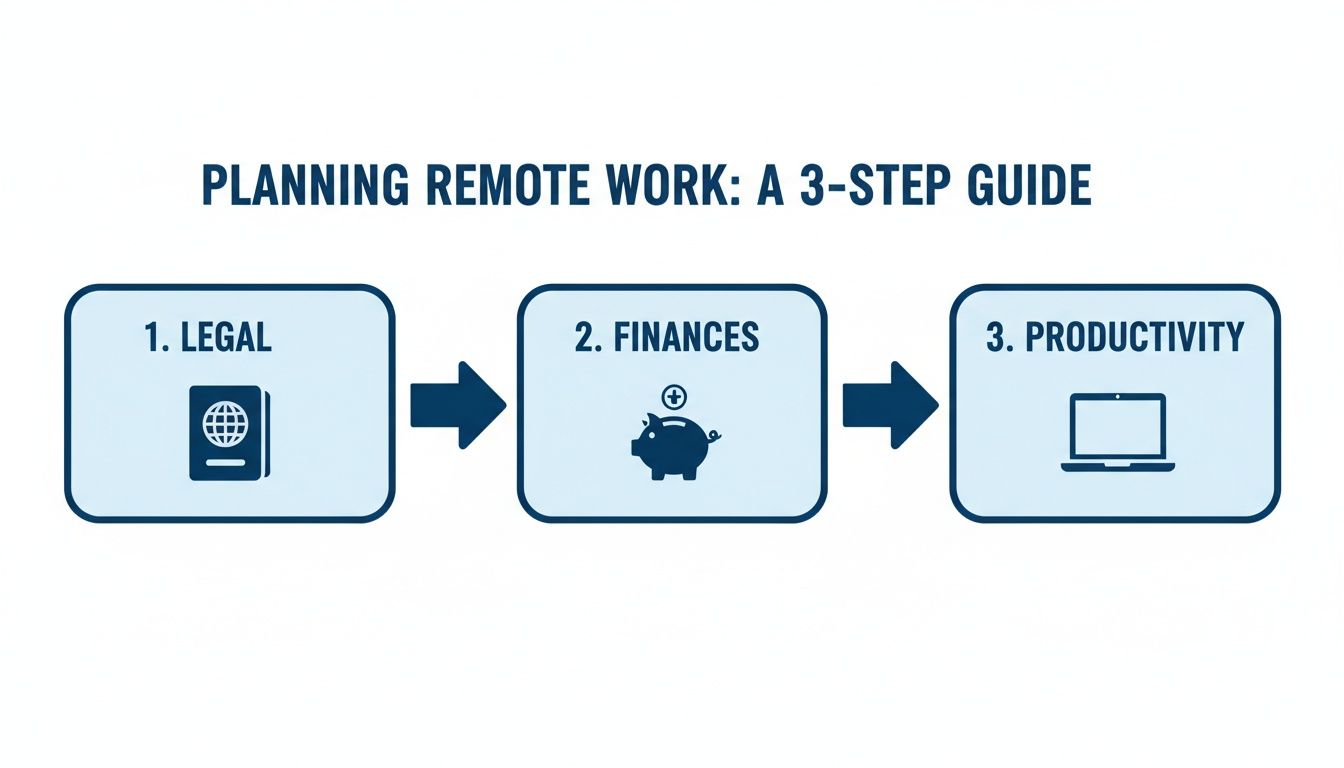
Breaking it down like this makes a big, intimidating goal feel much more manageable.
To give you a clearer picture of what's ahead, here's a quick look at the core areas we'll be covering.
Your Remote Work Abroad Planning Checklist
A quick overview of the essential pillars for planning your remote work adventure, giving you a clear snapshot of what this guide covers.
| Planning Area | Key Focus | Why It Matters for Success |
|---|---|---|
| Legal & Employer Approval | Visas, especially digital nomad visas, and getting official permission from your company. | Without the right paperwork and your boss's okay, your trip could end before it even begins. This is the foundation. |
| Finances & Tax Planning | Understanding tax residency, handling different currencies, and smart budgeting. | Mismanaging your money or taxes abroad can lead to huge headaches. Solid financial planning ensures your adventure is sustainable. |
| Productivity & Connectivity | Creating a reliable workspace with the right gear, securing fast internet, and managing time zones. | Your ability to perform your job effectively is non-negotiable. This is what separates a vacation from a viable work lifestyle. |
Tackling each of these areas thoughtfully is what turns a dream into a well-executed plan. This is how you go from just thinking about working from a cafe in Spain to actually doing it without a hitch.
Getting the Green Light: Visas and Employer Approval
Alright, you’ve done your initial research and the dream is starting to feel real. Now it’s time to tackle the two biggest hurdles: the legal paperwork and getting your boss on board.
These aren't just boxes to tick; they are the foundation of a successful, stress-free international work experience. Getting these right from the start makes all the difference.
First Things First: Understanding Your Visa Options
Let's be clear: working on a tourist visa is a huge gamble. It's often illegal and can land you in serious trouble, from fines to deportation. Don't risk it.
The good news? The world is finally catching up. Countries are rolling out the red carpet for remote professionals with specialized visas. The rise of the digital nomad visa is a complete game-changer, giving you a clear legal path to live and work abroad for an extended period, usually one to two years.
By early 2025, more than 43 jurisdictions worldwide will offer some form of digital nomad or remote worker visa. It’s a clear sign that governments see remote talent as a major economic plus. You can find more details in the global digital nomad report on globalcitizensolutions.com.
These visas are designed for people like us, but they do have specific requirements. You’ll need to pull together a solid application package to prove you're a self-sufficient professional.
Common Digital Nomad Visa Requirements:
- Proof of Remote Work: This usually means an employment contract or client agreements that show your job isn't tied to a physical office.
- Income Threshold: Countries want to know you can support yourself. Portugal, for instance, requires around €3,280/month, while Costa Rica's threshold is $3,000/month.
- Health Insurance: You'll need proof of a comprehensive health plan that covers you in your destination country. This is non-negotiable.
- Clean Criminal Record: A standard background check is almost always part of the process.
Crafting the Perfect Pitch for Your Employer
Once you’ve got a handle on the visa situation, it’s time for the big conversation with your manager. The key here is to frame this not as a personal perk, but as a well-thought-out business proposal that benefits everyone.
Start by reminding them of your solid performance and track record. You've already proven you can work effectively from home—this is just a change of scenery. Your productivity isn't tied to your zip code, and you have the results to prove it.
Then, shift the focus to the company's upside. Explain how this opportunity will re-energize you, boosting your morale and long-term loyalty. A happy, engaged employee is a productive one, and retaining top talent saves the company a fortune in hiring and training costs.
The secret to getting a "yes" is to anticipate their concerns and have solutions ready before they even ask.
Proactive Solutions to Common Concerns:
- Security: "I will exclusively use the company VPN and adhere to all data security protocols, working only from secure, private networks."
- Time Zones: "I've mapped out my work schedule to ensure at least five hours of overlap with the team's core hours for seamless collaboration."
- Communication: "I propose daily check-ins on Slack and will maintain my current level of responsiveness to ensure I'm always connected."
- Legal & Tax: "I will be personally responsible for securing my visa and managing my own tax obligations, so there will be no administrative burden on the company."
Presenting this as a formal, documented plan shows you're serious. To add a layer of professionalism, you can suggest formalizing the arrangement. Our guide on creating a remote work policy template can help you build a solid framework for your proposal.
When you show you’ve thought through every angle, you transform a personal dream into a credible, low-risk business case. That’s how you get an enthusiastic "yes."
Managing Your Finances: Taxes and Banking

Let's talk about money. Getting your financial strategy sorted is one of the most critical parts of successfully working abroad. This isn't just about budgeting for sightseeing—it's about building a solid foundation so you can actually enjoy the experience without constant financial stress.
Navigating international banking and taxes can feel like a total maze at first, full of confusing rules and sneaky fees. But once you have the right tools and a bit of know-how, you can manage your money from anywhere with confidence. It all boils down to understanding your tax situation, picking the right bank accounts, and planning ahead.
Decoding Your Tax Obligations
Taxes are probably the least exciting part of this adventure, but you absolutely cannot ignore them. The single most important concept to get your head around is tax residency. This is what determines which country gets to tax your income.
Most countries base this on time. Spend more than 183 days in a place, and you'll likely be considered a tax resident. For instance, if you're an American working from a Lisbon apartment for eight months, Portugal might see you as a tax resident and expect you to pay taxes there. This can lead to a nightmare scenario called double taxation, where both your home country and your new host country demand a cut.
The good news is that most countries have double taxation treaties to prevent this very thing. These agreements spell out which country has the primary right to tax your income so you don't get hit twice.
I can't stress this enough: talk to a tax professional who specializes in expat taxes before you go. They can look at your specific plans and tell you exactly what to expect, potentially saving you thousands in a costly mistake.
As you set up your workspace, keep in mind that many of your expenses could be deductible. To learn more about what you can claim, check out our guide on work-from-home tax deductions.
Modern Banking for a Borderless Lifestyle
Your hometown bank probably isn't cut out for this lifestyle. Trying to use it abroad often means getting slammed with terrible exchange rates and sky-high international transfer fees. Every time you move money or make a purchase, you're paying a hidden penalty.
This is where modern fintech companies completely change the game. Services like Wise and Revolut are non-negotiable tools for any digital nomad.
These platforms are built for people who live and work across borders. They offer multi-currency accounts, letting you hold, manage, and send money in dozens of currencies from a single app. The real magic is in their transparent, low fees and real-time exchange rates, which will save you a small fortune over time.
Why a Fintech Account is a Must-Have:
- Multi-Currency Wallets: Hold your salary in USD, pay your rent in EUR, and have some GBP on hand for a weekend trip to London—all in one place.
- Dirt-Cheap Transfers: Say goodbye to the ridiculous fees traditional banks charge for sending money internationally.
- Real Exchange Rates: You get the actual mid-market rate you see on Google, not an inflated rate with a hidden markup.
- Linked Debit Cards: Spend directly from your foreign currency balance with a debit card, avoiding conversion fees at cafes, shops, and ATMs.
Getting an account set up is usually a quick online process. Honestly, this is one of the easiest and most impactful steps you can take to protect your income from being eaten up by unnecessary bank fees.
Budgeting and Financial Safeguards
A solid budget is your ultimate safety net. Before you go, dive into the cost of living in your top destinations. I use sites like Nomad List or Numbeo all the time for a realistic picture. Map out a monthly budget that covers everything—rent, utilities, groceries, co-working space, and of course, fun.
Finally, you need an emergency fund. This is non-negotiable. Aim to have at least three to six months of living expenses saved in an account you can access easily. This is your cushion for life's curveballs—a sudden flight home, a broken laptop, or an unexpected medical bill. Having that financial buffer means a small hiccup won't derail your entire journey, giving you the peace of mind to truly embrace the adventure.
Finding a Remote Job That Lets You Live Anywhere
Landing a role that actually supports your dream of working from another country is, without a doubt, the most important piece of the puzzle. It’s not just about finding any job that lets you work from home; it's about finding the right one. You need a company with a culture that genuinely embraces global talent and trusts its team, no matter where they plug in their laptop.
Getting there requires a smart approach, and it all starts with how you present yourself online.
Think of your LinkedIn profile and resume as your global billboard. They need to signal to recruiters that you're the perfect candidate for a location-independent role. This means you have to do more than just list your job duties; you need to show you can work on your own, juggle time zones, and communicate like a pro across any digital platform.
Polishing Your Profile for Remote Roles
First things first, let's get your LinkedIn headline and summary working for you. Sprinkle in keywords that recruiters are actively searching for, like "Remote," "Distributed Teams," or "Global Collaboration."
But don't stop there. Go deeper than just listing skills. You need to provide concrete proof that you’ve thrived in remote or hybrid environments before.
A few tweaks can make a huge difference:
- Showcase Your Autonomy: Use action-oriented phrases that prove you’re a self-starter. Think "Independently managed a project pipeline from concept to completion" or "Spearheaded a cross-functional initiative with minimal supervision."
- Highlight Your Tech Stack: Mention you're comfortable with asynchronous tools like Slack, Asana, or Trello. This is shorthand for "I know how a modern distributed team operates."
- Quantify Your Wins: Numbers talk. Instead of a vague "contributed to team goals," try "Increased team productivity by 15% by implementing a new project management workflow."
These small changes shift the narrative. You go from being someone who can work remotely to someone who excels at it. You’re telling a story about a professional who is ready for the unique challenges and opportunities of working abroad.
If you want a closer look at roles that are a natural fit for this lifestyle, our guide on the best digital nomad jobs is a great place to start.
Where to Find Genuine Remote-First Companies
Next, you need to know where to look. General job boards are often a black hole, flooded with listings that aren't what they seem. I've found that specialized platforms are a much better bet.
Sites like RemoteWeek, We Work Remotely, and FlexJobs are goldmines because they curate roles from companies that are truly committed to remote work, not just dipping a toe in the water. These are the businesses that already have the policies and support systems in place for a global team.
Don’t just look for jobs that are "remote-friendly." Aim for companies that are "remote-first." There's a massive difference—it’s like choosing a company that tolerates remote work versus one that builds its entire culture around it.
For freelancers, this also means getting a handle on the local rules. If you're eyeing a place like Dubai, for example, understanding the process for securing a freelance license in Dubai is a non-negotiable step.
What About Hybrid Roles?
What if your current job is hybrid, not fully remote? You're not alone. The working world is clearly shifting in this direction, with some projections showing that 83% of global employees will embrace a hybrid model by 2025.
The job market reflects this. Hybrid role postings jumped from 15% to 24% between 2023 and 2025, while strictly in-office jobs are on the decline. In a major tech hub like San Francisco, a full 33% of new job listings are for hybrid positions.
This trend actually creates an opportunity. If your company is already comfortable with a hybrid setup, proposing an extended period of remote work from abroad is a much smaller ask. You could frame it as a "work-cation" or a temporary trial run.
My advice? Pitch a location with significant time zone overlap to keep disruptions to a minimum. If you can prove that you can maintain—or even boost—your productivity while you're away, you'll have all the ammunition you need to turn a temporary arrangement into a permanent one.
Creating Your Mobile Office and Mastering Productivity
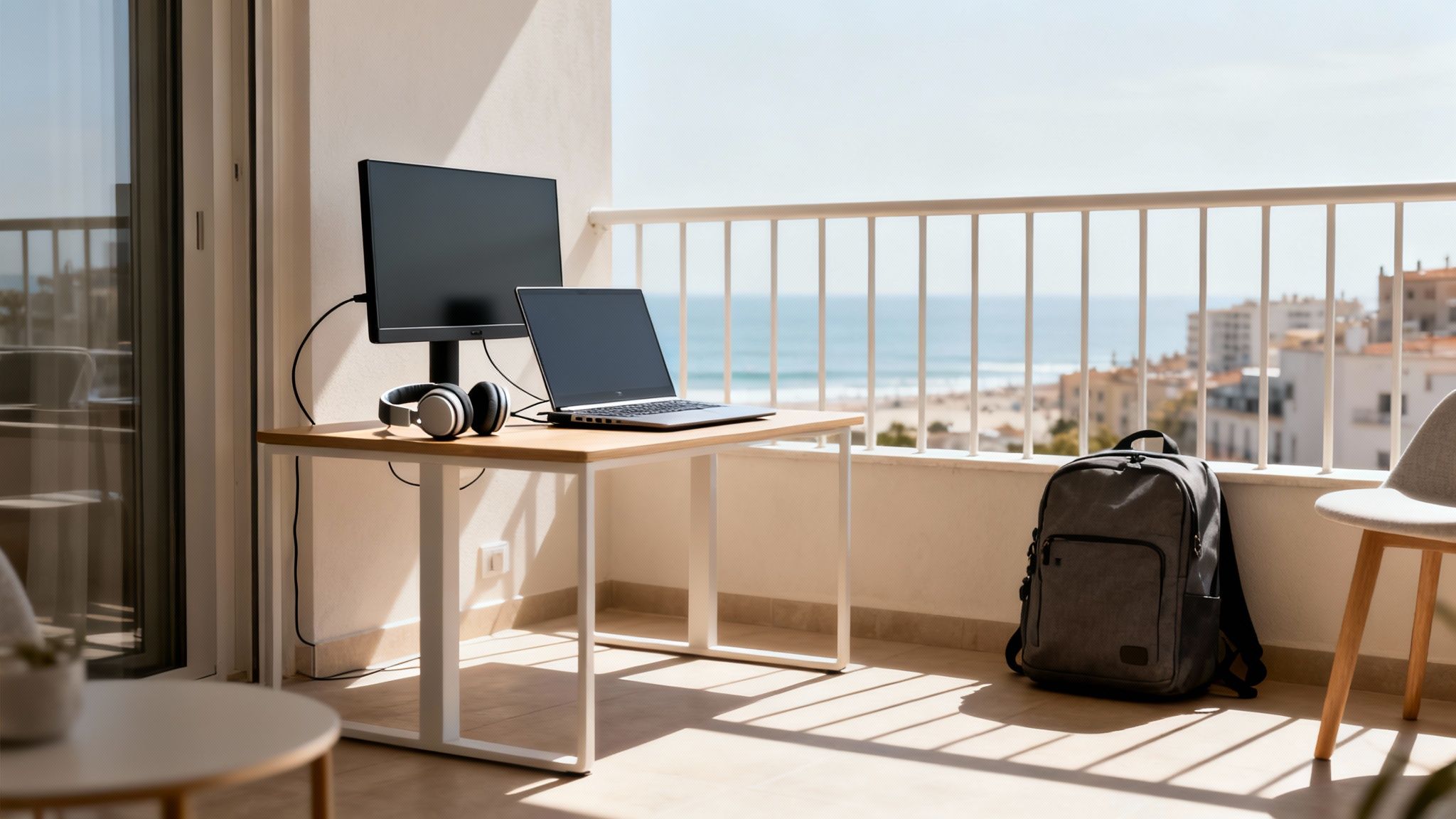
Let's get one thing straight: your success working abroad hinges entirely on your ability to actually get your work done. Just because you've swapped a cubicle for a beachfront cafe doesn't mean your professional standards can take a vacation.
Building a reliable and efficient mobile office isn't a nice-to-have; it's the very foundation of a sustainable international work life. This is all about being strategic with the gear you pack and mastering the art of staying productive, no matter what time zone you find yourself in. It's about creating a setup that lets you deliver your best work from anywhere on the planet.
Your Essential Remote Work Tech Toolkit
Packing for a long-term remote work trip is a world away from packing for a two-week holiday. Every single item in your bag has to earn its keep, especially your tech. You're not trying to build a portable server farm, but a few key pieces of gear will make a world of difference in your daily comfort and efficiency.
Forget the temptation to pack every gadget you own. Your goal is a minimalist but powerful toolkit that covers the essentials. For instance, a simple, lightweight laptop stand can save you from weeks of agonizing neck pain, while a quality headset ensures you sound crisp and professional on every single call. These small investments pay for themselves almost immediately.
To help you pack smart, here’s a practical checklist of the tech that truly matters.
Your Essential Remote Work Tech Toolkit
A practical checklist of the must-have technology and gear to ensure your remote work setup is seamless and professional.
| Gear Category | Essential Item | Key Feature to Look For |
|---|---|---|
| Connectivity | Portable Wi-Fi Hotspot | Unlocked to accept local SIM cards for cheap, reliable data. |
| Security | Reputable VPN Service | A strict no-logs policy and servers in your home country to access necessary sites. |
| Productivity | Portable Second Monitor | Lightweight, USB-C powered for a simple one-cable setup. |
| Audio | Noise-Canceling Headphones | Essential for blocking out distractions in cafes, airports, and co-working spaces. |
| Power | Universal Travel Adapter | One adapter that works in multiple countries, ideally with built-in USB ports. |
Think of this table as your starting point. Your specific role might require other gear, but these five items form the core of a rock-solid mobile office.
Securing a Stable Internet Connection
I'm going to be blunt: if you don't have a reliable internet connection, you don't have a remote job. It is the single most critical piece of your entire setup. Just showing up in a new city and hoping for the best is a recipe for a stressful, job-threatening disaster.
Before you even think about booking accommodation, you need to become an internet detective. Don't blindly trust a listing that just says "Wi-Fi included." You have to dig deeper. Ask your Airbnb host to send you a screenshot of a speed test. This one simple step can save you from a month of dropped video calls and agonizingly slow file uploads.
I learned this lesson the hard way during my first long-term trip in Sucre, Bolivia. The internet was so slow it was practically unusable for my work. I quickly realized that pre-trip research on connectivity isn't just a good idea; it's a fundamental part of the job.
Always have a backup plan. If you're even slightly unsure about the Wi-Fi in your apartment, know where the nearest co-working spaces are. They offer not just high-speed internet but also a professional environment and a chance to meet fellow remote workers. And on your very first day, buy a local SIM card with a generous data plan. It's a non-negotiable safety net.
Managing Time Zones and Asynchronous Work
One of the biggest mental shifts you'll make when working abroad is learning to operate across different time zones. Trying to perfectly mirror your home office's 9-to-5 schedule from halfway around the world is a one-way ticket to burnout. The key isn't working harder; it's working smarter.
This is where asynchronous communication becomes your superpower. It’s a workflow built on the simple idea that not every conversation needs to happen in real-time. Instead of a constant stream of instant messages demanding immediate replies, your team communicates through detailed project updates, thoughtful comments in shared documents, and crystal-clear task assignments.
Here's how to make it work for you:
- Embrace Clarity: Over-communicate in all your written updates. Provide context, state clear deadlines, and try to anticipate questions before they're asked to avoid back-and-forth delays.
- Schedule Overlap: Identify a few core hours where your workday overlaps with your team's. Protect this time fiercely and use it only for high-priority, collaborative discussions that truly need to be live.
- Set Expectations: Be completely upfront about your working hours in the new time zone. Make sure your Slack status, calendar, and email signature all reflect when you're available for a quick chat versus when you're offline.
Mastering this rhythm is what unlocks the real freedom of this lifestyle. It allows you to structure your day for both maximum productivity and maximum enjoyment. You can get your deep, focused work done in the morning and still have the entire afternoon free to explore your new city—all without ever dropping the ball.
So, Are You Ready for Your Remote Work Adventure?
You’ve made it through the nitty-gritty. From wrestling with visa applications to figuring out how to set up a reliable office on the go, the path to working remotely from another country should feel a lot less like a mystery and more like a plan. What might have seemed like a wild dream is actually achievable with the right preparation and a bit of grit.
Remember, this isn't just a logistical challenge—it's a massive opportunity for personal growth. You're about to prove that great work doesn't need a corporate headquarters and that your productivity isn't tied to a specific zip code. Every detail you've planned, from your tax strategy to your tech-packed backpack, is a brick in the foundation of a truly rewarding new chapter.
Your Next Chapter Is Waiting
It's easy to get bogged down in the details, but don't let the planning phase intimidate you. Think of it as laying the groundwork for your freedom.
The real mental shift happens when you stop asking, "Can I do this?" and start asking, "How will I do this?" When you break it all down, that enormous goal becomes a simple checklist you can tick off, one box at a time.
This is more than a change of scenery; it's a chance to redesign your life on your own terms. The world is brimming with new cultures to explore, people to meet, and experiences that are waiting just outside your current routine.
You've got the knowledge. You've got the tools. The only thing left is to take that first, real step. Start planning your adventure today—you'll be glad you did.
Got Questions? We've Got Answers
Even the most meticulously planned adventure has a few lingering "what ifs." Taking your job on the road is a huge life change, and it’s totally normal to have questions. Here are some straight-talking answers to the things we hear most often from people getting ready to work abroad.
How Much Money Should I Really Have Saved?
This is the million-dollar question, isn't it? The honest-to-goodness answer is that it completely depends on where you're going and how you plan to live.
A solid rule of thumb, no matter the destination, is to have a dedicated emergency fund. I'm not talking about your fun money; this is a separate stash that can cover three to six months of your non-negotiable living expenses. Think of it as your "get out of jail free" card for a medical emergency, a last-minute flight home, or any other curveball life throws your way.
On top of that, you'll need to research the real cost of living where you're headed. Tally up the initial hit: security deposits, visa fees, first month's rent, and maybe even some basic furniture. Having that buffer means you can start this new chapter feeling secure, not scrambling.
Can I Just Work on a Tourist Visa?
It’s tempting, I get it. But working on a tourist visa is playing with fire. In most countries, it’s straight-up illegal and can land you in a world of trouble—we're talking hefty fines, deportation, or even getting banned from the country for years. It's a massive gamble with your future travel plans.
The smart play is always to go the official route.
- Look into Digital Nomad Visas; more countries are offering them every year.
- Secure a proper Work Permit if you have a job offer from a local company.
- See if your destination offers a Freelance Visa for self-employed pros.
Stick to the legal path. It might take a bit more paperwork upfront, but it gives you peace of mind and protects you from a nightmare scenario with immigration.
Be careful with the "gray area" argument. While some people get away with it, immigration officers have the right to turn you away at the border if they even suspect you plan to work illegally. That’s a trip that could be over before it even starts.
What if I Get Super Lonely or Homesick?
Let's be real: loneliness is a genuine challenge when your support system is a world away. The trick is to get ahead of it. Don't just sit in your apartment and wait for community to find you—you have to build it.
Start before you even leave. Jump into local expat groups on Facebook or other social platforms. Once you land, make it a point to join a language class, find a local hobby group, or spend a few days a week at a coworking space. These are goldmines for meeting people who get what you're doing.
And don't forget about your crew back home. Schedule regular video calls to stay in the loop. Feeling homesick is part of the journey; having a strategy to deal with it will make all the difference.
Ready to find a job that will actually let you live this dream? At RemoteWeek, we specialize in connecting talented tech professionals with remote-first companies that get it. Start looking for a career that supports your life, not the other way around.