
How to Confidently Accept a Job Offer for a Remote Tech Role

Getting a job offer is a huge win, but don't pop the champagne just yet. Before you sign anything, it's time to do your final round of due diligence. This is especially true for remote roles, where the fine print can make or break your entire work experience.
A rushed "yes" can lead to overlooking details that directly impact your work-life balance, career growth, and overall happiness. Think of this pre-acceptance phase as your last, most important investigation.
Your Pre-Acceptance Checklist for Remote Job Offers
This flowchart lays out the basic decision-making process you'll go through when an offer lands in your inbox.
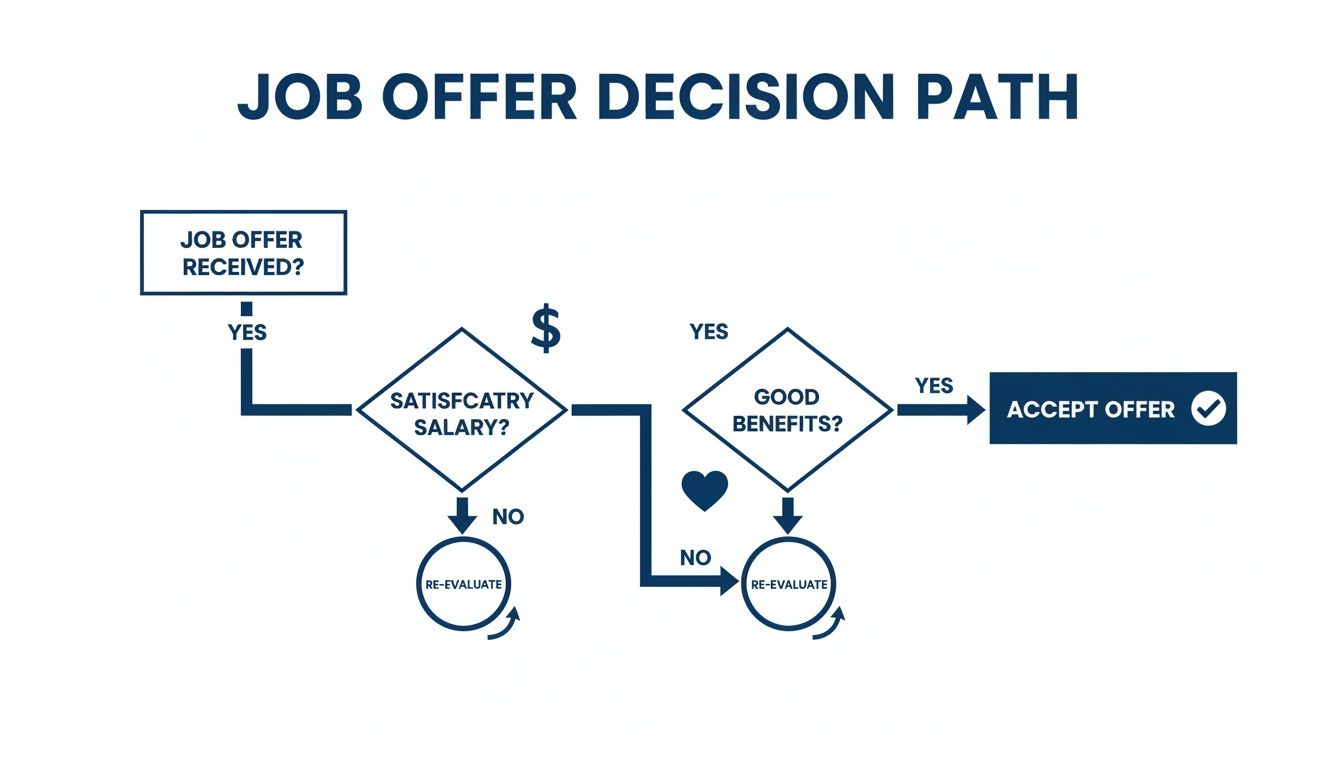
It’s a great visual reminder that you need to look at the whole picture—salary, benefits, and culture—before making that final call.
Digging Deeper than Base Salary
The salary figure always grabs the most attention, but it’s just the starting point. I've seen plenty of people take a higher salary only to realize it comes with lackluster benefits, making the overall package less valuable than a competing offer.
You need to look at the complete financial picture. Ask yourself:
- Equity and Stock Options: What’s the vesting schedule? Is it a standard four-year plan with a one-year cliff? More importantly, what percentage of the company are they actually offering?
- Performance Bonuses: How are these measured? Are the targets well-defined and, crucially, achievable for someone who isn't physically in the office?
- Signing Bonus: If they’re offering one, are there any strings attached? Look for clawback clauses that might require you to pay it back if you leave within a year or two.
Taking this holistic view gives you a true sense of the offer's economic value beyond just your monthly paycheck.
Vetting Remote-Specific Benefits and Culture
The demand for remote work isn't just a trend; it's the new standard for many. Recent data shows a staggering 87% of job seekers prioritize remote options in their search. Even more telling, 45% of people now say remote work is the single most important factor when considering a new job. This shift means companies are (or should be) offering more than just permission to work from home.
Look for perks that genuinely support a remote-first lifestyle:
- Home Office Stipend: Will they help you pay for an ergonomic chair, a proper monitor, or other essentials? This shows they’re invested in your long-term comfort and productivity.
- Wellness and Connectivity Allowances: Do they offer stipends for high-speed internet, gym memberships, or mental health resources? These benefits are the remote equivalent of in-office perks.
- Asynchronous Work Policies: This is a big one. Does the company's culture actually embrace flexible hours, or does "remote" just mean you're chained to a rigid 9-to-5 schedule at your kitchen table?
Vetting a company's remote culture is non-negotiable. Look for evidence of trust, autonomy, and clear communication channels. A company that invests in its remote infrastructure is a company that invests in its people.
Juggling these different factors can be tricky. If you have more than one offer on the table, our guide on how to compare job offers can help you weigh everything systematically.
To help you keep track of all the moving parts, I've put together a checklist summarizing the key areas you'll want to review. It’s designed specifically to help you evaluate an offer through the lens of a remote worker.
Remote Job Offer Evaluation Checklist
This checklist helps you systematically review the key components of a remote job offer to ensure it aligns with both your career ambitions and your lifestyle needs.
| Category | What to Verify | Why It Matters for Remote Roles |
|---|---|---|
| Compensation | Base salary, bonuses (signing & performance), equity, retirement plans (401k/RRSP matching) | Ensures the total financial package is competitive and accounts for potential home office costs. Equity vesting shouldn't be impacted by your location. |
| Health & Wellness | Medical, dental, and vision insurance coverage; mental health support; wellness stipends (gym, apps) | Strong remote companies invest in employee wellbeing, recognizing the unique challenges of WFH life, like isolation and burnout. |
| Work-Life Balance | Paid time off (PTO) policy, flexible work hours, company-wide holidays, parental leave | A culture that truly supports asynchronous work and encourages taking time off is crucial for avoiding burnout and maintaining a healthy separation. |
| Remote Setup & Support | Home office stipend, equipment provision (laptop, monitors), internet/co-working space allowance | This shows the company is committed to setting you up for success, not just shifting overhead costs onto you. |
| Professional Development | Budget for courses, conferences, certifications; clear paths for career progression and promotions | Opportunities for growth can be less visible in a remote setting. A formal budget and clear career ladder are signs of a supportive environment. |
| Company Culture | Communication tools & norms (e.g., Slack, Teams), meeting cadence, social events (virtual/in-person) | You want to join a culture of trust and autonomy, not one of micromanagement and constant surveillance. How they communicate is a huge clue. |
Using a structured approach like this ensures you don't forget anything important. It’s about making a clear-headed decision based on all the facts, not just the excitement of the moment.
Looking Beyond the Paycheck: How to Negotiate Your Remote Offer

Alright, you've got the offer in hand. This is the moment to make sure the role is truly a great fit, and that goes far beyond the salary figure. While money is obviously important, remote work introduces a whole different set of variables that can make or break your experience.
Your negotiation should always start with solid research. Don't just pull a number out of thin air. Look up the market rates for your role and experience level, but be sure you're looking at national or even global remote averages, not just what companies are paying in your hometown. This frames your request based on your value in the broader market, which is exactly where you'll be competing.
But don't stop at the salary. Think bigger. What will actually make your remote work life better, more productive, and more sustainable? This is your chance to build the job you really want.
Building Your Ideal Remote Workspace
In a traditional office, you don't think twice about your desk, your chair, or the high-speed internet. It's all just there. But at home, those essentials suddenly become your responsibility and your expense. This is a huge, and often overlooked, area for negotiation.
A truly remote-first company gets this. They know that a proper setup isn't a luxury; it's a necessity for you to do your best work. So, don't be shy about asking for a home office budget.
Here’s a simple way to bring it up:
"I'm so excited about this offer and can't wait to get started. To ensure I can create a productive and ergonomic home office from day one, could we discuss a one-time stipend of $1,000 for equipment?"
See how that works? You're not just asking for cash. You’re framing it as a direct investment in your productivity, which makes it a smart business decision for them.
Negotiating for Growth, Not Just Gear
Once your physical workspace is covered, it’s time to think about your professional growth and personal well-being. These are the benefits that pay dividends long after the initial salary excitement wears off. Often, companies have more flexibility here than they do with base pay.
Think about asking for things like:
- A Professional Development Budget: Request a set amount per year for courses, certifications, or conference travel. It shows you're serious about your craft and want to keep your skills sharp.
- A Four-Day Work Week or Flexible Hours: If the culture feels right, you can test the waters. Just be sure to frame it around productivity and deep work, not just working less.
- A Clear Path for Advancement: Ask them to define what success looks like in the first six months. Where can you go from there? Getting clarity on career progression for remote employees is critical.
These aren't just fluffy perks. They're the building blocks of a successful and fulfilling remote career. If you need more inspiration, check out our guide on smart questions to ask recruiters for more ideas. Every part of this negotiation is an opportunity to shape the role into what you need it to be.
Decoding the Fine Print in Your Remote Work Contract
So, the offer is on the table. Before you pop the champagne, there’s one critical step left: the employment contract. This isn't just a formality; it's the official rulebook for your new role. For remote jobs, the details buried in the legalese can make or break your entire experience, defining your freedom, boundaries, and professional future.
Skipping a thorough review is a rookie mistake that can cause major headaches later. Think of the contract as the final, legally binding confirmation of everything you've discussed. It’s where verbal promises about salary, title, and benefits become concrete terms.
Key Clauses You Cannot Afford to Skim
Some parts of the contract deserve a second, and even a third, read. They might look like standard boilerplate, but the specific wording carries serious weight for your career trajectory.
You’ll want to put these three areas under a microscope:
- Non-Compete Agreements (NCAs): This clause can block you from working for a competitor after you leave. For remote professionals, a vaguely worded NCA is especially dangerous—it could freeze you out of an entire global industry, not just a local market.
- Intellectual Property (IP) Clauses: Who owns the brilliant code you write or the designs you create? This section spells it out. Make sure it clearly states that the company's ownership is limited to work done on company time with company resources, leaving your personal side projects completely yours.
- Termination Conditions: Get crystal clear on how things could end, whether you resign or the company lets you go. Look for specifics on notice periods, severance, and what constitutes a "for cause" termination, as that can directly affect your eligibility for benefits.
A contract isn't just a hurdle to jump over. It’s a tool for alignment, ensuring you and your new employer are starting on the same page with the same expectations.
The remote job market is holding strong, especially in tech. Even with economic shifts, remote roles consistently account for about 6% of new monthly postings. That translates to roughly 600,000 opportunities every single month, giving you the leverage to negotiate a contract that truly works for you.
Remote-Specific Language to Verify
Beyond the standard legal stuff, a good remote contract will address the unique realities of working from anywhere. If these details are missing, it might be a sign the company hasn't fully thought through its remote policies.
Be on the lookout for specific language covering:
- Work Location Flexibility: Does the contract chain you to a specific state or country for tax reasons? Or does it give you the freedom to work from abroad for a few weeks? You need to know the official policy.
- Equipment Ownership: Who pays for the laptop, monitor, and other essential gear? If the company provides it, what’s the process for returning everything if you leave?
- Mandatory In-Person Meetings: Find out if you’re expected to travel to headquarters for "mandatory" team offsites or all-hands meetings. The contract should clarify how often this happens and who foots the bill for travel and accommodation.
Knowing your rights regarding potential breach of contract remedies gives you a better understanding of the legal power behind these terms. And if your offer has some strings attached, our guide on navigating a conditional job offer can help you through the next steps.
If anything feels ambiguous or overly restrictive, don't be afraid to ask for clarification. And when in doubt, having a legal professional take a quick look can be one of the best career investments you ever make.
How to Formally Accept the Job Offer with Confidence

You’ve done the hard work of interviewing, evaluating, and negotiating. Now it's time to seal the deal. How you accept the offer is your first official act as a new team member, and it sets the tone for your entire tenure.
The best way to handle this is with a one-two punch: a clear, professional email to get everything in writing, followed by a quick, personal phone call to build immediate rapport.
Crafting the Perfect Acceptance Email
Think of your acceptance email as your first official document. It’s not just you saying "yes"—it's a written record confirming the exact terms you both agreed to. This simple step protects you and the company, making sure there are no surprises down the line.
Your email needs to be professional but should also let your personality and excitement shine through. Here’s what it absolutely must include:
- A Simple, Direct Subject Line: Don't get fancy. "Job Offer Acceptance - [Your Name]" is perfect.
- A Note of Gratitude: Kick things off by genuinely thanking the hiring manager and the team for the opportunity.
- A Clear "I Accept": Use direct language. Something like, "I am thrilled to formally accept the position of [Job Title]." leaves no room for doubt.
- Confirm the Key Details: This is crucial. Briefly restate the core terms you agreed upon, like your salary, official start date, and any other make-or-break items you negotiated (e.g., a signing bonus or specific remote work stipend).
Getting these details in writing creates a paper trail and serves as a final check that everyone is on the same page. For a deeper dive, this guide on How to Accept a Job Offer with Confidence is a fantastic resource.
The Follow-Up Call That Builds Rapport
An email handles the logistics, but a phone call makes a human connection. This quick, personal touch is a game-changer for starting a positive relationship with your new manager before you even log on for day one.
This call is purely about connection, not last-minute negotiation. Keep it short and sweet. A couple of minutes is all you need to say how excited you are and ask a simple, forward-thinking question. Try something like, “Is there anything I can start reading up on before my first day to hit the ground running?”
This proactive approach shows you’re eager and helps calm any of those first-day nerves. By following this two-step process to accept a job offer, you ensure a smooth, professional start and make a great first impression before your new role even begins.
Navigating Counteroffers and Other Last-Minute Hurdles
You’ve made your decision, given your notice, and are ready for the next chapter. Then, just as you’re about to coast to your last day, your current boss slides a counteroffer across the table. It’s a classic move, and it can be incredibly tempting—flattering, even.
But before you get swayed, take a deep breath and think. Why are they making this offer now? A counteroffer rarely fixes the root problems that sent you job hunting in the first place. Was it a dead-end role, a draining culture, or a lack of meaningful projects? A bigger paycheck is usually a short-term bandage on a long-term issue.
How to Decline a Counteroffer Without Burning Bridges
When turning down a counteroffer, the goal is to be graceful but firm. The tech world can be surprisingly small, and you never know when your paths will cross again. There’s no need for a dramatic exit.
A simple, direct approach is your best bet. Try something like this:
- Start with gratitude: "Thank you so much for putting this offer together. I really appreciate the gesture."
- Stand your ground: "After careful consideration, I'm going to stick with my decision to accept the new role at [New Company]."
- Explain it's about more than money: "This was never just about compensation. I’m really excited about the opportunity for growth and the new challenges this role presents."
This script acknowledges their effort, respectfully closes the door on more back-and-forth, and keeps the relationship intact.
A quick word of caution: accepting a counteroffer fundamentally changes your relationship with your employer. They know you had one foot out the door, which can create an undercurrent of mistrust affecting future projects and promotions.
What to Do When an Offer Is Pulled
It's rare, but it happens. A company can rescind a job offer, and it’s a jarring experience. This can be due to anything from an unexpected budget cut to a last-minute internal restructuring. It feels personal, but it often isn't.
Your first move is to stay professional. Reach out to the hiring manager or HR for a clear explanation. Was it a company-wide freeze? A misunderstanding on the background check? Knowing why provides closure and helps you figure out your next steps.
The good news is that the remote job market is incredibly resilient. One report logged a record high of over 424,000 remote jobs posted in a single year, proving that opportunities are out there. You can dig into the full stats over on the Virtual Vocations blog.
Don't dwell on it. Immediately reactivate your search. Ping your network, reconnect with other companies you were talking to, and let them know you’re available again. A rescinded offer is a frustrating setback, but it’s one you can bounce back from quickly.
You've navigated the interviews, aced the technical challenges, and now the offer is on the table. But even after all the hard work, a few last-minute questions can pop up right before you sign on the dotted line.
It's completely normal. Let's walk through some of the most common questions that come up at this final stage, so you can move forward with total confidence.
How Long Do I Have to Accept a Job Offer?
Most companies will give you a clear deadline, which usually falls somewhere between 24 hours and a full week. A really short timeline can sometimes signal that they're in a hurry to fill the role, while a longer window often means they're confident you're their top choice and respect your need to make a considered decision.
What if they don't give you a date? It's perfectly fine—and smart—to ask for a few business days to think it over. This doesn't make you look indecisive; it shows you're thorough.
Try saying something like, "Thank you so much for this offer! I'd like to take a couple of days to review the details and will get back to you by [Specific Day]." This gives you the breathing room you need without making them feel like you're stalling.
Never let an employer pressure you into a rushed decision. A great company will give you the space to properly evaluate everything. This is the moment to be deliberate, not hasty.
Can I Change My Mind After Accepting an Offer?
Technically, yes. In most places with "at-will" employment, you can legally back out of an offer you've already accepted. But I have to be blunt: this should be your absolute last resort.
The tech world can be surprisingly small. Pulling out after giving your "yes" can burn bridges and harm your professional reputation. Before you accept, be as sure as you possibly can.
If something completely unavoidable happens and you absolutely must rescind your acceptance, handle it with care.
- Be Quick: Let the hiring manager know the second you've made your final decision.
- Pick Up the Phone: This kind of news is best delivered in a direct conversation, not an email. It shows respect.
- Be Honest, But Brief: You don't owe them a long, complicated story. A sincere apology for the change of plans and genuine gratitude for the opportunity is enough.
Managing a tough situation like this with professionalism can go a long way in preserving your relationships.
What Happens After I Send My Acceptance Email?
Once that email is sent, the company’s HR and onboarding machine will kick into gear. The first thing you'll likely see is a flood of official paperwork—your final employment contract, tax forms (like your W-4), and documents for benefits enrollment.
For a remote position, this is also when the logistics get real. Expect to get information on your company-issued equipment, like when your laptop will arrive and how to get set up on Slack, email, and other key software.
It’s also a nice touch to send a quick follow-up to your new manager. A simple note confirming your start date and asking if there's anything you can read up on to hit the ground running is a great way to show you're eager to get started.
Should I Ask for the Offer in Writing Before Accepting?
Yes. 100%. This is non-negotiable.
A verbal offer is fantastic news, but it isn't official until it’s in writing. The written offer letter is your source of truth—it's where all the details you've discussed, from salary to start date, are laid out.
It is standard practice to ask for the formal document before you give your final answer. You can keep it simple: "Thank you for the wonderful news! I am very excited about this opportunity. Could you please send over the formal offer in writing so I can review all the details?"
And one last piece of advice: never, ever resign from your current job until you have a signed, written offer from the new one.
Finding the right remote role at a company that truly values its team can be a challenge. RemoteWeek cuts through the noise by curating job listings exclusively from top-rated, employee-focused tech companies. Start your search with confidence and find a remote job you'll love at RemoteWeek.