
What Is a Conditional Job Offer and How Do You Respond

You've made it through the interviews, impressed the hiring manager, and finally, an email lands in your inbox with the subject line "Job Offer." Fantastic! But as you read through it, you see the phrase “conditional job offer.”
So, what does that really mean?
Think of it as the company saying, “We think you're the one, and we want you on the team. We just need to cross a few final T's and dot a few I's before we make it official.” It's a genuine offer of employment, but it hinges on you successfully meeting a few specific requirements first.

A Standard Step in Modern Hiring
Receiving a conditional offer is a great sign. It means you’re the top choice, and the company is ready to move forward. They're just completing their due diligence before sealing the deal.
This isn't a hurdle; it's a completely normal part of the hiring process today, especially for remote jobs where employers need to verify everything from your right-to-work status to your home office security without ever meeting you face-to-face. It's a key part of what makes you an employee, which you can read more about in our guide on the differences between an independent contractor vs employee.
This practice has become the norm. In fact, a recent global survey revealed that 73% of organizations wait to run background checks after extending a conditional offer. It’s a smart, fair way for companies to keep their top candidate engaged while they handle the necessary paperwork and legal checks. You can dig deeper into these global background screening trends if you're curious.
Conditional vs Unconditional Job Offer At a Glance
This quick comparison should help you immediately grasp the key differences between a conditional offer and the final, locked-in version.
| Feature | Conditional Job Offer | Unconditional (Final) Job Offer |
|---|---|---|
| Status | Contingent on meeting requirements | Final and legally binding |
| Next Steps | You need to complete checks (background, references, etc.) | You move straight to onboarding |
| Risk | Can be withdrawn if conditions aren’t met | The offer is secure and can't be easily retracted |
| Your Action | Don't resign from your current job just yet! | It's safe to give notice and get ready to start |
Ultimately, a conditional offer isn't something to stress about. It's a transparent and standard final step in the hiring journey. Once you understand what’s required, you can tackle the final steps with confidence and turn that conditional "yes" into a firm start date.
The Most Common Conditions You Will Encounter
So, you've got a conditional job offer in hand. Great! Now, let's talk about those "conditions." Don't let the formal language spook you; these are just the final checkpoints before you're officially part of the team. Think of it less as a series of tests and more as the company doing its final due diligence. They’ve already decided you’re the one for the job—this is just the paperwork to make it official.
These conditions are almost always directly related to the role itself. The goal is simply to verify the details and ensure everything is buttoned up from a legal and logistical standpoint.

Background Checks
The background check is probably the most standard condition you'll see. Companies use these to confirm who you are and to manage risk, which is especially important for jobs involving sensitive data, finances, or security clearance.
The depth of these checks can vary, but most will look into a few key areas:
- Criminal History: This is pretty standard. Keep in mind that "ban the box" laws in many states and cities mean employers can't ask about this until after they've made a conditional offer.
- Employment Verification: The screening service will reach out to your previous employers to confirm your job titles and dates of employment. It's a simple fact-checking exercise.
- Education Verification: This step just confirms that you graduated from the schools you listed on your resume and earned the degrees or certifications you claimed.
For tech jobs, especially remote ones where you'll have access to company systems from afar, these checks can sometimes be a bit more thorough.
Reference Checks
You probably already provided a list of references, right? Well, the post-offer reference check is a little different. It's less about the hiring manager trying to figure out if you're a good fit and more about getting that final stamp of approval on your work ethic, reliability, and team skills.
These last calls are usually with your former bosses who can speak directly about your performance. The conversation isn't about your potential anymore; it’s about confirming that you’re the professional they believe you to be.
A conditional offer shifts the purpose of a reference check. It's no longer about selling you as a candidate; it's about confirming you are the professional you presented yourself to be.
Proof of Eligibility to Work
This one is a straight-up legal requirement, and there’s no getting around it. In the U.S., every single employer has to verify that new hires are legally authorized to work. This is handled through the official Form I-9, Employment Eligibility Verification.
You’ll need to show specific documents that prove your identity and your right to work. The most common ones are:
- A U.S. Passport or Passport Card
- A Permanent Resident Card (often called a Green Card)
- A combination of two documents, like a driver's license plus a Social Security card or a birth certificate
This is a mandatory step for everyone, no matter their citizenship. If you can't provide valid documents, the company will have no choice but to withdraw the offer.
Verification of Degrees and Certifications
For specialized tech roles, having a specific degree or a particular certification isn't just a "nice-to-have"—it's a fundamental requirement of the job. Your resume says you have it, but the conditional offer is when the company officially crosses the T's and dots the I's.
This is especially critical in fields like cybersecurity, cloud architecture, or software development where certifications (like a CISSP or an AWS Certified Solutions Architect) are the industry standard for proving your skills. They need to know for sure that you have the credentials before you get access to their systems.
Home Office and Security Setup for Remote Roles
This is a newer condition on the block, but it’s becoming incredibly common for remote tech jobs. The company isn't trying to judge your decor—they need to make sure your home office is secure and functional.
This is a big deal for companies in regulated industries like finance or healthcare. They have strict data security policies to follow, and your home setup is now part of that ecosystem. They might need to confirm:
- You have a dedicated, private workspace to keep sensitive company information off-screen from others.
- Your internet connection is stable, secure, and fast enough to meet their standards.
- You have the right equipment or can properly set up the gear they send you.
This check ensures you can hit the ground running productively and safely from day one. It's a practical step that helps build the trust needed to make a remote work relationship successful.
Understanding Your Rights During the Process
So, you’ve got a conditional job offer in hand. It’s an exciting moment, but it’s also when you need to be aware of your rights. This isn't some legal gray area where anything goes. The whole process is actually wrapped in some pretty strict rules designed to protect you.
Simply put, employers can’t just make up any condition they want. They are legally bound to ensure every requirement is fair, directly related to the job, and applied to every candidate in the same role. The system is designed to prevent discrimination, making sure the decision to hire you was based on your skills, not something that could trigger bias.
What Employers Can and Cannot Legally Ask For
Think of it like this: every condition in your offer letter has to pass a common-sense test. Is this really necessary for the job? If not, you might be looking at a red flag. An employer's requests have to be tied directly to the practical needs of the position you've been offered.
Let’s break down what’s generally okay versus what crosses the line:
- Job-Related Inquiries: It’s perfectly reasonable to require a valid driver’s license for a delivery driver. It’s not reasonable to ask for one from a remote software engineer who will never be behind the wheel for work.
- Medical Examinations: A company can ask you to pass a physical fitness test for a physically demanding role, but only after extending a conditional offer. They can't ask for a medical exam for a desk job unless it’s a standard requirement for everyone in a similar role.
- Background Information: An employer can look into criminal convictions if you’re applying for a job in finance. However, they can’t legally pull the offer just because of an old arrest that never led to a conviction.
These aren’t just suggestions; they’re legal requirements. For a deeper look into how companies manage these obligations from their side, it can be helpful to understand their overall contract management workflow.
Key Takeaway: Any condition an employer sets must be a legitimate business necessity. The burden of proof is on them to show that the requirement is essential to doing the job safely and effectively.
The Shift to Post-Offer Screening
You might have noticed that companies now wait until after the offer to run these sensitive checks. That’s not an accident. This shift is a deliberate move toward fairer hiring practices. By holding off, employers reduce the chance of making a decision based on protected information like your age, disability, race, or religion.
The legal and ethical rules have tightened up a lot over the years to combat discrimination and protect privacy. In fact, most organizations now perform background and medical checks only after extending a conditional offer, a practice designed to keep qualified candidates in the running. You can even read the academic research on this hiring trend if you want to dive deeper.
This structured process ensures that potentially biasing information is only looked at once you've already been chosen as the top candidate based on merit. Knowing your rights here gives you the power to spot unfair practices and make sure you’re treated with respect.
How To Respond To Your Conditional Offer
Getting that conditional job offer feels fantastic. You're the front-runner, the company's top pick. But hold on—how you navigate what comes next is incredibly important. Your response isn't just an email; it's your first official communication as a potential new hire, and it sets the tone for everything to follow.
The goal here is simple: show your enthusiasm, confirm you understand the conditions, and clearly map out the next steps. It's all about managing expectations—yours and theirs—from the get-go.
Step 1: Review Everything, No Skimming Allowed
Before your fingers even touch the keyboard, take a moment. Breathe. Now, read that offer letter from start to finish. It’s so easy to get caught up in the excitement and gloss over the details, but the fine print is what matters most right now.
Pinpoint every single condition. Are they clear-cut requirements, like a background check, or are they a bit more open to interpretation, like "satisfactory reference checks"? Look for any deadlines attached to these conditions. A hasty acceptance without fully understanding the terms can lead to headaches later.
The Golden Rule: Never, ever resign from your current job until you have it in writing that all conditions are met and the offer is final. A conditional offer is a proposal, not a done deal.
Step 2: If It's Vague, Ask for Clarity
If any part of the offer feels fuzzy, now is your chance to ask questions. Vague conditions are potential roadblocks, and clarifying them upfront is just smart. Don't worry about seeming difficult; asking for details shows you’re diligent and professional.
For instance, if the offer mentions a background check, you could politely ask what the check covers and which company will be performing it. If a "technical assessment" is on the list, it's perfectly reasonable to inquire about the format so you can prepare. Our guide on how to write effective emails can help you frame these questions perfectly.
This flowchart walks you through the key decision points for any job offer condition.
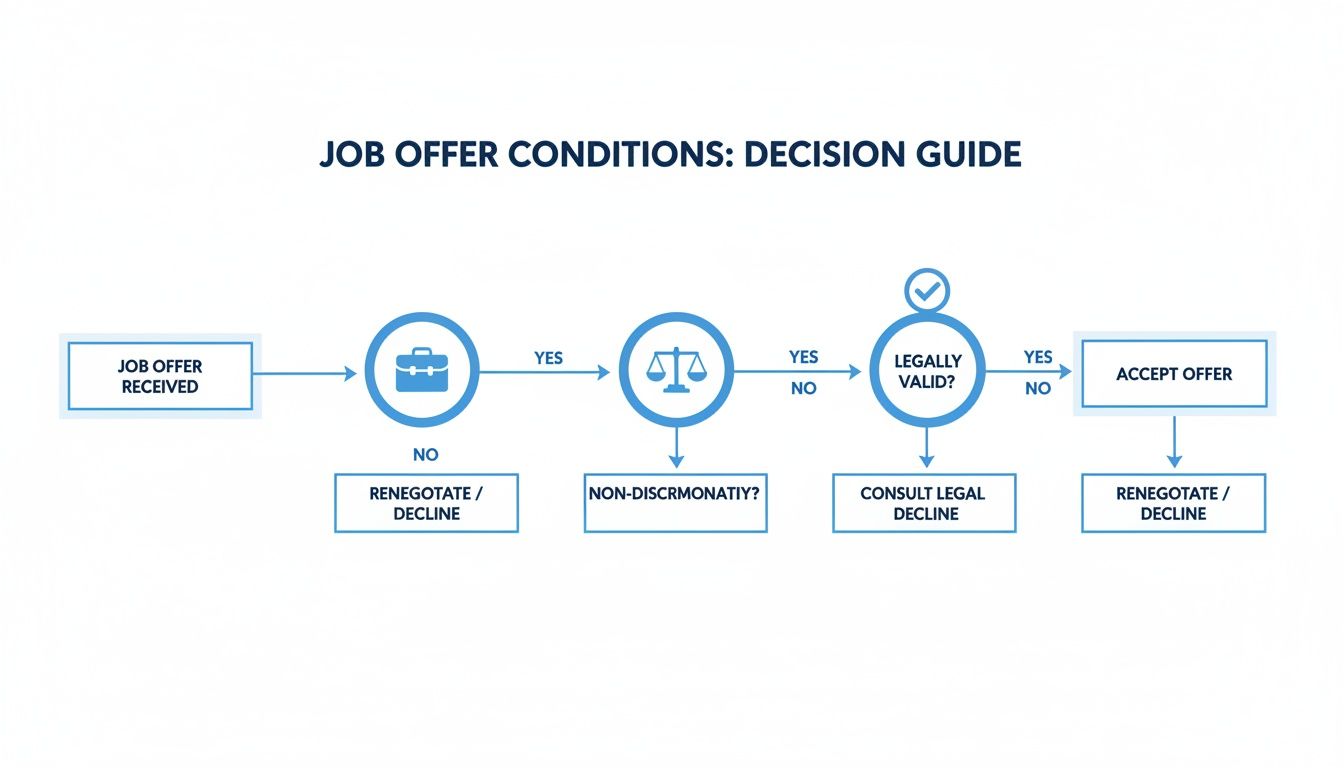
The main takeaway here is that every single requirement from an employer should be justifiable and directly related to the responsibilities of the job.
Step 3: Accept Conditionally and Align on Timelines
Time to write your response. You want to sound excited but also be precise. Remember, you're not giving a final, unconditional "yes" just yet. You are accepting the offer pending the successful completion of the stated conditions.
Your email should do three things:
- Show Gratitude: Kick things off by thanking the hiring manager and reiterating how excited you are about the role.
- Acknowledge the Conditions: Mention that you've reviewed the offer and understand the conditions that need to be met.
- Confirm Your Intent: State clearly that you accept the offer contingent upon satisfying these requirements.
This is also the perfect time to get on the same page about timelines. Politely ask for a rough estimate of how long the checks will take to complete. This helps you manage your own planning and shows them you’re proactive.
Step 4: Handle Negotiations Before You Accept
If you're thinking about negotiating your salary, benefits, or start date, you need to do it before conditionally accepting. As soon as you signal acceptance—even with strings attached—you’re basically agreeing to the current terms. Trying to circle back and renegotiate after that point comes across as unprofessional and can sour the relationship.
Knowing some powerful contract negotiation strategies can make a huge difference here. Frame any counteroffer politely, back it up with research on market rates, and tie it to the value you bring. Once you’ve settled on new terms and they send a revised offer, then you can move forward with your conditional acceptance.
Sample Response Snippets for Your Offer Letter
Crafting the right words can be tricky, so here are a few templates to get you started. You can adapt these to fit your specific situation and personality.
| Scenario | Sample Response Text |
|---|---|
| Simple Acceptance (No Questions) | "Thank you so much for the offer! I’ve reviewed the details and the conditions outlined, and I am thrilled to conditionally accept the position. I'm ready to get started on the background check and any other necessary steps. Please let me know what you need from me." |
| Accepting with a Timeline Question | "I'm very excited to receive this offer and conditionally accept the role. I understand the conditions regarding the reference and background checks. Could you please provide an estimated timeline for when these will be completed? I look forward to moving forward." |
| Asking for Clarification | "Thank you for this exciting opportunity! I've read through the offer letter and I conditionally accept. I had a quick question about the 'technical equipment verification' condition—could you provide more detail on what this process involves? I want to ensure I have everything ready." |
| After Negotiating Terms | "Thank you for sending over the revised offer. The updated terms look great, and I'm happy to conditionally accept the position. I understand the remaining conditions and will provide the necessary information for the background check promptly." |
By following these steps, you’ll handle this crucial stage with professionalism and confidence. You're not just protecting your own interests; you're showing your future employer that they absolutely made the right choice.
What to Do If a Condition Is Not Met
Getting that call or email about an issue with a background check can feel like a punch to the gut. It's easy to spiral, but take a deep breath. A flagged condition doesn't automatically kill your job offer.
Employers are human. They know that life happens and that reports aren't always perfect. This is your moment to show them how you handle a tough situation—with professionalism, honesty, and a cool head. Most companies will start what’s called an “interactive process,” which is just a formal way of saying they want to have a conversation with you about the findings.
First Steps When a Problem Arises
When you get that notification, your first reaction matters. Panic and defensiveness won't do you any favors. Instead, switch into a calm, information-gathering mode.
Here’s a simple, strategic approach to take right away:
- Request a Copy: You have a legal right to see the report. Ask HR or the screening company for a complete copy so you know exactly what they’re looking at.
- Review for Inaccuracies: Go through that report with a fine-tooth comb. Are the dates right? Is a criminal charge listed that isn't yours? You’d be surprised how often simple clerical errors pop up.
- Gather Your Documentation: If you spot a mistake, you'll need proof. This is where old pay stubs, W-2s, or court documents showing a charge was dismissed or expunged become your best friends.
- Prepare Your Explanation: If the information is accurate but needs some context—maybe a past mistake you've learned a lot from—craft a short, honest explanation.
Communicating with the Employer
Once you have your facts straight, it's time to talk. Don't dance around the issue. Address it head-on with transparency. Frame your response not as an excuse, but as helpful context that gives them the full picture.
For instance, if your background check shows a one-month gap in your employment dates, you could say something like: “I noticed the report lists my end date as August, but my final project actually wrapped up in September, which is what I put on my resume. I’m happy to share my final pay stub to clear that up.” A simple, proactive statement like that can resolve the whole thing on the spot.
Key Insight: Employers are often just as interested in how you handle adversity as they are in the issue itself. A calm, solution-focused response can actually build their confidence in you, not erode it.
Understanding Potential Outcomes
So, what happens next? It really depends on the severity of the issue and the type of job. A minor date discrepancy is almost never a deal-breaker. On the other hand, failing a mandatory drug screen or having a relevant criminal conviction for a high-security role will likely lead to the offer being pulled.
This final check is especially critical in the tech world, where the stakes are high for everyone. An Ashby analysis found that while the average offer acceptance rate is 78%, it dips to 73% for technical roles. This shows just how much scrutiny is happening on both sides of the table. You can dive deeper into these talent acquisition trends to see the data for yourself.
If the offer does get withdrawn, try to find out why. Sometimes it's something you can't control, like a last-minute hiring freeze that has nothing to do with you. It’s a tough pill to swallow, but handling the news gracefully will protect your professional reputation for future opportunities.
Spotting Employer Red Flags During This Stage
The conditional job offer isn't just a final hurdle for you to clear; it’s one last, critical chance to evaluate your potential employer. How a company navigates this stage tells you everything about its culture, professionalism, and how it really treats its people. Think of it as your final interview—of them.

This process is absolutely a two-way street. While they're busy verifying your background, you should be verifying their character. A smooth, transparent, and respectful process is a massive green flag. On the flip side, a chaotic or shady experience can hint at much bigger problems down the road.
Vague or Shifting Conditions
One of the biggest red flags is a lack of clarity. If the conditions in your offer are fuzzy, poorly defined, or suddenly change without a good reason, you need to be careful. A legitimate, professional company will have its process dialed in and documented.
Vagueness is a problem because it leaves you in a vulnerable spot. Keep an eye out for these warning signs:
- Ambiguous Language: You might see phrases like "satisfactory references" with no explanation of what "satisfactory" actually means.
- Moving Goalposts: The company starts adding new conditions or requirements after you've already accepted the initial offer.
- Unclear Timelines: They can't give you a straight answer on how long the checks will take, leaving your career in limbo.
A good employer sets clear expectations and sticks to them. Anything less can be a preview of a disorganized and frustrating work environment.
High-Pressure Tactics and Invasive Requests
Feeling rushed is another major red flag. An employer who genuinely wants you on the team will give you a reasonable amount of time to review the offer and complete the required steps. If they're pushing for an immediate decision or threatening to pull the offer because you have questions, that’s a sign of a bad culture.
You should also be wary of requests that feel a little too personal or cross a line. A company should never ask you for:
- Your social media passwords
- Personal bank statements (anything beyond what’s required for setting up direct deposit)
- Medical history that has nothing to do with your ability to perform the job
An employer’s behavior during the conditional offer stage is a direct preview of your future working relationship. Pressure and a lack of transparency now often lead to bigger problems later.
These aren't just minor annoyances; they're often early signs of a toxic work culture. Learning to spot them now can save you from a world of hurt later. Treat this stage as your final opportunity to make sure this is a place you actually want to work.
Your Top Questions, Answered
Getting to the offer stage is exciting, but the details can be a little tricky. Let's clear up some of the most common questions that pop up when you're handed a conditional job offer.
How Long Does It Take to Clear Job Offer Conditions?
This is the classic "how long is a piece of string?" question, but we can give you a pretty good estimate. The timeline really hinges on what the company needs to check.
Simple reference checks? A few days, tops. But a comprehensive background screening, especially one that needs to pull records from different states or even countries, can easily stretch to one or two weeks.
Your new HR contact should give you a heads-up on the expected timeline. If they don't bring it up, don't be shy—ask them! Knowing the timeframe helps you manage your own expectations and keeps the anxiety at bay.
The Golden Rule: Never, ever resign from your current job until you have it in writing that all conditions are met and your offer is officially confirmed. A conditional offer is promising, but it's not a done deal.
Can I Negotiate My Salary After Accepting a Conditional Offer?
Short answer: No, you really shouldn't.
Think of it this way: your acceptance, even a conditional one, is your handshake on the terms presented. The time to talk money, benefits, and perks is before you give that handshake.
Trying to go back to the negotiating table after you've already agreed to the package can make you look indecisive. It's a surefire way to start things off on the wrong foot and, in a worst-case scenario, could even lead to the company pulling the offer. Get all your ducks in a row first, then accept.
Is a Conditional Job Offer Legally Binding?
A conditional job offer is more like a serious statement of intent than a locked-in legal contract. It’s the company saying, "We want to hire you, as long as you pass these final checks."
The employer has the legal right to take back the offer if you don't meet the specific, job-related conditions they laid out.
However, they can't just change their mind for any reason. For instance, they can't legally pull an offer for discriminatory reasons—like information about your race, age, or a disability that doesn't affect your ability to do the job. If you check all their boxes and meet every condition, the professional expectation is that they'll welcome you aboard.
Finding a remote job where you feel valued and secure is more important than ever. RemoteWeek is a curated job board dedicated to connecting you with employee-focused tech companies that have strong, positive workplace cultures. We vet every company to ensure they meet high standards for employee satisfaction, so you can search with confidence. Explore high-quality remote roles.