
Top 10 Interview Questions for Project Coordinator Roles in 2025

Securing a remote project coordinator position requires more than just a strong resume; it demands a stellar interview performance. In a remote-first work environment, companies seek candidates who are not only organized and proactive but also excellent communicators and self-starters capable of thriving with autonomy. This guide is your strategic playbook, breaking down the essential interview questions for project coordinator roles you are most likely to face.
This comprehensive listicle is designed to help you prepare methodically. We will explore key categories of questions, including behavioral, situational, and technical, to provide deep insight into what hiring managers are really looking for behind their queries. From demonstrating your conflict resolution skills with difficult stakeholders to proving your mastery of project management tools and processes, this article will equip you with the confidence and knowledge to stand out from the competition.
Beyond preparing thoughtful answers, practicing how to articulate them effectively is crucial for making a strong impression, especially over a video call. Learn more about how to improve your English pronunciation for job interviews to ensure your message is always clear and powerful. Our goal is to provide you with a clear roadmap, covering everything from managing competing deadlines to handling late-stage project errors, so you can confidently navigate your next interview and land a rewarding remote role.
1. Tell me about a time you managed multiple projects with competing deadlines
This is a classic behavioral interview question for a project coordinator role. Hiring managers ask it to move beyond theoretical knowledge and see your practical skills in action. They want to understand your real-world approach to organization, prioritization, and communication when faced with pressure and conflicting demands, which is a daily reality for most project coordinators.

Your answer reveals your ability to think strategically, use tools effectively, and maintain clear communication with stakeholders. It's your chance to prove you can bring order to chaos.
What the Interviewer Wants to Hear
Interviewers are listening for a structured thought process. They want to see that you don't just react to the nearest deadline but have a system for evaluating priorities.
- Prioritization Method: Do you use a recognized framework like the Eisenhower Matrix (urgent/important) or do you assess tasks based on project value, dependencies, and stakeholder impact?
- Organizational Tools: Do you mention specific software (e.g., Asana, Trello, Jira) or techniques (e.g., Gantt charts, Kanban boards) to visualize and track progress?
- Communication Strategy: How do you proactively manage stakeholder expectations? Do you negotiate deadlines, reallocate resources, or provide regular status updates to prevent surprises?
- Problem-Solving: What did you do when things didn't go as planned? How did you adapt?
How to Structure Your Answer
The STAR method (Situation, Task, Action, Result) is perfect for this question. It provides a clear, concise narrative that demonstrates your competence.
- Situation: Briefly describe the context. For example, "In my previous role, I was coordinating a website redesign, a new feature launch for our app, and an internal software migration simultaneously."
- Task: Explain your specific responsibility. "My task was to ensure all three projects progressed according to their timelines, despite resource overlap and conflicting deadlines."
- Action: Detail the specific steps you took. "I created a master dashboard in Monday.com to track all key deliverables. I then used a priority matrix to rank tasks based on urgency and impact, and I held a brief weekly sync with stakeholders from each project to communicate progress and flag potential risks."
- Result: Quantify the outcome. "As a result, we delivered the app feature on schedule, completed the software migration with zero downtime, and successfully renegotiated a more realistic deadline for one phase of the website redesign, preventing team burnout."
For more strategies, explore these tips on how to manage multiple projects effectively.
2. Describe a situation where you had to handle a difficult team member or stakeholder
This is another core behavioral question that hiring managers rely on to assess your interpersonal skills and emotional intelligence. A project coordinator’s success hinges not just on managing tasks, but on managing people and their expectations. This question probes your ability to navigate conflict, communicate diplomatically, and maintain project momentum despite personal friction.
How you answer this reveals your professionalism, empathy, and conflict resolution strategies. Interviewers want to see that you can de-escalate tension and guide difficult conversations toward a productive outcome, which is a critical skill for keeping projects on track.
What the Interviewer Wants to Hear
The interviewer is looking for a mature and methodical approach to conflict. They want to know that you can separate the person from the problem and focus on a resolution that serves the project's goals.
- Empathy and Professionalism: Do you demonstrate an ability to understand the other person's perspective, even if you disagree with it? Do you remain calm and professional?
- Problem-Solving Focus: Do you shift the conversation from blame to a solution? Do you focus on project objectives rather than personal disagreements?
- Communication Skills: How did you approach the conversation? Did you listen actively, ask clarifying questions, and articulate your own position clearly and respectfully?
- Boundaries and Escalation: Do you know when to handle a situation yourself versus when to escalate it to a manager? Did you document the issue appropriately?
How to Structure Your Answer
Again, the STAR method (Situation, Task, Action, Result) is the ideal framework for delivering a compelling and structured response.
- Situation: Briefly set the scene. For example, "In my last role, a key stakeholder was frequently providing last-minute feedback that derailed our development sprints and caused team frustration."
- Task: Define your responsibility in that context. "My role was to address the stakeholder's behavior to protect the team's morale and the project timeline, without damaging our relationship with their department."
- Action: Describe the concrete steps you took. "I scheduled a one-on-one meeting to understand their concerns. I learned they felt out of the loop, so I established a new communication protocol: a weekly demo just for them to provide feedback at a designated time. I clearly explained the impact of out-of-band requests on the project."
- Result: Share the positive outcome. "This new process made the stakeholder feel heard and valued. It eliminated scope creep from last-minute changes, our sprint predictability improved by 30%, and the relationship became much more collaborative for the remainder of the project."
3. Walk me through how you organize and track project deliverables and timelines
This question is a direct inquiry into your hands-on, practical skills. Interviewers use it to verify that you have a systematic approach to the core duties of a project coordinator: managing tasks, monitoring progress, and ensuring everything stays on schedule. It’s less about theory and more about your real-world processes and tool proficiency.
Your answer demonstrates your ability to create and maintain order. It shows the interviewer whether you can be trusted to manage the intricate details that determine a project's success or failure. This is your chance to showcase your organizational prowess.
What the Interviewer Wants to Hear
The hiring manager is looking for a structured, tool-driven methodology. They want to see that you have a repeatable process for tracking all moving parts of a project.
- Methodology and Tools: Do you mention specific project management software (like Jira, Asana, or Monday.com)? Do you describe using tools like Gantt charts, Kanban boards, or a risk register?
- Tracking Process: How do you monitor progress against the baseline? Do you track key metrics or milestones? How often do you check in?
- Documentation: What is your system for documenting changes, decisions, and progress? Do you use a change log or create regular status reports?
- Communication Flow: How do you ensure stakeholders are aware of timelines and progress? How do you make project information visible and accessible?
How to Structure Your Answer
Use a real project example to walk the interviewer through your process step-by-step. This makes your answer tangible and credible.
- Situation: Briefly set the scene. "On a recent software implementation project, we had over 200 individual deliverables spread across three development sprints."
- Task: Define your specific role. "My responsibility was to create and maintain a central tracking system to monitor every deliverable, its dependencies, and its deadline."
- Action: Describe your process in detail. "I started by creating a work breakdown structure to list all tasks. Then, I built out the project schedule in Smartsheet, creating a Gantt chart that clearly showed the critical path and dependencies. For daily tracking, I used a Kanban board in Jira, moving tasks from 'To Do' to 'Done'. I also generated a weekly status report from this data to share with stakeholders."
- Result: Share the positive outcome. "This systematic approach provided total visibility into our progress. We were able to identify a potential bottleneck two weeks in advance, adjust resources, and ultimately deliver the project 100% on schedule."
Effective tracking is crucial, and using the right tools can make all the difference. For more insight, check out these time tracking apps for freelancers that can also be adapted for project coordination.
4. Your project is running behind schedule. What do you do?
This situational question is a stress test designed to evaluate your problem-solving skills, proactivity, and communication abilities under pressure. A delayed project is an inevitability, so hiring managers use this question to see if you panic or if you have a logical, structured approach to get things back on track. Your response reveals your capacity for critical thinking and accountability.

They are looking for a candidate who takes ownership of the situation, diagnoses the problem before acting, and manages stakeholder expectations transparently. This is a chance to show you can navigate challenges calmly and professionally.
What the Interviewer Wants to Hear
Interviewers are looking for a multi-faceted approach that balances investigation, communication, and action. They want to see that you avoid the blame game and focus on constructive solutions.
- Root Cause Analysis: Do you jump to conclusions or do you first investigate why the project is behind? Mentioning techniques like the "5 Whys" or reviewing the project plan for scope creep or resource gaps shows depth.
- Proactive Communication: Do you hide the bad news or communicate it immediately? The best answers involve notifying stakeholders early, explaining the impact, and coming prepared with a recovery plan.
- Solution-Oriented Mindset: Do you just report the problem, or do you propose solutions? Strong candidates will present several options, such as reallocating resources, adjusting the scope, or negotiating a new timeline, along with their respective trade-offs.
- Learning and Prevention: Do you mention documenting the issue and the solution? Discussing how you would apply these "lessons learned" to prevent similar delays in the future demonstrates strategic thinking.
How to Structure Your Answer
Use the STAR method to frame your response, but focus heavily on the 'Action' part to detail your recovery process.
- Situation: Briefly set the scene. "On a recent software deployment project, we discovered two weeks before launch that a critical integration module was failing its quality assurance tests, putting our go-live date at risk."
- Task: State your objective. "My responsibility was to assess the full impact of the delay, develop a recovery plan, and manage all stakeholder communications to realign expectations."
- Action: This is the core of your answer. "First, I met with the engineering lead to understand the root cause of the QA failures. I then updated our risk register and immediately scheduled a meeting with the project sponsor to transparently communicate the delay and its potential business impact. I presented three options: 1) a phased launch, 2) reallocating two developers from another project to expedite the fix, or 3) a revised timeline. We decided to reallocate the developers."
- Result: Share the positive outcome. "By acting quickly and providing clear options, we got the project back on track with only a four-day delay instead of the projected two weeks. We also implemented a new pre-integration testing protocol, which we documented as a lesson learned to prevent this issue in future projects."
5. Tell me about your experience with project management methodologies
This question is a technical/behavioral hybrid designed to gauge your formal project management knowledge. Hiring managers want to know if you understand structured frameworks like Agile, Scrum, or Waterfall and, more importantly, if you know when and how to apply them. It shows them you're not just "winging it" but can bring a systematic, proven approach to organizing work.
Your response reveals your theoretical foundation and practical adaptability. It's a chance to demonstrate that you can select the right tool for the job, whether it's a highly structured, predictive model or a flexible, iterative one.
What the Interviewer Wants to Hear
Interviewers are listening for fluency in project management concepts and proof that you can connect theory to practice. They want to see that you understand the "why" behind a methodology, not just the "what."
- Methodology Knowledge: Can you clearly define at least one or two methodologies (e.g., Agile, Waterfall, Scrum, Kanban)? Can you explain their core principles?
- Practical Application: Have you actually used these methodologies in a real-world project? Can you describe the ceremonies, artifacts, and roles involved?
- Adaptability: Do you understand that no single methodology is perfect for every project? Can you explain why you might choose one over another, or even use a hybrid approach?
- Certifications & Formal Training: Do you mention any relevant certifications (like PMP, CSM, PRINCE2) that validate your expertise?
How to Structure Your Answer
Use a clear, comparative approach. Start with the methodology you have the most experience with and then branch out, showing your versatility.
- State Your Primary Experience: Begin by clearly stating the methodology you've used most. For example, "In my most recent role, we primarily used a Scrum framework for our software development projects."
- Detail Your Experience: Provide specifics on your involvement. "I was responsible for facilitating daily stand-ups, helping the product owner manage the backlog, and tracking burndown charts during our two-week sprints to ensure we hit our goals."
- Show Versatility (if applicable): Mention other methodologies you know or have used. "However, for a different project involving an office move, we used a more traditional Waterfall approach. The fixed timeline and clear, sequential phases made it a better fit for that specific goal."
- Connect to a Result: Briefly explain the benefit of using that approach. "Using Waterfall allowed us to set a clear budget and timeline upfront, which was critical for stakeholders, and we completed the move 10% under budget."
6. How do you ensure effective communication within a project team and with stakeholders?
This behavioral question gets to the core of a project coordinator's role. Since coordinators act as the central communication hub, hiring managers ask this to gauge your ability to create and maintain clear, consistent, and appropriate lines of communication. They need to know you can keep everyone from developers to executives aligned and informed.
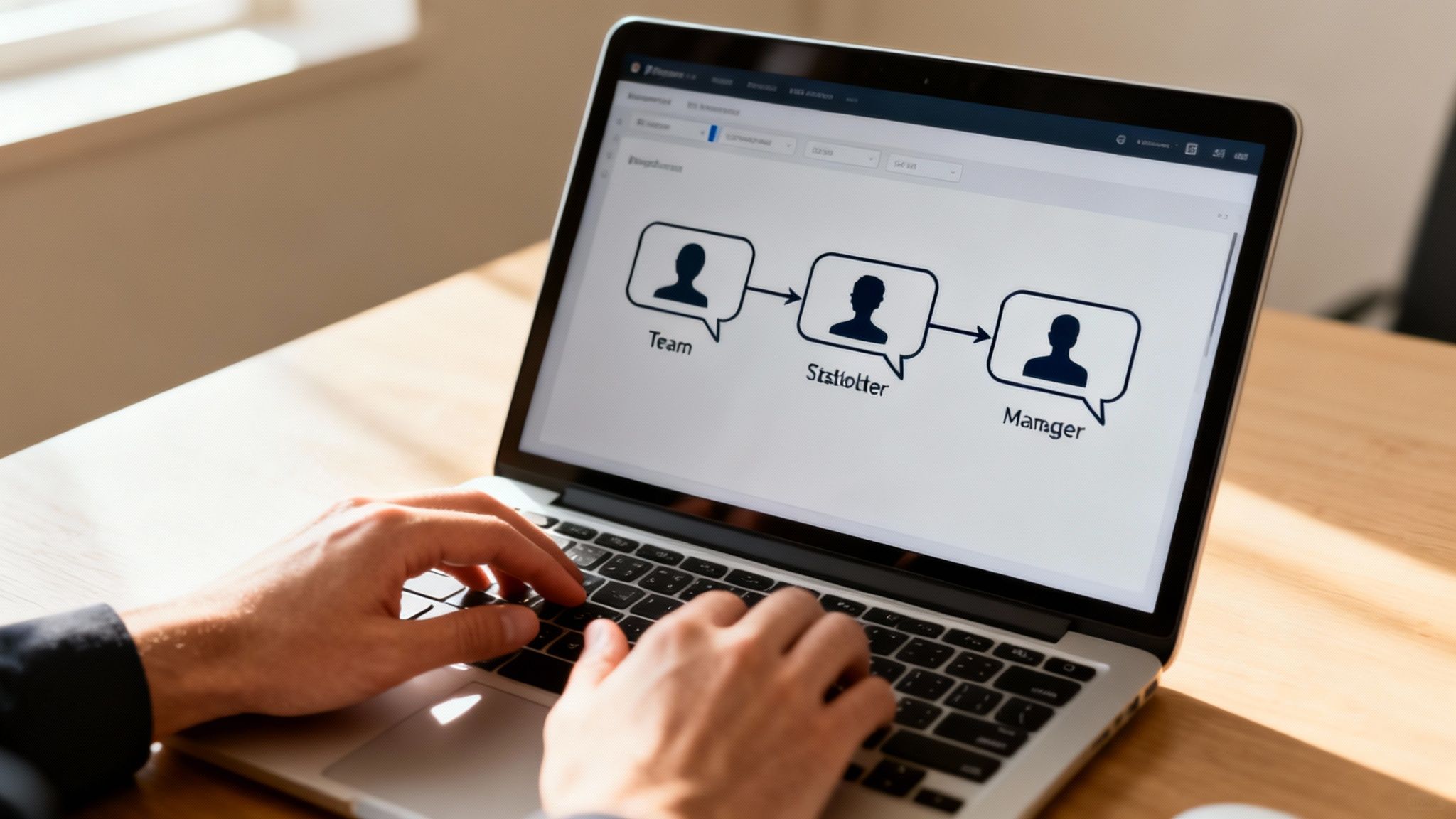
Your response should demonstrate a proactive, strategic approach to communication, not a reactive one. It's your opportunity to show that you understand that different audiences require different information, delivered in different ways.
What the Interviewer Wants to Hear
Interviewers are looking for evidence of a structured communication plan. They want to see that you can do more than just send emails; you can facilitate a flow of information that builds trust and prevents misunderstandings.
- Communication Planning: Do you mention creating a formal communication matrix or plan? Do you define who needs what information, when they need it, and in what format?
- Audience Tailoring: How do you adapt your message for different stakeholders? Can you articulate the difference between a daily stand-up update for the project team and a monthly executive summary?
- Tool Proficiency: Do you reference specific tools for different communication purposes? This could include Slack for quick updates, a project portal for documentation, and scheduled video calls for key decisions.
- Proactive Management: How do you handle communicating risks, delays, or bad news? Do you have a process for escalation and transparent reporting?
How to Structure Your Answer
The STAR method (Situation, Task, Action, Result) is an excellent way to frame your answer, providing a concrete example of your communication skills.
- Situation: Briefly set the scene. For example, "On a recent project to develop a new customer portal, we had team members across three time zones and a key stakeholder group that was not tech-savvy."
- Task: State your objective. "My responsibility was to create a communication strategy that kept the distributed team in sync while providing clear, high-level updates to the stakeholders without overwhelming them with technical jargon."
- Action: Describe the steps you implemented. "I established a communication plan that included daily stand-ups on Slack for the dev team, a weekly email digest with progress metrics for the project manager, and a bi-weekly demo call with stakeholders using a simple, visual presentation. All documentation was centralized in a Confluence space."
- Result: Share the positive outcome. "This tailored approach reduced unnecessary meetings by 30% and improved stakeholder satisfaction scores. They specifically mentioned feeling 'in the loop' and confident in the project's direction, leading to a smooth final approval."
Explore different ways to keep your team connected with these remote team collaboration tools.
7. Describe your experience coordinating between different departments or teams
This is a core behavioral question for a project coordinator because projects rarely exist in a vacuum. Hiring managers ask this to gauge your ability to act as a central communication hub, build consensus, and navigate the different priorities, cultures, and communication styles that exist between departments like Engineering, Marketing, Sales, and Finance.
Your answer demonstrates your diplomatic skills and your capacity to align diverse teams toward a single, shared objective. It’s a chance to show you can bridge organizational silos and foster a collaborative environment, which is essential for project success.
What the Interviewer Wants to Hear
Interviewers are looking for evidence that you are a facilitator and a diplomat, not just a task manager. They want to see how you handle the human element of project management.
- Communication Methods: How do you adapt your communication style for different audiences? Do you use specific tools or meeting cadences (e.g., cross-functional stand-ups, shared Slack channels) to keep everyone aligned?
- Conflict Resolution: How do you handle disagreements or competing priorities between departments? Can you find common ground and mediate a solution?
- Building Relationships: Do you proactively build rapport with key contacts in different teams, or do you only interact when a task is due?
- Process Creation: Have you ever established a new process or communication plan to improve cross-functional collaboration?
How to Structure Your Answer
The STAR method (Situation, Task, Action, Result) is again the ideal framework. It helps you tell a compelling story about your cross-functional collaboration skills.
- Situation: Set the scene. "In my last role, I was the project coordinator for a major product launch that required tight collaboration between the Engineering, Marketing, and Customer Support teams."
- Task: Define your role. "My main task was to ensure that all three departments were perfectly aligned on the timeline, messaging, and technical readiness to guarantee a smooth launch for our customers."
- Action: Describe your specific steps. "I established a weekly cross-functional sync meeting with leads from each department. I also created a shared dashboard in Asana to provide a single source of truth for all deliverables, dependencies, and deadlines. When Marketing needed technical specs and Engineering needed campaign assets, I facilitated direct communication to prevent delays."
- Result: Share the positive outcome. "This proactive coordination led to a successful launch that exceeded our initial user adoption goals by 15%. The clear communication channels we established were later adopted as a standard process for all future product launches."
8. What experience do you have with budget tracking and cost management?
This is a core technical question that assesses your financial literacy within a project context. While project managers often own the budget, project coordinators are increasingly involved in tracking expenses, processing invoices, and flagging variances. Hiring managers ask this to gauge your comfort with numbers, attention to detail, and understanding of how financial health impacts project success.
Your answer demonstrates your ability to be a responsible steward of company resources. It shows you understand that projects are not just about timelines and deliverables but also about delivering value within financial constraints. This skill is critical for any project coordinator looking to grow into a project management role.
What the Interviewer Wants to Hear
The interviewer is looking for evidence that you can be trusted with financial data. They want to know if you have a systematic approach to monitoring costs and if you understand the importance of accurate reporting.
- Financial Processes: Can you describe a clear process for tracking expenses, from purchase orders to final reconciliation?
- Tools and Software: Do you have experience with specific tools like Excel spreadsheets for budget tracking, or accounting software like QuickBooks or Oracle?
- Variance Analysis: Do you understand what to do when actual costs differ from the budgeted amount? How do you investigate and report these variances?
- Communication: How do you communicate financial status to project managers or other stakeholders? Can you prepare a basic budget summary report?
- Proactive Mindset: Do you just track numbers, or do you look for cost-saving opportunities and flag potential overruns before they become major issues?
How to Structure Your Answer
Use the STAR method to provide a concrete example of your budget management experience. This makes your skills tangible and easy for the interviewer to understand.
- Situation: Briefly set the scene. "In my role coordinating an annual marketing conference, I was responsible for tracking a $50,000 budget for vendor expenses, including catering, venue, and AV equipment."
- Task: State your specific responsibilities. "My task was to monitor all spending against the budget, ensure all invoices were processed correctly, and provide a weekly financial status report to the project manager."
- Action: Describe the steps you took. "I maintained a detailed Excel spreadsheet that logged every purchase order and invoice. Each week, I compared actual spending to our budget forecast, highlighting any line items that were trending over. I also identified a vendor who offered a 10% early payment discount, which I flagged to my manager."
- Result: Share the positive outcome. "As a result, we stayed 5% under budget, which allowed us to add an unexpected networking feature to the event. The project manager had full visibility into our financial status at all times, preventing any end-of-project surprises."
9. Tell me about a time you had to quickly learn something new to complete a project
Project environments are dynamic, and a project coordinator often needs to wear many hats. This behavioral question is designed to test your adaptability and learning agility. Hiring managers want to see that you embrace challenges, take initiative to close knowledge gaps, and can become proficient in a new area under pressure.
Your response to this question demonstrates your resourcefulness and proactive problem-solving skills. It's a chance to show you are not just a task manager but an asset who can grow with the project's needs, a key trait they look for when evaluating candidates for a project coordinator position.
What the Interviewer Wants to Hear
Interviewers are looking for evidence that you can learn quickly and apply that new knowledge effectively. They want to understand your learning process and your attitude toward unexpected hurdles.
- Initiative: Did you wait to be told what to do, or did you identify the knowledge gap and seek out a solution yourself?
- Learning Process: How did you go about learning? Did you use online courses, consult with internal experts, read documentation, or use a combination of methods?
- Application: How did you apply what you learned directly to the project? Show a clear link between your new skill and a positive project outcome.
- Time Management: How did you balance the time spent learning with your existing project responsibilities? This shows you can manage your workload effectively.
How to Structure Your Answer
Using the STAR method (Situation, Task, Action, Result) will help you tell a compelling and structured story that highlights your capabilities.
- Situation: Briefly set the scene. "In my last role, we were launching an email marketing campaign, but our team's specialist left unexpectedly mid-project, and the new software was unfamiliar to everyone."
- Task: State your objective. "My task was to get up to speed on the new email marketing platform, Mailchimp, within one week to avoid delaying the campaign launch."
- Action: Describe the steps you took to learn. "I immediately enrolled in Mailchimp’s official online tutorials and dedicated two hours each morning to them. I also scheduled a 30-minute call with a contact in another department who had experience with the tool to ask targeted questions. I created a test campaign to practice building segments and automation flows."
- Result: Quantify the impact your learning had. "As a result, I successfully built and scheduled the entire campaign, which launched on time and achieved a 25% open rate, exceeding our target. I also created a simple 'how-to' guide for the team to use for future campaigns."
10. How would you handle discovering a major error or omission late in a project?
This situational question is a stress test of your integrity, accountability, and problem-solving skills. Hiring managers aren't looking for someone who has never made a mistake; they're looking for someone who knows how to handle one professionally. How you respond to a high-stakes crisis reveals your character and maturity.
This question moves beyond simple task management to explore your ability to navigate failure, communicate difficult news, and lead a course correction under pressure. It's a chance to demonstrate that you are a resilient and reliable coordinator who can be trusted when things inevitably go wrong.
What the Interviewer Wants to Hear
Interviewers are assessing your crisis management protocol. They want to see a calm, logical approach that prioritizes transparency and solutions over blame or panic.
- Accountability: Do you take immediate ownership of the situation, even if the error wasn't directly your fault?
- Communication: How quickly and clearly do you escalate the issue to the right people? Do you come prepared with an initial impact assessment?
- Problem-Solving Focus: Do you shift quickly from identifying the problem to developing and proposing solutions?
- Damage Control: Do you demonstrate an understanding of how to minimize the impact on the project timeline, budget, and stakeholders?
- Learning and Prevention: Do you mention a final step of analyzing the root cause to prevent future occurrences? This shows strategic thinking.
How to Structure Your Answer
The STAR method is again a great framework, but you can adapt it to a more forward-looking, "how I would handle it" scenario.
- Situation: Acknowledge the gravity of the scenario. "Discovering a major error late in a project is a serious situation that requires immediate and careful action."
- Task: Define your immediate goals. "My first priority would be to understand the full scope of the error and then to communicate it transparently to the project manager and key stakeholders."
- Action: Detail your step-by-step plan. "I would immediately conduct a rapid assessment to quantify the impact on the timeline, budget, and deliverables. Concurrently, I'd schedule an urgent meeting with the project lead, presenting both the problem and potential solutions. My communication would be factual and solution-oriented, not focused on blame. Next, I'd work with the team to implement the agreed-upon corrective action plan."
- Result: State the desired outcome of your actions. "By taking these steps, the goal is to mitigate the damage, realign stakeholder expectations with a new, realistic plan, and rebuild trust through transparent handling of the crisis. Finally, I would facilitate a post-project review to ensure we implement processes that prevent a similar error from happening again."
Top 10 Project Coordinator Interview Questions Comparison
| Question | 🔄 Implementation complexity | ⚡ Resource requirements | 📊 Expected outcomes | 💡 Ideal use cases | ⭐ Key advantages |
|---|---|---|---|---|---|
| Tell me about a time you managed multiple projects with competing deadlines | 🔄 Medium — requires probing for specifics and metrics | ⚡ Low — verbal example; minimal prep | 📊 Evidence of prioritization, time management, tooling | 💡 Hiring project coordinators who juggle concurrent tasks | ⭐ Reveals real-world workload-management and organization |
| Describe a situation where you had to handle a difficult team member or stakeholder | 🔄 Medium — sensitive follow‑ups to assess nuance | ⚡ Low — anecdotal response | 📊 Insight into emotional intelligence and conflict resolution | 💡 Roles demanding stakeholder diplomacy and team harmony | ⭐ Shows professionalism, accountability, and diplomacy |
| Walk me through how you organize and track project deliverables and timelines | 🔄 Medium‑High — may need technical walkthroughs | ⚡ Medium — may request tools, artifacts, or demos | 📊 Demonstrates process rigor, tools proficiency, and traceability | 💡 Technical PM roles needing proven tracking systems | ⭐ Provides concrete proof of methodology and attention to detail |
| Your project is running behind schedule. What do you do? | 🔄 Medium — evaluate decision process and trade‑offs | ⚡ Low — scenario discussion; may request examples | 📊 Reveals problem‑solving, mitigation plans, and communication | 💡 Assessing crisis response and recovery planning skills | ⭐ Shows proactive mitigation and stakeholder management |
| Tell me about your experience with project management methodologies | 🔄 Medium — clarify depth vs. breadth of knowledge | ⚡ Low — discussion; certifications may be reviewed | 📊 Indicates methodological fit and adaptability | 💡 Hiring for specific frameworks (Agile, Waterfall, hybrid) | ⭐ Highlights framework knowledge and relevant certifications |
| How do you ensure effective communication within a project team and with stakeholders? | 🔄 Medium — asks for plan and examples | ⚡ Low — may request templates or cadence examples | 📊 Shows communication strategy, channels, and escalation paths | 💡 Roles acting as central communication hub | ⭐ Demonstrates ability to prevent misalignment and keep visibility |
| Describe your experience coordinating between different departments or teams | 🔄 Medium — probes for influence without authority | ⚡ Low — example‑based; may ask for artifacts | 📊 Evidence of cross‑functional alignment and consensus building | 💡 Matrixed organizations and multi‑stakeholder projects | ⭐ Reveals diplomacy, stakeholder navigation, and collaboration |
| What experience do you have with budget tracking and cost management? | 🔄 High — may require numeric examples and documents | ⚡ Medium — may need spreadsheets or reports | 📊 Shows financial discipline, variance analysis, forecasting | 💡 Projects with cost responsibility or scaling budgets | ⭐ Indicates readiness for higher ownership and financial control |
| Tell me about a time you had to quickly learn something new to complete a project | 🔄 Low‑Medium — focuses on learning approach and timeline | ⚡ Low — anecdotal with possible evidence of outcomes | 📊 Demonstrates learning agility, resourcefulness, and impact | 💡 Fast‑paced or evolving roles requiring quick upskilling | ⭐ Signals adaptability and self‑directed problem solving |
| How would you handle discovering a major error or omission late in a project? | 🔄 High — assess ethics, escalation, and remediation steps | ⚡ Low‑Medium — may ask for real example and impact analysis | 📊 Reveals accountability, crisis management, and recovery plan | 💡 Roles where risk, compliance, or quality are critical | ⭐ Tests integrity, transparency, and corrective leadership |
From Preparation to Offer: Your Next Steps to Success
Navigating the interview process for a remote project coordinator role is much like managing a project itself. It requires meticulous preparation, clear communication, and a strategic approach to showcasing your value. The comprehensive list of interview questions for a project coordinator we've explored isn't just a study guide; it's a blueprint for articulating your unique blend of organizational prowess, technical skill, and interpersonal finesse. By moving beyond rote memorization and towards genuine storytelling, you transform a simple Q&A session into a compelling narrative of your professional capabilities.
Remember, every behavioral question about a past challenge is an opportunity to demonstrate resilience. Every situational question about a hypothetical problem is a chance to prove your critical thinking. And every technical question about tools and methodologies is your moment to establish credibility. The ultimate goal is to connect the dots for the hiring manager, illustrating precisely how your past experiences and skills directly solve their current needs for a highly organized, proactive, and reliable remote team member.
Synthesizing Your Skills into a Cohesive Narrative
Your preparation shouldn't stop at formulating perfect answers. The real power lies in weaving these individual responses into a consistent and memorable story about who you are as a professional.
- Identify Your Core Themes: Review your answers. What are the recurring themes? Perhaps it's your exceptional ability to foster collaboration in a distributed team, your talent for bringing order to chaos, or your knack for using data to drive decisions. Identify two or three of these core strengths.
- Connect to the Remote Context: For each theme, explicitly link it to the demands of a remote work environment. If your theme is "proactive communication," explain how that translates to keeping stakeholders informed across different time zones without direct oversight. This demonstrates self-awareness and a deep understanding of what it takes to succeed outside a traditional office.
- Use the STAR Method as Your Framework: The STAR (Situation, Task, Action, Result) method is more than just a technique; it's a storytelling structure. Use it consistently to give your answers clarity, depth, and impact. The "Result" is your punchline, so always quantify it when possible (e.g., "This improved team efficiency by 15%" or "It helped us deliver the project two weeks ahead of schedule").
Actionable Next Steps to Secure Your Offer
With your answers polished and your narrative defined, it's time to put your preparation into action and manage the final phases of your "job search project."
- Conduct Mock Interviews: Practice is non-negotiable. Ask a friend, mentor, or career coach to run through these interview questions for a project coordinator with you. Record yourself to analyze your body language (even on video calls), tone of voice, and the clarity of your responses. This is where you iron out the wrinkles and build confidence.
- Polish Your Digital Footprint: In today's remote-first world, your online presence is often the first impression you make. Recruiters will look you up. Ensure your professional profiles are aligned with the story you're telling in interviews. A well-crafted digital brand can be a powerful asset, so take the time to learn about optimizing your LinkedIn profile to attract recruiters and make sure it reflects your expertise and readiness for the role.
- Prepare Your Own Questions: An interview is a two-way street. Prepare thoughtful questions for the hiring manager that demonstrate your genuine interest and strategic thinking. Ask about team dynamics, communication tools, performance metrics for the role, and the company's biggest project challenges. This shows you're not just looking for any job; you're looking for the right job.
By mastering these interview questions, you're not just preparing for a 30-minute conversation; you're investing in your career. You are building the confidence and communication skills that will not only land you the job but will also make you a more effective and successful project coordinator from day one.
Ready to put your preparation to the test? The best way to practice is by applying to real, high-quality remote roles. At RemoteWeek, we curate the best remote project coordinator positions from top companies, saving you the time and effort of sifting through endless job boards. Find your next opportunity on RemoteWeek and take the next confident step in your career journey.