
Grow Your Career with ios developer jobs remote: High-Paying iOS Roles
It's no secret that the market for ios developer jobs remote is on fire. Companies everywhere need top-tier talent to build and perfect their apps for Apple's massive user base, and they've realized that talent isn't limited by zip code. This shift has blown the doors wide open for developers, offering a global pool of opportunities right from your home office.
This guide is your playbook for navigating this new landscape and landing a remote role that's a perfect fit.
Why Remote iOS Development Is a Golden Opportunity
Let's face it: our world runs on apps, and a huge chunk of that world runs on iOS. For any serious business, a slick, reliable iOS app isn't just a "nice-to-have"—it's a direct line to their customers. This constant need to build, innovate, and maintain these apps has created a fierce competition for skilled developers, forcing companies to cast a much wider net.

This isn't just a feeling; the data backs it up. The remote work explosion has been great for developers' wallets. iOS specialists, in particular, are cashing in, with average freelance hourly rates sitting comfortably between $81-100 worldwide. That's a noticeable step up from what many Android developers make.
This premium isn't arbitrary. It reflects the specialized expertise needed to master Apple's ecosystem, especially with Swift now being the non-negotiable standard for modern development.
Your Roadmap to Landing a Great Remote Role
A successful job hunt is about more than just your coding chops. This guide breaks down the entire process, giving you practical, real-world advice every step of the way.
Here’s what we’ll cover:
- Crafting a Remote-Ready Portfolio: I'll show you how to frame your projects to scream "I'm a self-sufficient, great communicator," not just "I can write code."
- Finding and Vetting the Best Gigs: We'll dive into the best places to look and, more importantly, how to spot a genuinely good remote opportunity and steer clear of the duds.
- Acing the Remote Interview Gauntlet: Get actionable tips for crushing every stage—from the initial video screen to the technical deep-dive and the all-important culture-fit chat.
- Negotiating Like a Pro: Learn how to confidently ask for the salary and remote-work benefits you deserve, using data and proven strategies to back it up.
Before you even start applying, it’s smart to have a solid grasp of the high-level architectural decisions companies face. Understanding the trade-offs in Native vs. Hybrid App Development gives you incredible context, helping you understand why a team made certain choices and how you fit into their strategy.
By the time you're done here, you'll have a clear, step-by-step plan to find and secure high-paying ios developer jobs remote with companies that genuinely get it. Let’s jump in.
Building a Portfolio That Shines in a Remote World
When you're hunting for ios developer jobs remote, your portfolio is more than just a gallery of your past work—it’s your lead salesperson. In a remote setting, a hiring manager can't get a feel for your personality in the office or watch you solve a problem on a whiteboard. They have to rely on your portfolio to tell the story of who you are as a developer and, critically, as a potential remote teammate.

A killer remote portfolio doesn’t just show off flashy screenshots. It needs to demonstrate your problem-solving process, your communication chops, and your ability to get things done without someone looking over your shoulder. It’s your chance to answer the big questions on every remote hiring manager's mind: Can you manage your own time? Are you a clear written communicator? Is your code clean enough for a distributed team to pick up and run with?
Go Beyond "What" and Explain "Why"
So many developers fall into the trap of treating their project descriptions like a feature list. Just saying you "Built a to-do list app with SwiftUI and Core Data" tells a recruiter almost nothing about your actual skills. You have to narrate the journey.
A much stronger approach is to frame each project as a story of a problem and its solution. What was the initial challenge? Why did you choose a particular architecture? What unexpected hurdles did you have to overcome? This small shift in framing turns a simple technical exercise into a compelling case study of your engineering mind at work.
Your portfolio is your chance to show, not just tell. Every project description is an opportunity to prove you possess the soft skills essential for remote success—proactive communication, thoughtful documentation, and a knack for explaining complex decisions asynchronously.
Think about each project as if you're doing a mini-retrospective. What was the main goal? What technical trade-offs did you have to make? Knowing what you know now, what would you do differently? Answering these questions shows a level of professional maturity and self-awareness that is gold to remote teams. For more ideas, our guide on what makes you stand out from other candidates has some great tips.
Your GitHub Is Your Remote Work Resume
For any remote iOS developer, a clean, active GitHub profile can be far more persuasive than a traditional resume. It’s a living, breathing document of your real-world work habits.
Here’s how to make yours count:
- A Detailed README is Non-Negotiable: Every public project needs a solid
README.md. Explain what the project is, how to get it running, and the key technologies you used. This is a direct reflection of your ability to write clear documentation for an asynchronous team. - Showcase Clean, Intentional Commits: A commit history full of "fixed bug" or "stuff" is a major red flag. Instead, write descriptive commit messages that explain the why behind each change. It shows you respect your future teammates' time.
- Contribute to Open Source: You don't have to rewrite a framework. Even small contributions—fixing a typo in documentation, submitting a tiny bug fix—prove you can navigate a foreign codebase and collaborate with people you’ve never met face-to-face.
A polished portfolio also shows you have a good eye for usability and design. It’s not just about the code; it’s about proving you have a solid grasp of user interface design fundamentals. This tells them you can build apps that are not just functional but genuinely nice to use.
Ultimately, your portfolio should leave a hiring manager with one clear takeaway: "This is someone I can trust to get the job done, no matter where they are."
How to Find and Vet High-Quality Remote iOS Jobs
The number of remote iOS developer jobs has exploded, which is fantastic news. You’re no longer tethered to the companies in your immediate area. But with this ocean of opportunity comes a real challenge: separating the truly great roles from the low-effort, copy-paste listings.
Knowing where to look is the first, and most important, step.
Stop Wasting Time on Generic Job Boards
Let’s be honest, scrolling through giant, all-purpose job boards feels like shouting into the void. Your carefully crafted application often gets lost in a sea of thousands, and many of the roles aren't even truly remote-first.
Your time is far better spent on curated platforms that specialize in remote work. These niche boards are a game-changer because they do the initial filtering for you, vetting the companies they feature. This means you're connecting with organizations that already understand and embrace a strong remote culture.
For instance, at RemoteWeek, we focus exclusively on companies that genuinely invest in their teams. That selective approach cuts through the noise. Likewise, tech-specific boards can be absolute goldmines. If you’re a Swift expert, you’ll find highly relevant listings for remote Swift developer jobs without wading through irrelevant postings.
The key is to focus your search on platforms that prioritize quality over sheer quantity. It makes the entire process more efficient and less frustrating.
Vetted Platforms Are Your Best Bet
Not all job boards are created equal. The best ones have a rigorous process for evaluating the companies they list, ensuring you're looking at legitimate, high-quality opportunities.
Here’s a look at some of the top platforms where you’re more likely to find your next great role:
Top Platforms for Vetted Remote iOS Developer Jobs
| Platform | Primary Focus | Company Vetting Process | Best For |
|---|---|---|---|
| We Work Remotely | The largest remote-specific job board, covering all industries. | Companies pay a premium to post, which filters out low-effort listings. | A broad search with a high volume of quality roles. |
| RemoteOK | Tech-focused remote jobs, with a strong developer community. | Aggregates and curates listings from across the web. | Finding tech-centric companies, including innovative startups. |
| RemoteWeek | Curated roles from employee-centric, remote-first companies. | Hand-vets companies for strong remote culture and benefits. | Developers who prioritize work-life balance and company culture. |
| Arc.dev | Vetted remote developer jobs and a talent-matching service. | Rigorous screening for both developers and companies. | Senior developers looking for top-tier, long-term roles. |
By starting your search on these platforms, you're already one step ahead. You can trust that the companies listed are serious about hiring remote talent and have been evaluated for quality.
How to Read a Job Description Like an Engineer
Once you’ve found some promising listings, it's time to put on your detective hat and dissect the job description. A well-written JD is a huge green flag—it's your first real glimpse into a company's culture, their technical maturity, and how much they value their engineers.
Look for these positive signals:
- Clear Salary Bands: Companies transparent about compensation from the start respect your time. A vague promise of a "competitive salary" can be a red flag.
- A Detailed Tech Stack: A great listing goes beyond "iOS experience." It'll specify frameworks (like SwiftUI or Combine), architectural patterns (MVVM, TCA), and their CI/CD tools (Fastlane, GitHub Actions).
- A Focus on Work-Life Balance: Any mention of flexible hours, asynchronous work, or generous PTO is a fantastic sign of a healthy remote environment.
- Well-Defined Responsibilities: The role's duties should be specific and measurable, not just a generic wish list of every iOS skill imaginable.
On the flip side, be wary of red flags like commission-only pay, incredibly vague duties, or a laundry list of "required" skills that feels impossible for a single person to have.
A job description is a company’s first handshake. If it’s weak, confusing, or full of buzzwords, it’s telling you something important about their internal communication and organization. Trust your gut.
Dig Deeper: Verify Their Remote Culture
A great job description is a good start, but it's not the whole story. You need to verify that the company's remote culture is as solid as they claim. A little independent research here goes a very long way.
Start with employee reviews on sites like Glassdoor, but filter for comments from other engineers. Search for blog posts or articles written by their current team. Do their engineers speak at conferences or contribute to open source? This digital footprint offers a much more authentic insight into their real engineering culture.
Market data also tells a compelling story. According to research from BuiltIn, top remote roles in Seattle for iOS Core Product Engineers are offering $140K-$200K, while senior positions in the healthtech space can command $150K-$253K. In the Denver/Boulder area, you'll see similar senior roles advertised between $156K-$225K. Knowing these numbers helps you benchmark offers and target companies that are serious about paying market value.
By combining a targeted job search with sharp analysis, you can stop just applying for jobs and start strategically pursuing the career-defining remote roles you deserve.
Nailing the Remote iOS Interview
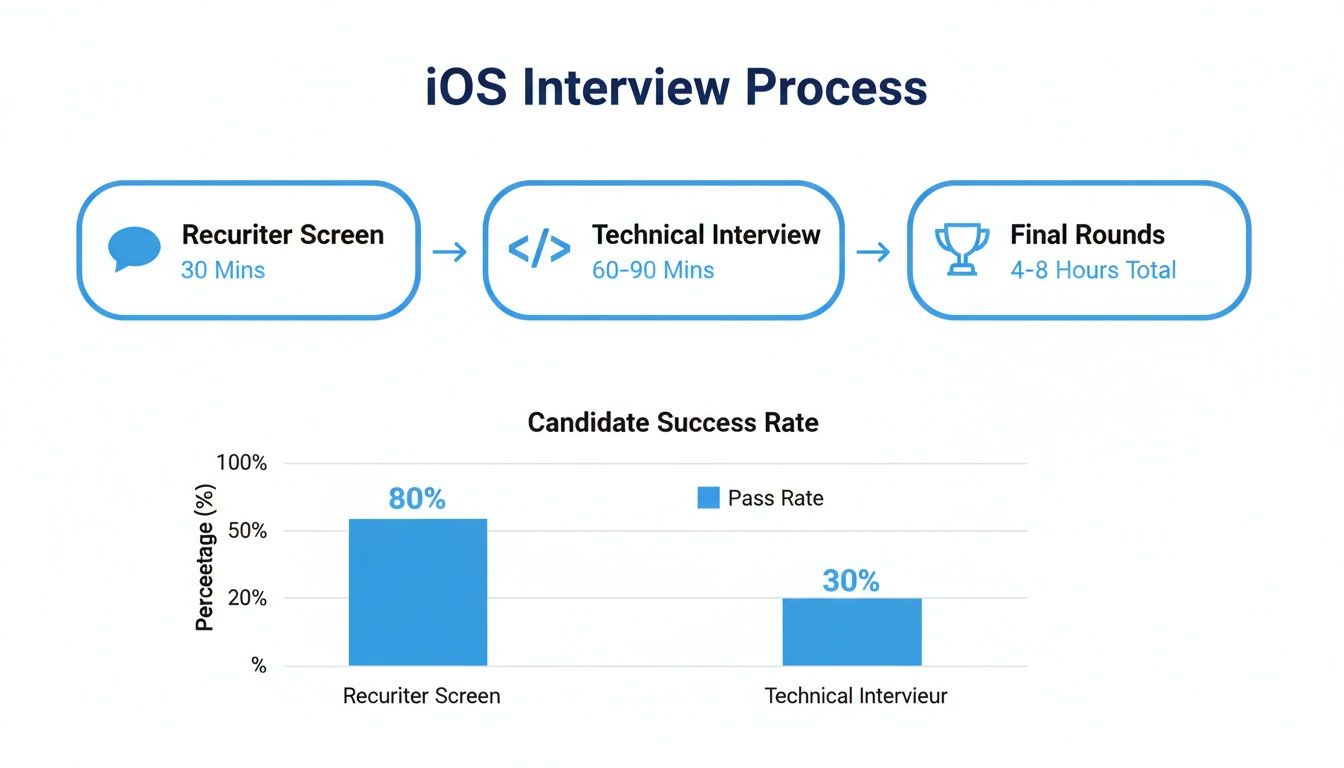
The interview process for a remote iOS job is a different beast altogether. It's not just about flexing your Swift and UIKit muscles; it’s about showing a potential employer that you can thrive without someone looking over your shoulder. You have to prove you're a solid developer and a dependable remote teammate.
From the first chat with a recruiter to the final, intense technical grilling, every single step is a test of your remote-readiness. Companies are betting on you, and they need to see that you can collaborate on a tricky feature with a team scattered across the globe.
Setting the Scene for Success
Before you even open your mouth, your interview environment is already talking. A chaotic background, bad lighting, or a choppy connection can signal disorganization right from the start. You don’t need a fancy home studio, but a little prep work makes a huge difference.
- Mind Your Background: Keep it simple and clean. A tidy bookshelf or a neutral wall works perfectly. I'd steer clear of those virtual backgrounds—they can be glitchy and often come across as less professional.
- Do a Tech Rehearsal: Seriously, test your camera, mic, and internet connection well before the call. Nothing torpedoes an interview faster than garbled audio or a frozen screen.
- Get Your Camera Angle Right: Position your camera at eye level. It’s a small tweak that completely changes the dynamic, making the conversation feel more like a real face-to-face chat instead of a weird surveillance feed.
Getting these little details right shows you're professional, organized, and serious about the opportunity. For more on this, check out our complete guide to virtual interview tips.
Tackling the Technical Challenges
Remote technical interviews usually fall into one of a few categories. Each is meant to test not just what you know, but how you work and collaborate from a distance.
1. The Take-Home Project
This is a huge favorite for remote companies because it’s the closest thing to an actual work assignment. You get a problem, a deadline, and the autonomy to solve it. But they're not just looking at the finished app.
Treat your take-home project like a real pull request. Your commit history, the quality of your README, and how you document your code are just as critical as the feature itself.
2. The Live Coding Session
This one is all about your thought process. The interviewer wants to hear how you break down a problem, articulate your strategy, and handle feedback on the fly. Remember to think out loud. Explain why you're doing what you're doing, even if you’re still working toward the solution.
3. The System Design Chat
If you're going for a more senior role, expect to be asked to architect a new feature or maybe even a whole app. This is where they test your big-picture thinking. You'll need to discuss trade-offs around things like scalability, performance, and user experience, and be ready to justify your decisions.
Proving You're Built for Remote Work
Your technical chops will get you in the door, but your soft skills will land you the job. Hiring managers are specifically looking for evidence that you have what it takes to work effectively on your own. You'll need to have specific examples ready to go.
- Autonomy and Initiative: Have a story ready about a time you spotted a problem, took ownership, and solved it without waiting for instructions. This is gold.
- Asynchronous Communication: Think of a time you worked through a complex issue or a disagreement using tools like Slack, Jira, or GitHub comments. Clear, concise writing is a remote superpower.
- Time Management: Be prepared to talk about how you structure your day, prioritize your work, and hit deadlines. If you've worked across different time zones before, make sure you bring that up.
For example, if they ask how you'd handle a vaguely defined task, you could walk them through a past project. Explain how you drafted a short document outlining your understanding and proposed technical path, then shared it for feedback before jumping into the code. This shows foresight, excellent communication, and a bias for action—exactly what every company wants in a candidate for ios developer jobs remote.
Negotiating Your Salary and Remote Work Terms
Getting a job offer is a huge win, but don't pop the champagne just yet. This is where the real conversation begins. It’s your chance to make sure the role isn't just a good technical fit, but also a great fit for your financial goals and the remote lifestyle you want.
Negotiating can feel awkward, but it doesn’t have to be. When you walk in with solid data, you transform a potentially uncomfortable haggle into a professional discussion about your market value. You're a specialist in a high-demand field—your compensation should absolutely reflect that.
Anchor Your Ask in Real-World Data
Before you even dream of a number, do your homework. Salaries for ios developer jobs remote are all over the map, influenced by everything from company size and location to your own experience. Your most powerful tool is a clear, data-backed salary range.
Looking at the numbers, you'll see some fascinating trends. Wellfound's 2026 hiring data shows the average remote iOS salary at US startups is $75,167, but that figure spans a wide range from $44K to $160K. Meanwhile, other US-focused sources report a much higher average of $171,433. Freelancers are doing well too, with rates of $81-100/hr, which can top $168K annually. This huge variance is exactly why you need to come prepared to negotiate.
This handy table breaks down what you might expect based on your location and experience level.
Average Remote iOS Developer Salary by Region and Experience
| Region | Junior Developer (1-2 Yrs) | Mid-Level Developer (3-5 Yrs) | Senior Developer (5+ Yrs) |
|---|---|---|---|
| North America (USA/Canada) | $95,000 - $130,000 | $130,000 - $170,000 | $170,000 - $220,000+ |
| Western Europe (UK/Germany) | $65,000 - $85,000 | $85,000 - $120,000 | $120,000 - $160,000+ |
| Australia/New Zealand | $70,000 - $90,000 | $90,000 - $130,000 | $130,000 - $170,000+ |
| Eastern Europe | $40,000 - $60,000 | $60,000 - $90,000 | $90,000 - $125,000+ |
| Latin America | $35,000 - $55,000 | $55,000 - $80,000 | $80,000 - $110,000+ |
Note: These are estimates in USD and can vary based on the specific company, benefits, and local cost of living.
Having made it through their entire interview process, you're in a much stronger position than you think. They've invested a lot of time and energy to get to you.
They chose you. That gives you leverage.
Look Beyond the Base Salary
A great remote offer is about more than just the base pay. Working from home brings a whole different set of needs and opportunities, so don't be shy about negotiating for perks that make a real difference in your day-to-day.
Think bigger than just the salary. Here are a few high-value items that can turn a good offer into a fantastic one:
- Home Office Stipend: A one-time or yearly allowance for a great chair, desk, or monitor shows the company is invested in your productivity and well-being.
- Flexible Working Hours: This is the heart and soul of remote work. Get clarity on core hours versus true flexibility. You want the autonomy to structure your day effectively.
- Professional Development Budget: A dedicated budget for conferences, courses, or certifications is a direct investment in your growth, which is a win-win for you and the company.
- Equity or Stock Options: Especially at startups, this can be a huge part of your total compensation. Make sure you understand the vesting schedule and what the options are actually worth.
Your goal isn't just to get paid; it's to be set up for success. A company that invests in your remote workspace and professional growth is one that truly gets what it takes to build a great remote team.
Clarify the Remote Work Logistics
Once you're happy with the compensation package, it’s time to iron out the practical details. Misaligned expectations about how the work actually gets done can quickly ruin an otherwise amazing role.
Before you sign anything, get clear answers on these key points:
- Time Zone Expectations: Are there "core hours" when you absolutely must be online? Is the team culture more synchronous or asynchronous? This is critical for work-life balance, especially across different time zones.
- Communication Norms: How does the team really talk? Is it a constant stream of real-time Slack messages or a more measured, thoughtful approach in tools like Jira or Notion?
- Meetings and Travel: Will you be expected to travel for in-person meetups? Knowing the frequency and duration ahead of time lets you plan your life around it.
Instead of a simple "yes/no" question, try asking something like, "Could you walk me through what a typical day of collaboration looks like? I'm curious about the balance between synchronous meetings and deep work." This gives you real insight into their culture, not just their official policy. Nailing down these details ensures you’re stepping into a role that genuinely works for you.
Got Questions About Remote iOS Jobs?
If you're diving into the world of remote iOS development, you probably have a few questions. It’s a competitive space, and whether you're just starting out or you've been building apps for years, knowing what hiring managers are really looking for can make all the difference. Let's get into some of the most common questions I hear from developers.
What Skills Are Actually in Demand Right Now?
Look, knowing Swift and SwiftUI is table stakes. To really get noticed, you need to show you’ve mastered the tools that modern, distributed teams rely on every day.
Concurrency is a huge one. If you can’t confidently work with Combine or async/await, you’re going to have a tough time. So many apps today need to feel snappy and responsive, and that all comes down to handling asynchronous work correctly. On a similar note, since apps often need to function without a perfect connection, a deep understanding of local data persistence with Core Data or Realm is non-negotiable for many teams.
Architecturally, MVC just doesn't cut it for complex projects anymore. You have to prove you can think in terms of scalability. Experience with patterns like MVVM (Model-View-ViewModel) or even TCA (The Composable Architecture) signals that you can build something that won't fall apart six months down the line and that other remote engineers can jump into without a week of hand-holding.
Don't underestimate the power of stellar asynchronous communication. This isn't just about being friendly on Slack. It's about writing Jira tickets so clear they answer questions before they're asked, crafting pull request descriptions that tell a story, and documenting your work so a teammate eight time zones away can pick up right where you left off.
Finally, show them you understand the full picture. A solid grasp of the CI/CD pipeline, using tools like GitHub Actions or Fastlane, is a massive plus. It shows you think about efficiency and automation, which are pure gold for any remote engineering culture.
How Can a Junior Developer Stand Out Without Remote Experience?
This is the classic chicken-and-egg problem, right? But it's totally beatable. Without professional remote work on your resume, your personal projects are your best evidence.
Forget building a dozen half-finished tutorial apps. Focus on one or two projects that you take from concept all the way to the App Store. Shipping an app is an incredible signal to employers. It proves you have the grit to see a project through and that you understand the entire development lifecycle, not just the fun coding part.
Treat your GitHub profile like your remote-work portfolio. It's your chance to show, not just tell.
- Write a killer README: Don't just list the features. Explain the why behind the app, detail the tech stack, and provide crystal-clear instructions on how to build and run it yourself.
- Keep a clean commit history: Your commit messages should tell a story. Explain the reasoning behind your changes, not just what you changed.
- Document your code: Add comments to explain complex logic or important trade-offs you made.
When you get to the interview, you can point directly to this repository as proof of your professional habits. You can even frame your lack of formal remote experience as a strength—you’re coming in fresh, ready to adopt their team's specific remote workflows without any bad habits to unlearn.
What Are the Biggest Mistakes People Make When Applying?
The number one mistake I see is the generic, spray-and-pray application. Remote jobs get flooded with applicants. Your resume and cover letter must be tailored to the company and the specific role. Read the job description carefully and mirror its language, highlighting how your experience directly solves the problems they're trying to fix.
Another huge misstep is neglecting your online professional footprint. Your LinkedIn and GitHub profiles need to be polished and consistent with your application. Trust me, recruiters will look you up, and a messy or outdated profile is an immediate red flag.
Finally, when you get to the interview, avoid giving vague answers about how you'd handle remote work. Don't just say, "I'm a great communicator." Give them a real story. Talk about a time you worked through a tough technical problem with someone purely through written comments on a pull request. Show them you’ve already been living the principles of effective remote collaboration, even if it was on a personal project.
Ready to find a remote role at a company that truly values its people? RemoteWeek curates high-quality remote tech jobs from companies with strong, employee-first cultures. Start your search for a better workplace today at https://www.remoteweek.io.