
Boost Your Profile: what makes you stand out from other candidates

When you're up against dozens, sometimes hundreds, of other qualified people for a remote job, what really makes you different? It comes down to proving you can not only do the job but thrive in an environment that demands independence.
It's less about listing skills and more about weaving a story that showcases your unique value. This story needs to have three main threads: your knack for remote work, the real-world results you've delivered, and how you genuinely connect with the company's culture. Nail this combination, and you're no longer just a good fit—you're the obvious choice.
Decoding the Standout Candidate Trifecta

Meeting the basic job requirements is just the ticket to entry these days. In the competitive remote space, you need a smarter approach to get a hiring manager to sit up and take notice. The Standout Candidate Trifecta is my go-to framework for this, zeroing in on the three things that truly matter to modern, forward-thinking companies.
This isn't just about tweaking your resume. It's about building a narrative around your professional identity. Before a recruiter even sees your application, you can start making an impression if you build your personal brand on LinkedIn and showcase what makes you unique.
To help you frame your thinking, let's break down these three core pillars.
Your Standout Candidate Trifecta
| Pillar | What It Means | Why It Matters to Remote Employers |
|---|---|---|
| Proven Remote Proficiency | Showing you have the self-discipline, communication skills, and tech-savviness to excel without a manager looking over your shoulder. | They need to trust you can manage your own time, communicate clearly (often asynchronously), and contribute effectively from day one. |
| Measurable Impact | Moving beyond a list of duties to showcase concrete, quantifiable achievements. Think numbers, percentages, and tangible outcomes. | It proves you don't just do the work; you deliver real, demonstrable value. You’re an investment, not just an expense. |
| Authentic Cultural Alignment | Demonstrating a genuine connection to the company's mission, values, and work style. This requires real research and introspection. | They want to hire someone who will be motivated, engaged, and stick around for the long haul because they believe in what the company is doing. |
Focusing on these three areas is more critical than ever. The number of fully remote jobs has exploded, growing from just 7% of positions in 2020 to a projected 28% by 2025. This massive shift means proving you're built for remote work is just as important as proving your technical skills.
By mastering these three areas, you move from being just another applicant to becoming a must-have candidate. You're not just checking boxes; you're solving the company's problems before you're even hired.
Proving Your Value as a Remote Professional
Anyone can say they "can work from home." That’s the easy part. The real challenge—and where you can shine—is proving you can actually thrive in a distributed, results-only environment.
Remote-first companies aren't just looking for task-doers. They need professionals who are self-sufficient, proactive, and fluent in digital collaboration. This is your chance to move beyond the usual buzzwords and show you have specific, high-value remote capabilities.
Listing "good communicator" on your resume just doesn't cut it anymore. Instead, you have to show what that actually looks like when your team is spread across the globe. A great candidate knows how to translate their past experiences into a language that remote hiring managers understand and get excited about. This is a huge piece of the puzzle in answering what makes you stand out from other candidates.
Articulating Your Remote-Specific Strengths
To really make an impression, you need to frame your skills through a remote-first lens. Think back on times you had to operate with a high degree of independence or use technology to close a communication gap.
- Asynchronous Communication Mastery: This is so much more than just sending emails. It’s about your knack for writing crystal-clear project updates in Slack, meticulously documenting processes in Confluence, and pushing work forward without needing a dozen meetings on the calendar.
- Proactive Problem-Solving: Remote work is all about initiative. Talk about the times you spotted a potential roadblock, dug in to figure out what was going on, and rolled out a fix before anyone even asked you to.
- Digital Tool Proficiency: Don't just say you know Slack. Get specific. Explain how you used tools like Asana or Jira to manage a complex project, create total transparency for the team, and keep everyone aligned across different cities.
The goal is to paint a picture of a candidate who doesn't just adapt to remote work but excels because of it. You’re not a liability who needs hand-holding; you’re an asset who can be trusted to deliver from anywhere.
From Vague Claims to Concrete Examples
Let's see this in action. We'll take a common, forgettable statement and turn it into a powerful, remote-centric achievement. This is how you show, not just tell, your value.
Before: "I'm a strong communicator with good organizational skills."
After: "I led a project launch across three time zones using asynchronous updates in Notion. By creating a central project hub, I kept the entire team aligned and on schedule, eliminating the need for any unnecessary sync meetings and delivering the project 10% ahead of schedule."
See the difference? The "after" version is specific and loaded with value. It shows you've mastered asynchronous work, you're skilled with a specific tool (Notion), and you delivered a quantifiable result (delivering ahead of schedule). This is the kind of hard evidence that makes a recruiter stop scrolling.
If you want to dive deeper into what abilities matter most, check out our guide on the best skills for remote work to find more examples.
Highlighting Autonomy and Self-Discipline
At the end of the day, remote hiring managers have one big question on their minds: can we trust you to be productive without someone looking over your shoulder? Your ability to demonstrate autonomy and self-discipline is absolutely non-negotiable.
Think about projects you've owned from start to finish. Did you set and manage your own deadlines? Did you take charge of a task that had fuzzy requirements and see it through? These stories are gold.
Frame these experiences as proof that you are a self-starter who can be trusted to manage your own workload and drive results independently. You're not just capable of working remotely—you're built for it.
Turning Your Experience into Measurable Achievements
Anyone can say they "improved team efficiency." It’s a nice-sounding phrase, but it’s completely forgettable. A hiring manager has heard it a hundred times, and without proof, it carries zero weight. If you really want to show what makes you stand out, you have to stop describing your duties and start proving your impact with cold, hard numbers.
This is about turning your professional history into a compelling story of tangible results. Think about it: every task you’ve ever completed had an outcome. Your job now is to dig up that outcome, quantify it, and show how it added real business value. This simple shift in perspective transforms a boring list of responsibilities into a powerful portfolio of achievements.
From General Duties to Specific Wins
Start by auditing your past roles. Look at your old responsibilities and ask yourself a simple question for each one: "So what?" What actually happened because I did that? Who benefited, and how much? This is where the gold is buried.
A developer doesn't just "work on the API." A standout developer says they "Reduced API latency by 30%, improving user experience for over 50,000 active users and cutting monthly server costs by 15%." See the difference? That statement tells a complete story of technical skill and business impact.
The same goes for every role. A marketer who "managed social media" is far more impressive when they can claim they "Grew organic Instagram engagement by 45% in six months, resulting in a 20% increase in lead conversions from the platform." That kind of specificity makes your value undeniable.
Structuring Your Wins with the STAR Method
The STAR method (Situation, Task, Action, Result) is a classic for a reason—it works. It’s a straightforward framework for building a narrative around your accomplishments that’s easy for anyone to follow. It forces you to provide context and, most importantly, deliver that all-important measurable outcome.
Let's quickly walk through it:
- Situation: Briefly set the scene. What was the challenge? (e.g., "The customer support team was getting bogged down by the same repetitive questions.")
- Task: What were you responsible for fixing? (e.g., "I needed to find a way to reduce the number of low-level support tickets.")
- Action: What did you actually do? (e.g., "I analyzed the most common tickets and built a new, searchable knowledge base from scratch.")
- Result: What was the final, quantifiable outcome? (e.g., "This single project led to a 40% reduction in support tickets within three months and boosted our customer satisfaction scores by 18%.")
By framing your experience this way, you're not just listing skills anymore. You're providing concrete proof that you can solve problems and deliver real value. That’s what separates a good candidate from a great one.
Quantifying your accomplishments is also a massive part of creating application materials that get noticed. For more on this, check out our guide on building powerful resumes for remote jobs.
The diagram below highlights the core remote skills that truly shine when you back them up with numbers.
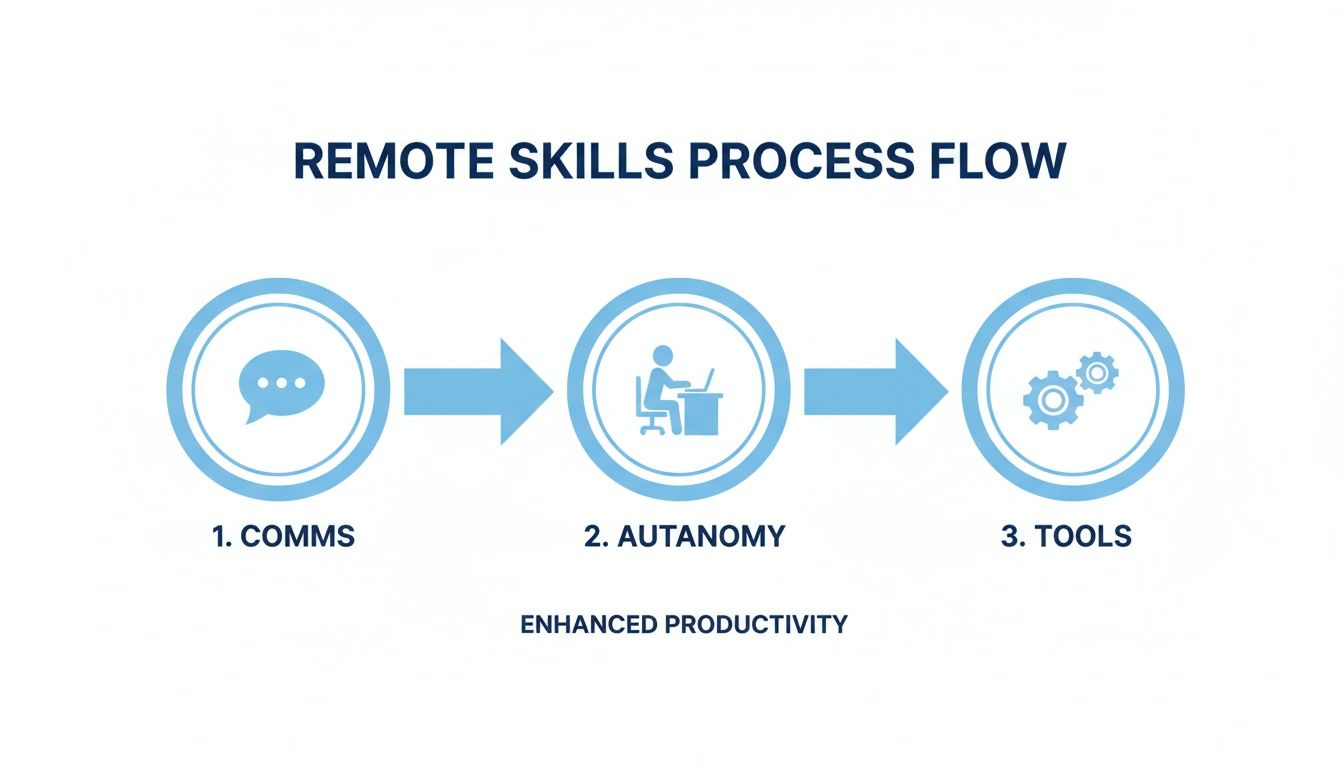
This shows how fundamental skills like communication, autonomy, and tool proficiency become game-changers once you can prove their impact with measurable results.
Aligning Your Strengths with the Company's Needs
Even the most impressive, data-backed achievements can fall flat if they don’t resonate with what a company is looking for. It's a common mistake to just list your greatest hits and hope for the best. The real magic happens when you show a hiring manager how your specific wins directly solve their problems.
This is where tailoring comes in. It’s the secret sauce that transforms your application from just another resume in the pile into a compelling, targeted solution. This alignment shows you’ve done your homework. You get what they're up against, you speak their language, and you're ready to add real value from day one.
Dissecting the Job Description for Clues
Think of the job description as your roadmap. Don't just skim it for keywords; you need to read between the lines to uncover the story behind the role. What are the real pain points they're trying to solve? If they mention "scaling systems" or "improving user engagement" multiple times, that's not just a task—it's a critical business challenge.
Your mission is to pinpoint both the obvious requirements and the more subtle hints they're dropping.
- Explicit Needs: These are the black-and-white qualifications. Things like "proficiency in Python" or "5+ years of B2B marketing experience." These are the absolute must-haves.
- Implicit Needs: This is where the detective work comes in. Phrases like "streamline our onboarding process" or "build a brand voice from the ground up" are screaming for a solution. They're telling you exactly where they're hurting.
- Cultural Cues: Pay attention to the adjectives they use. Words like "fast-paced," "collaborative," or "autonomous" give you a huge window into their company culture and the kind of person who will thrive there.
A job description isn't just a list of duties; it's a cry for help. Your application should be the answer to that cry, showing you've not only heard them but already have a plan to deliver.
Mapping Your Skills to Their Pain Points
Once you've dissected the job description, grab a piece of paper or open a doc and create a simple two-column chart. On one side, list the company's biggest needs and pain points. On the other side, map one of your quantifiable achievements directly to each of those points.
This simple exercise is a game-changer. It forces you to draw a straight line from your past accomplishments to their future needs.
For instance, if the job description mentions a need to fix a clunky user experience, you can map your past project where you "reduced user clicks by 25%" directly to that problem. Suddenly, the connection is impossible to ignore.
A Real-World Tailoring Example
Let's see how this works for a hypothetical Project Manager role at a company struggling with efficiency.
Original Resume Bullet:
- Managed software development projects using Agile methodologies.
It's not wrong, but it's bland. It says what you did, but not why it mattered or what the outcome was. It’s forgettable.
Now, let's tailor that same experience based on a job description that repeatedly mentions a need for "improving cross-functional workflows and delivering projects on time."
Tailored Resume Bullet:
- Led a cross-functional team to launch a new software feature, delivering it two weeks ahead of schedule by implementing a streamlined Agile process that improved team communication and cut down on redundant meetings.
See the difference? This version is a direct hit. It uses their language ("cross-functional"), speaks directly to their pain point ("delivering projects on time"), and provides a hard, quantifiable result (two weeks ahead of schedule). You've just gone from being "a candidate" to being "a problem-solver."
Nailing Your Answer in the Interview

When the hiring manager leans in and asks, “So, what makes you stand out from other candidates?” — that’s your cue. This isn't just another question; it's your moment to deliver a confident, memorable pitch that pulls everything together.
Your response should feel authentic and powerful. It’s about weaving your unique skills, proven impact, and genuine interest in the company into a single, compelling story. A killer answer here can make you unforgettable.
Crafting a Memorable Response
The best answers are structured but don't sound scripted. You want to blend a high-level summary of your value with a specific, powerful example. This proves you can think strategically and back it up with real-world results.
A great response feels less like a rehearsed speech and more like you’re confidently summarizing your professional brand.
Start by acknowledging what the role truly needs, then show how your unique combination of experience is the perfect answer. Here's a simple flow that works:
- Start with your Unique Value Proposition: Kick things off with a strong opening line that sums up what makes you different.
- Back it up with a Concrete Example: Share a quick story (think STAR method) that shows this value in action.
- Tie it Back to Them: End by connecting your strengths directly to the company's mission or a specific challenge they mentioned.
The goal is to build a narrative the hiring manager will remember long after the call ends. You're not just listing skills; you're telling the story of the specific value you, and only you, can bring to their team.
Proactively Address Remote Work Concerns
In any remote interview, the hiring manager is silently evaluating your ability to work independently and manage your own time. You can get ahead of this by framing your remote work skills as a core strength.
After all, productivity metrics are a huge talking point in the remote world. Some studies show a 35% to 40% productivity jump for remote workers. If you can explain how working remotely helps you do better work, you build a powerful case for yourself. To get up to speed on these trends, you can learn more about the current state of remote work from Neat.
For example, you could say, "What really makes me stand out is my proven ability to drive projects forward with a high degree of autonomy, a skill I've sharpened in my past remote roles. I'm not just comfortable with asynchronous communication; I thrive in it because it allows me to do deep work and deliver better results."
Sample Answers for Different Levels
Your answer should shift depending on where you are in your career. An early-career professional will focus on potential and skills, while a senior leader will talk more about strategic impact and leadership.
For a Junior-Level Candidate:
"I think what makes me different is my combination of fresh technical skills and a genuine drive to learn. For example, in my last project, I taught myself a new analytics tool over a weekend to better track our campaign performance. That effort led directly to a 15% improvement in our key metrics. I'm excited to bring that same initiative to your team."
For a Senior-Level Candidate:
"My key differentiator is my experience not just in leading remote teams, but in building the systems that help them succeed. At my last company, I designed and implemented a new project management framework that cut down on useless meetings by 50% and pushed our on-time project delivery to 95%. I see a similar opportunity here to help scale your team's impact."
Mastering this question is a big step, but it's just one part of the process. To get ready for the entire interview, check out our full list of virtual interview tips.
Common Questions About Standing Out
Let's dig into some of the real-world scenarios that come up when you're trying to figure out what makes you different. These are the tricky, "what-if" questions I hear all the time.
How Do I Stand Out with No Direct Remote Work Experience?
This is a classic chicken-and-egg problem, but it's easier to solve than you think. You have to focus on the skills that make remote work successful, not just the job title.
Think about times you've worked independently, managed your own projects with little oversight, or used digital tools to get things done with a team. Did you coordinate a group project in college using Slack and Asana? That counts. Did you manage a freelance gig entirely through email and Zoom? That’s gold.
The goal is to prove you already have the self-discipline, communication habits, and tech-savviness of a great remote employee.
What if My Past Roles Don't Have Obvious Metrics?
Not every job comes with a neat dashboard of KPIs, and that's okay. Shift your focus from quantitative results to qualitative wins and process improvements.
Did you create a new documentation system that everyone on the team started using? Did you get a shout-out from your manager for handling a particularly tricky client situation? These are powerful achievements.
Frame them with impact. Instead of saying "I improved a process," try: "Redesigned the client onboarding checklist, which my manager noted for cutting down new-client support tickets by nearly 50%."
The real differentiator isn't always a huge number. It's showing you have a problem-solver's brain and a drive to make things better, even in small ways. That’s what gets you noticed.
Should I Mention Personal Projects or Hobbies?
Yes, but with a purpose. A personal project or hobby is a fantastic way to stand out, as long as it tells a story that’s relevant to the job.
- A personal coding project is a no-brainer for a developer role.
- Running a successful blog or growing a social media account shows serious initiative for a marketing position.
For companies with a strong, unique culture, even a less-related hobby can make you memorable if it connects to their values. The key is to always tie it back to what the company does or what the role requires.
If you're looking for more answers to your career questions, you can explore further career advice and insights to help sharpen your strategy.
Ready to find a remote job where your unique strengths are exactly what they're looking for? RemoteWeek lists roles from top companies that genuinely care about their people and culture. Find a better remote career at https://www.remoteweek.io.