
Remote Work From Home Jobs: A Practical Guide to Legit Roles

For millions of people, the idea of working from home has gone from a distant dream to a very real career path. It’s not just a passing trend anymore; it's a major change in how we think about our professional lives, offering a kind of flexibility and freedom that a typical 9-to-5 office job rarely can.
The Reality of Today's Remote Job Market
Let's get one thing straight: remote work has grown up. We're long past the days of makeshift home offices and companies tentatively dipping their toes in the water. Today, the remote job market is a stable, competitive, and highly sought-after space. This isn't some temporary fix—it’s now a core part of the global economy, and companies are actively building their entire business models around a distributed workforce.
The numbers back this up. By 2025, the worldwide remote workforce had exploded, jumping from about 20% in 2020 to 48% in just five years. Here in the United States, that translates to over 32.6 million people working from home. It's a clear, sustained shift away from the traditional office. You can dig deeper into these remote work statistics and their impact on the global economy.
Key Industries Embracing Remote Work
While you can find remote roles in almost any field these days, some industries have gone all-in. If you're looking for the most opportunities, these are the sectors to watch.
- Technology and Software Development: No surprise here—the tech world leads the pack. Jobs like software engineer, AI specialist, and technical writer are almost expected to be remote, with companies scouting for top talent from all over the world.
- Marketing and Creative Services: Think digital marketers, content creators, and graphic designers. These roles often flourish in a remote environment where creativity and flexible hours go hand-in-hand.
- Customer Support and Sales: Thanks to cloud-based tools, positions like technical support manager and account executive can be done from anywhere. This allows companies to build powerhouse teams without being limited by location.
- Finance and Accounting: With secure digital systems now the norm, jobs like accounts receivable specialist and revenue accounting manager are increasingly moving out of the office.
The smartest remote job seekers I've seen get one thing right: Companies aren't just hiring for skills. They're hiring for a mindset. You have to prove you can communicate clearly, manage your own time, and be an active part of a digital team. That's often more important than the technical stuff on your resume.
The Mindset Required for Remote Success
Speaking of mindset, landing a great remote job takes more than just a polished resume. Hiring managers are specifically looking for people who can thrive without a boss physically looking over their shoulder.
Self-discipline is non-negotiable. When you're the one in charge of your schedule, the drive to stay focused and hit your deadlines has to come from within. Just as crucial is proactive communication. You can't just bump into a colleague in the hallway to ask a quick question. You have to be deliberate about sending updates, clarifying tasks, and making your presence felt on platforms like Slack or Asana.
Think of this guide as your game plan. It's packed with real-world strategies to help you find and land a remote job you'll love.
Finding Legitimate Remote Work From Home Jobs (Without the Scams)
Trying to find a great remote job can feel like you're digging for gold. There are thousands of listings out there, and it’s way too easy to get lost in the noise or, worse, stumble into a scam. The trick isn't just about searching more; it's about searching smarter.
You have to get strategic. It means knowing exactly where the best opportunities are hiding and how to spot the red flags from a mile away. Your time is valuable, so let’s make sure you’re spending it applying for real jobs with great companies.
The entire professional world has shifted dramatically in just a few years, and remote work is no longer a niche perk—it's a core part of the modern economy.
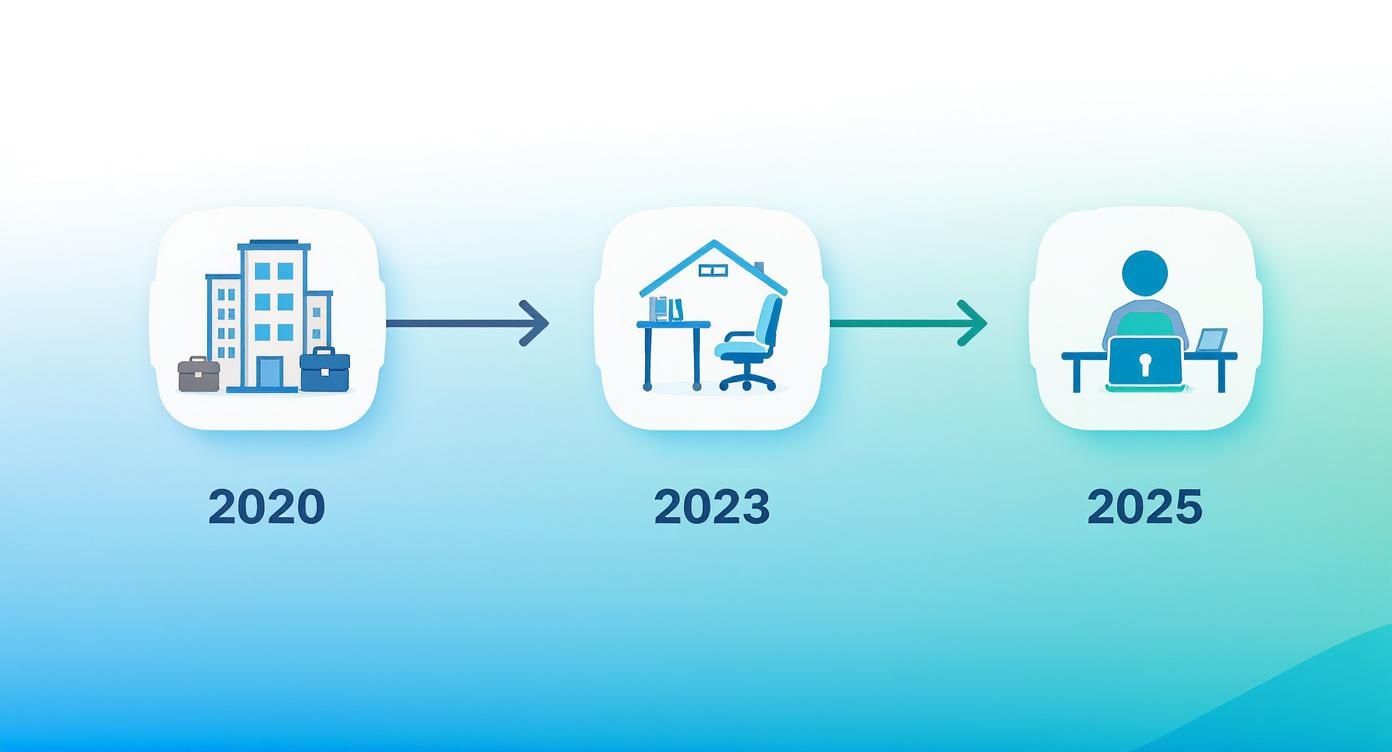
This shift means you need to adapt how you hunt for jobs, moving beyond old-school methods and embracing a more targeted approach.
Think Beyond the Mega Job Boards
Sure, the big-name job sites have tons of listings, but they're also where everyone else is looking. The real gems are often found on specialized platforms that cater to specific industries or remote-only roles.
Think of it like this: a massive job board is a giant superstore, but a niche site is a curated boutique. You’ll find fewer listings at the boutique, but they’re far more likely to be a perfect fit. This focused approach connects you with employers who already get what it takes to build a successful remote team in your field. For example, if you're in a specialized field like Web3, you’ll have better luck on dedicated sites. This guide on the top platforms for crypto jobs remote is a great example of where to look.
To get you started, here’s a quick rundown of some of the best platforms out there. Each one offers something a little different, so it’s worth exploring them to see which fits your needs.
Top Platforms for Finding Remote Work From Home Jobs
| Platform | Best For | Key Features |
|---|---|---|
| RemoteWeek | Tech roles at employee-focused companies with high satisfaction ratings. | Curates jobs only from companies with a Glassdoor rating of 3.5 or higher, ensuring a focus on positive workplace culture. |
| We Work Remotely | A wide variety of remote positions, from programming to customer support. | One of the largest and most established remote-specific job boards with a global reach. |
| FlexJobs | Professionals seeking flexible and remote roles across dozens of career categories. | Hand-screens every job and company for legitimacy, offering a scam-free experience for a subscription fee. |
These platforms do a lot of the initial vetting for you, which is a huge time-saver. You can feel more confident that the listings are from real companies looking for serious candidates.
Tap Into the Hidden Job Market
Some of the absolute best remote jobs are never even posted on a public job board. They're filled through professional networks, industry communities, and word-of-mouth. If you’re not looking in these places, you’re missing out.
Get active in Slack channels and Discord servers dedicated to your profession. They are absolute goldmines. I’ve seen hiring managers drop a job opening in a channel before it goes live anywhere else, hoping to find someone who’s already part of the community.
The strongest candidates I see are the ones who are active participants in their professional communities. They're not just applying for jobs; they're building relationships and demonstrating their expertise long before an application is ever submitted. This proactive approach makes a huge difference.
How to Spot and Dodge Remote Job Scams
The rise of remote work has, unfortunately, attracted a lot of scammers. Learning to spot the red flags is a non-negotiable skill for any remote job seeker. The number one rule? A legitimate company will never ask you for money.
Be skeptical of job posts that are incredibly vague but promise an unbelievably high salary for very little work. If it sounds too good to be true, it almost always is. A real company will have a professional website, a clear hiring process, and easy-to-find contact information.
Keep an eye out for these tell-tale signs of a scam:
- You're Asked to Pay: If they want you to pay for "training," "software," or a "background check," run.
- Unprofessional Communication: Emails riddled with typos or sent from a personal address (like a Gmail or Yahoo account) are a huge red flag.
- Vague Job Details: Can they clearly explain what you’ll be doing day-to-day? If not, be very cautious.
- High-Pressure Tactics: Scammers often try to create a false sense of urgency to get you to act before you have time to think.
Staying vigilant is your best defense. For a deeper dive, our guide on finding work at home jobs with no scams has even more tips to keep your job search safe and productive.
Building Your Application for a Remote World
When you’re going after a remote job, your standard resume just isn’t going to cut it. Remote hiring managers are looking for more than just a list of qualifications; they need solid proof you can thrive without someone looking over your shoulder. Your entire application package—your resume, cover letter, and even your LinkedIn profile—needs to scream "I'm a self-sufficient, top-tier remote employee."
It's really all about translation. You have to take the skills you used in an office and make them obvious to a recruiter who’s never met you in person.
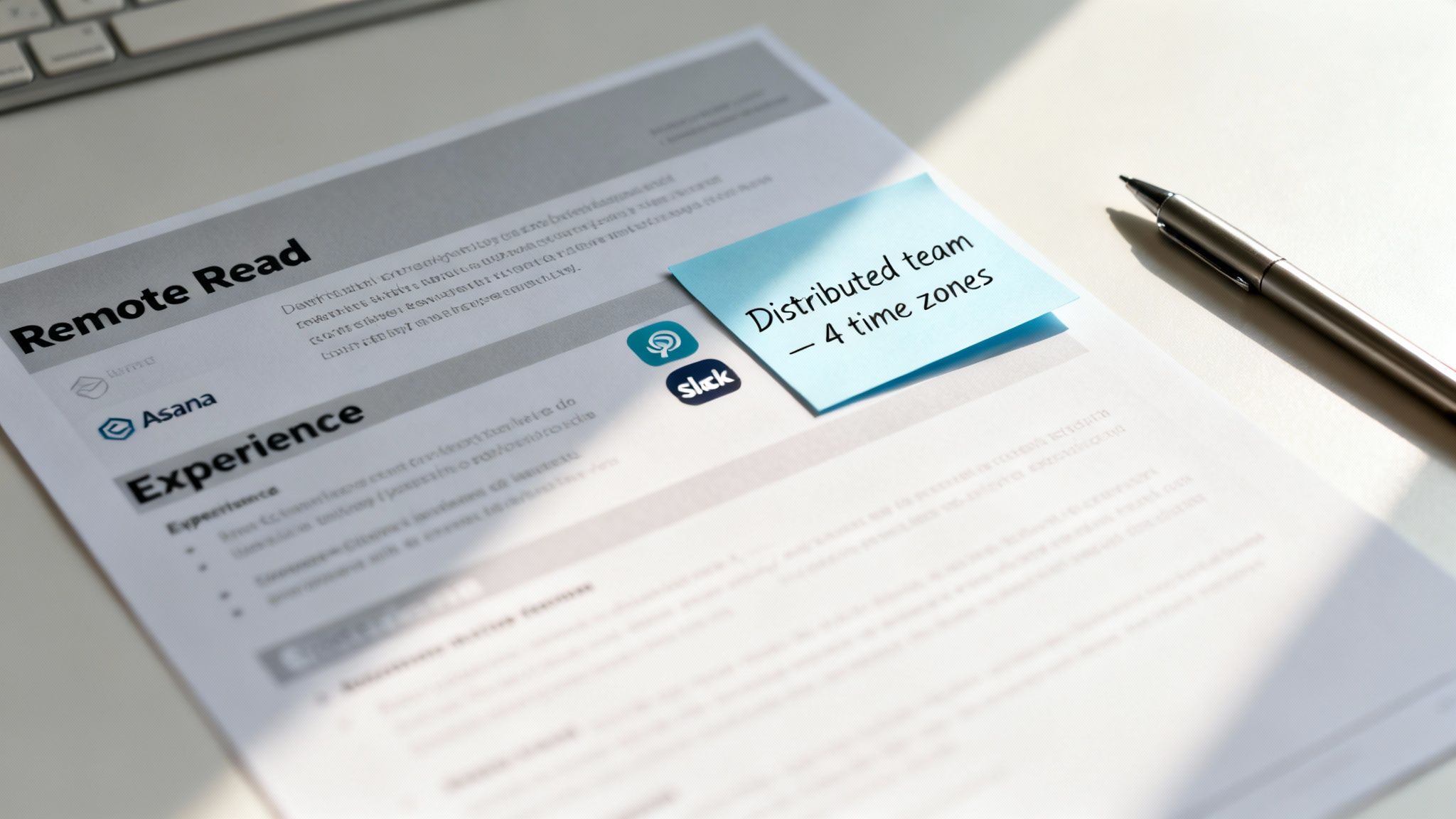
Translate Your Experience into Remote Skills
Go through your resume, line by line, and ask yourself, "How does this prove I can work independently?" Every single bullet point is an opportunity to showcase your remote readiness.
Let's take a common example. Instead of just saying you managed a project, you need to show how you did it in a way that proves you're built for remote work.
Before:
- Managed a project to launch a new software feature.
After (Remote-Ready):
- Led a distributed project team across three time zones using Asana for task management and Slack for asynchronous daily check-ins, delivering the new feature 10% ahead of schedule.
See the difference? The second version instantly proves you’re comfortable with the tools and rhythms of a distributed team and can deliver results without being in the same building.
Show Off Your Digital Toolkit
Being fluent in the language of remote work software is absolutely essential. Don't just list the tools you’ve used. Weave them directly into your job descriptions to show you know how to use them to get things done.
I highly recommend adding a dedicated “Technical Skills” or “Digital Toolkit” section. It’s a quick-scan area for recruiters. Be sure to include:
- Communication Platforms: Slack, Microsoft Teams, Discord
- Project Management Software: Asana, Trello, Jira, Monday.com
- Video Conferencing: Zoom, Google Meet, Webex
- Cloud Collaboration: Google Workspace, Microsoft 365, Notion, Confluence
When a recruiter sees these names, it’s an immediate signal that you’ll be able to jump right into their workflow with minimal ramp-up time.
Think of your resume as a marketing document. The product is you—a highly communicative, self-starting professional. Every word should reinforce that you're a low-risk, high-reward hire who can excel from anywhere.
Put Communication and Self-Management Front and Center
In a remote job, how you communicate is just as critical as the work itself. Hiring managers are on the lookout for signs that you’re a proactive, clear, and reliable communicator.
Use the summary section of your resume and your cover letter to provide concrete examples of these soft skills in action. Talk about how you manage your time, keep your team in the loop, and collaborate with people you might never meet face-to-face. For a deep dive, our guide on crafting resumes for remote jobs has tons of specific examples.
Here are a few phrases you can adapt to fit your own experience:
- "Thrive in asynchronous environments by providing detailed daily progress reports via Slack."
- "Expertly managed my own schedule and deadlines on long-term projects with minimal direct supervision."
- "Maintained strong team cohesion through clear documentation in Notion and proactive communication."
Each of these statements gives the hiring manager tangible proof of your remote capabilities. By shifting your mindset and tailoring your application this way, you’ll stop looking like just another applicant and start looking like the perfect fit for a modern, forward-thinking company.
Winning the Virtual Interview
https://www.youtube.com/embed/YPH9PONqDbo
The virtual interview is your final hurdle, but it's also your biggest stage. This is where you go beyond your resume and prove you have the self-discipline, communication chops, and drive to thrive in a remote role. Getting it right is about more than just having good answers—it requires a flawless tech setup, a professional presence, and the ability to project confidence through a screen.
Think of the video call as the new handshake. A blurry camera, spotty audio, or a chaotic background sends a message before you even say a word. Your goal is to make the technology completely invisible so the focus stays entirely on you and why you're the perfect fit for this work-from-home job.
That means you have to prepare your digital stage well in advance, not five minutes before the call. Test your internet connection, make sure your lighting is flattering (light sources in front of you are always best), and check that your audio is crystal clear. Even a simple external microphone or a good headset can make a massive difference.
Setting Your Digital Stage for Success
Your environment speaks volumes about you as a potential remote employee. A messy room or people walking by in the background can signal a lack of professionalism or an inability to manage distractions—a major red flag for any hiring manager.
To make the best impression, you need to be intentional about your space.
- Pick a Neutral Background: A clean, organized bookshelf or a simple, uncluttered wall works wonders. Steer clear of virtual backgrounds; they can be glitchy and often look less professional than the real thing.
- Get Your Camera Angle Right: Position your camera at eye level. Looking down at the camera is never a good look, and looking up can make you seem disengaged. Don't be afraid to stack a few books under your laptop to get it just right.
- Eliminate All Distractions: Give your family or roommates a heads-up about your interview schedule. Silence your phone and close every unnecessary tab and notification on your computer. Your full attention needs to be on the conversation.
When hiring for remote roles, managers are looking for more than just skills. They're assessing your ability to operate autonomously. A well-prepared, distraction-free interview environment is the first piece of evidence you can offer to show you're up to the task.
Answering Remote-Specific Interview Questions
When you're interviewing for a remote position, the hiring manager is listening for specific proof that you can manage yourself and communicate effectively from afar. They want to hear that you can solve problems on your own and stay productive without someone looking over your shoulder.
Get ready for questions designed to test exactly these skills. Vague answers just won't cut it. You need to come armed with concrete examples that showcase your remote readiness. For instance, if they ask how you handle distractions, saying "I close my door" is a weak answer. A strong answer describes your actual system.
Let's walk through how to frame your responses with real-world scenarios.
Question: "How do you stay motivated and manage your time without a manager physically present?"
- Your Answer: "I rely on a structured daily routine. I use a tool like Asana to map out my tasks each morning, sorting them into 'must-do' and 'can-wait' lists. This keeps me laser-focused on the highest priorities. I also block out 15-minute breaks every couple of hours to step away and recharge, which helps me maintain a steady pace all day."
Question: "Describe a time you solved a problem without a manager's immediate input."
- Your Answer: "In my last role, a critical client file failed to upload to our shared server, and my manager was in a completely different time zone. My first move was to check our internal documentation in Notion for troubleshooting steps. When that didn't work, I reached out to a senior colleague in another department on Slack for advice, and we figured it out quickly. I then documented the fix and shared it with the team to make sure it wouldn't happen again."
This kind of answer shows you're proactive, resourceful, and a clear communicator—all non-negotiable traits for succeeding in a remote team.
Remote Work and the Inclusive Workplace
Looking at the bigger picture, it's worth noting how the rise of remote work is reshaping the workforce for the better. The move away from location-based hiring has swung the doors wide open for a much more diverse and inclusive pool of talent, which is a massive win for modern companies.
This shift is fostering incredible gains in accessibility and diversity. In the U.S. alone, it has allowed an additional 2 million people with disabilities to join the workforce. On top of that, remote job postings tend to attract 15% more applications from women and a whopping 33% more from underrepresented minorities, creating more equitable opportunities for everyone. You can dig deeper into the impact of remote work on workforce diversity and see how this trend is evolving.
Designing Your Productive Home Workspace
So, you landed the remote job. Congratulations! That's a huge win. But here's something many people don't realize until they're a few weeks in: succeeding in a remote role isn't just about what you do, it's about where you do it. Your home workspace is your new command center, and setting it up right is one of the smartest career moves you can make.
Working from the dining room table or the couch might seem fine for a day or two, but it's a recipe for burnout. A dedicated, well-thought-out space creates a crucial mental boundary between your work life and your home life.
The Ergonomic Essentials for Health and Focus
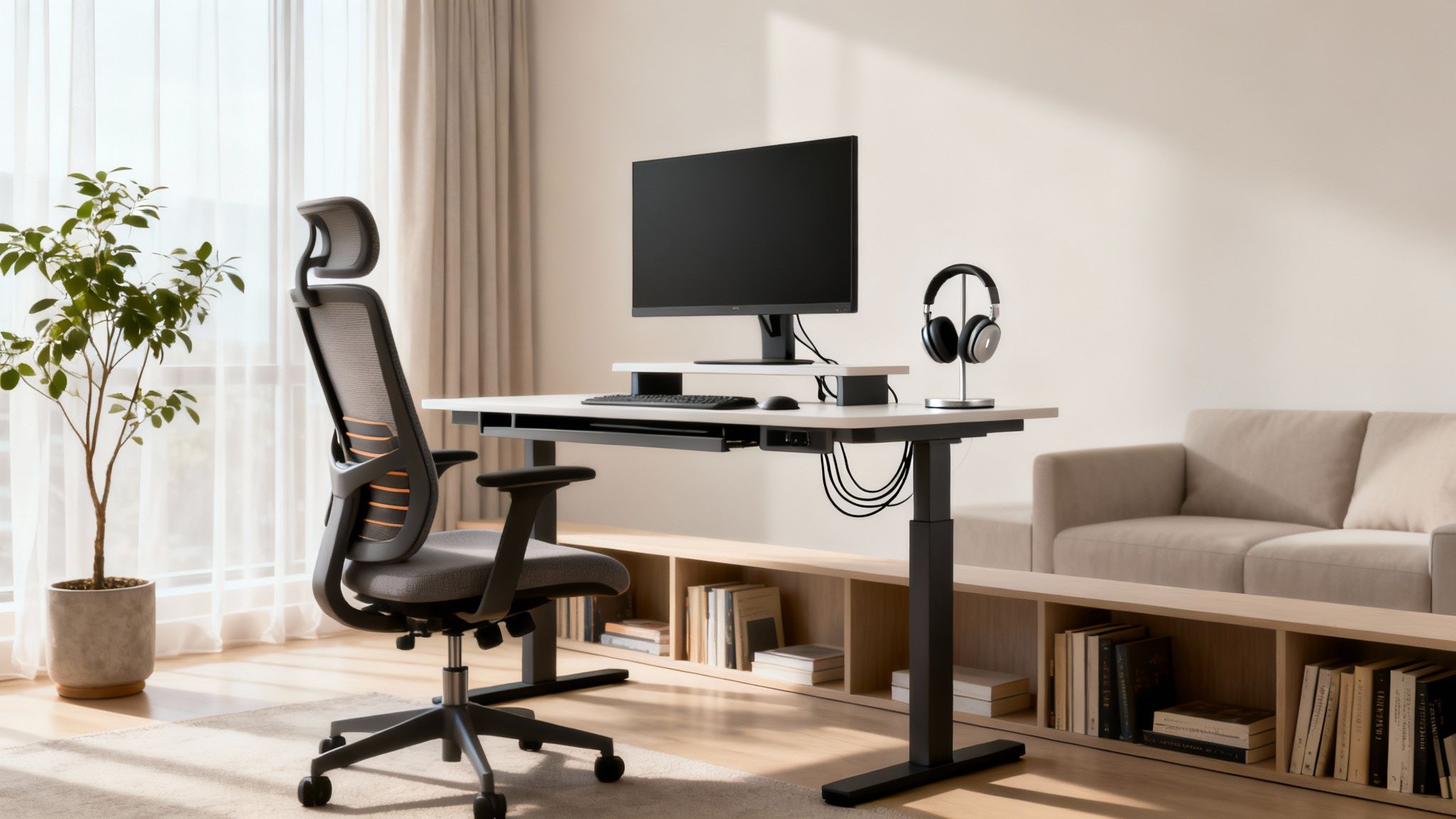
Let's be real: long hours hunched over a laptop will take a toll on your body. Ergonomics isn't just some corporate buzzword; it’s the science of setting up your space to fit you, which prevents aches and pains while helping you stay focused for longer.
Your chair is the most important piece of the puzzle. You need something with adjustable height, armrests, and good lumbar support. The goal is to have your feet flat on the floor with your knees bent at a 90-degree angle. Your monitor should be positioned so the top of the screen is at (or just below) eye level. No more neck craning.
Here are a few game-changing adjustments:
- Monitor Placement: Your screen should be about an arm's length away. If you're using a laptop, an external monitor is ideal, but at the very least, get an external keyboard and mouse. Trust me, your wrists will thank you.
- Keyboard and Mouse: Position them so your elbows are at a comfortable 90-degree angle, keeping your wrists straight.
- Consider a Standing Desk: Alternating between sitting and standing is one of the best things you can do to fight off the negative effects of being sedentary all day.
For a deeper dive, check out our complete guide on setting up a home office for remote work. It’s got a full checklist to get you sorted.
Creating Boundaries Between Work and Life
One of the sneakiest challenges of working from home is the way your job can creep into your personal time. Without the physical commute to an office, the lines get blurry fast. This is where setting up clear, non-negotiable boundaries becomes essential.
If you have a spare room, use it. The simple act of closing a door at the end of the day sends a powerful signal to your brain that work is over. Don't have a whole room? No problem. Even carving out a dedicated corner in your living room and using a bookshelf or a decorative screen to visually block it off can make a huge difference.
Your workspace should be a sanctuary for focus. The goal is to create a physical and mental barrier that tells your brain, 'This is where work happens,' making it easier to switch off completely at the end of the day.
Your Digital Workspace and Tech Setup
Your physical setup is only half the battle; your digital environment matters just as much. A choppy, unreliable internet connection is the ultimate productivity killer for anyone working remotely.
This is why investing in good tech is non-negotiable. It's not just you—approximately 40% of remote workers have already upgraded their home internet to handle the demands of cloud software and constant video calls, according to a recent report on remote work statistics. A solid connection means you can show up to meetings and collaborate without the classic "Can you hear me now?" frustration.
Finally, think about the software that can make your day smoother. Noise-canceling apps are a lifesaver for drowning out background noise during important calls, and time-tracking tools can help you see exactly where your hours are going. A well-equipped physical and digital workspace is the foundation for a long, successful, and sustainable remote career.
Your Questions About Remote Work Answered
As you start looking for remote jobs, you're bound to have questions. It's a different way of working, with its own quirks, challenges, and some seriously great perks. To clear things up, I’ve put together answers to the questions I hear most often.
Think of this as your personal FAQ for building a solid remote career. We'll cover everything from dipping your toes in with a hybrid role to handling your taxes from a home office.
Is a Hybrid Job a Good Way to Start Working Remotely?
Yes, absolutely. A hybrid role is probably the best on-ramp you can get into a fully remote career. It’s the perfect way to show your current (or future) boss that you're productive and reliable outside the office, all while staying connected to your team.
When you kill it in a hybrid setup, you're building a rock-solid case for going fully remote later. You're creating a proven track record of getting things done without someone looking over your shoulder. That’s exactly what recruiters for 100% remote jobs are looking for.
What Are the Biggest Mistakes on a Remote Job Application?
The single biggest mistake is sending out a generic resume. You have to tailor it to highlight skills that matter for remote work—things like asynchronous communication, self-discipline, and your comfort level with tools like Slack, Asana, or Trello.
Another common slip-up is failing to explain why you want to work remotely for that company. They need to see you’re excited about their mission, not just any job that lets you wear sweatpants all day. And a small thing that's actually a huge deal: a sloppy online presence or tech fails during an interview can get you disqualified on the spot.
"The most common mistake is failing to translate your in-office achievements into the language of remote work. You have to prove you can deliver results autonomously. Show, don't just tell."
How Do I Prove I Can Work Independently in an Interview?
Come prepared with specific stories. The easiest way to frame them is using the STAR method (Situation, Task, Action, Result) so your answer is clear and powerful.
Think about a project where you were pretty much on your own and walk them through it.
- Situation: Briefly set the scene and explain the project's goal.
- Task: What exactly was your responsibility?
- Action: What specific steps did you take? How did you manage your time and knock down roadblocks yourself?
- Result: Share the outcome. Use numbers to make it real.
Here’s a quick example: "My manager was on leave, and I was tasked with launching a new social media campaign on a tight deadline. I built the content calendar, scheduled everything using Buffer, and tracked the analytics myself. The result was a 20% jump in follower engagement in just one month."
What About the Financial Side of Working from Home?
It's smart to think about the money side of things. Your finances can look a little different when you work from home. For a deep dive into the tax implications of working from home and potential deductions, checking out expert guides is your best bet. Getting a handle on this stuff early on can really pay off.
Ready to find a remote job at a company that truly values its people? RemoteWeek curates high-quality tech roles from companies with strong employee satisfaction ratings. Stop sifting through endless listings and start applying to jobs you can trust at https://www.remoteweek.io.