
How to Write a Good Resume Headline for Remote Tech Jobs

Think of a resume headline as your professional billboard. It's that one short, punchy phrase right at the top of your resume that sums up exactly who you are and what you do for a specific role. It's your first, and sometimes only, chance to grab a recruiter's attention by showcasing your seniority, top skills, and any specializations you bring to the table.
Why Your Headline Is Your First and Last Impression
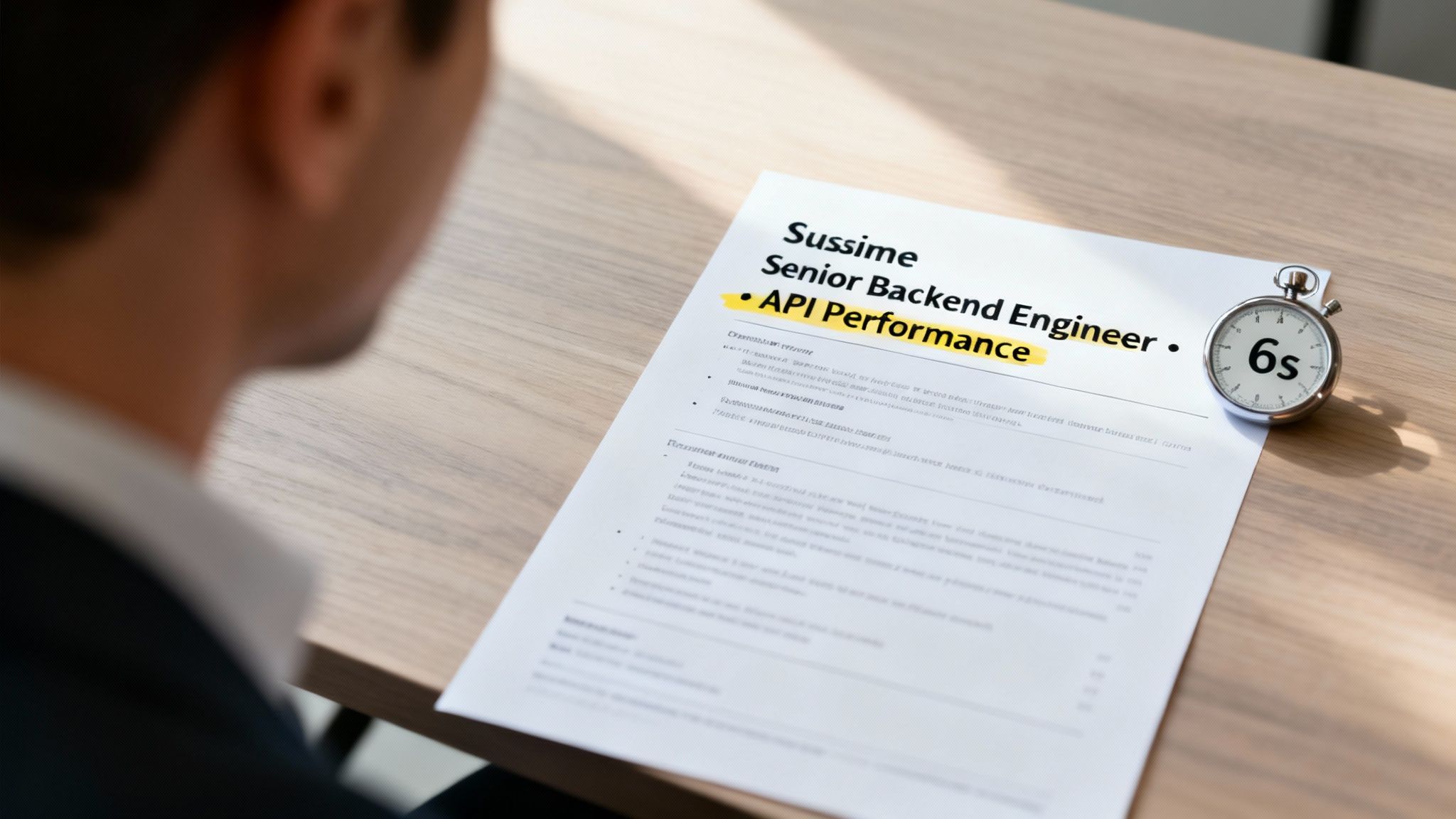
In the hyper-competitive world of remote tech hiring, your application has a razor-thin window to make an impact. This isn’t just an old saying; it's the reality of a process flooded with applications and dominated by automated screening tools. Your resume headline is the single most important element in this first cut, acting as a quick-glance summary for both the software and the human reviewer on the other side.
It's a lot like an email subject line. A vague one gets ignored or deleted. But a specific, compelling one gets opened right away. For a hiring manager sifting through a sea of PDFs, your headline is the first piece of data they use to decide if you’re even a potential fit. If it's weak, that first impression will almost certainly be their last.
The Six-Second Test
Recruiters are built for speed. In most major hiring markets, they spend a mere 6–8 seconds on their initial scan of your resume. That’s all the time you get to convince them to keep reading.
Considering that over 75% of resumes are filtered out by an Applicant Tracking System (ATS) before a person ever sees them, a headline that leads with specific skills, your seniority level, and the role you’re targeting is a game-changer. It helps both the algorithm and the recruiter instantly know where you fit.
This initial screening is ruthless. A strong headline makes sure your most valuable qualifications aren't lost somewhere on page two. It's your best defense against getting cut in the first round, especially when you're up for a sought-after remote tech job.
A resume headline isn't just a job title. It's a strategic branding statement that tells a hiring manager exactly who you are and what you bring to their team in a single glance. Think of it as your elevator pitch, boiled down to one powerful line.
To see just how much difference a few words can make, let's look at a quick comparison.
Headline Impact Before and After
| Element | Generic Headline ('Software Developer') | Strategic Headline ('Senior Python Developer | FinTech & AWS | Remote First') |
| :--- | :--- | :--- |
| Clarity | Vague. What kind of developer? What level? | Crystal clear. Instantly communicates seniority (Senior) and primary skill (Python). |
| Relevance | Low. Doesn't connect to a specific job req. | High. Signals expertise in a high-demand industry (FinTech) and cloud platform (AWS). |
| ATS Score | Poor. Lacks keywords that match the job description. | Excellent. Packed with keywords recruiters and algorithms search for. |
| Remote Fit | Unclear. No indication of remote work preference or experience. | Perfect. "Remote First" explicitly states a preference and signals experience. |
| First Impression | Forgettable. Blends in with hundreds of other applicants. | Memorable. Paints a picture of a specialized, experienced candidate. |
As you can see, the strategic headline immediately tells the recruiter's brain (and the ATS) everything it needs to know to move you to the "yes" pile.
Your Professional Identity in a Snapshot
A thoughtfully written headline sets the stage for the rest of your resume. It frames your experience and guides the reader’s eye toward the skills you want them to notice most. This is especially true when you're putting together resumes for remote jobs, where being direct and clear is a huge advantage.
Remember, your resume is just one piece of the puzzle. Employers are increasingly checking out your entire online presence, so understanding the impact of your digital footprint on job opportunities is essential. Your headline is the first block in building that strong, cohesive professional brand.
The Anatomy of a High-Impact Headline
If you want to create a resume headline that gets results every time, you need a reliable formula. This isn't about wild creativity; it's about strategic clarity. You're aiming for a powerful, condensed summary that speaks directly to recruiters and gets past the Applicant Tracking Systems (ATS).
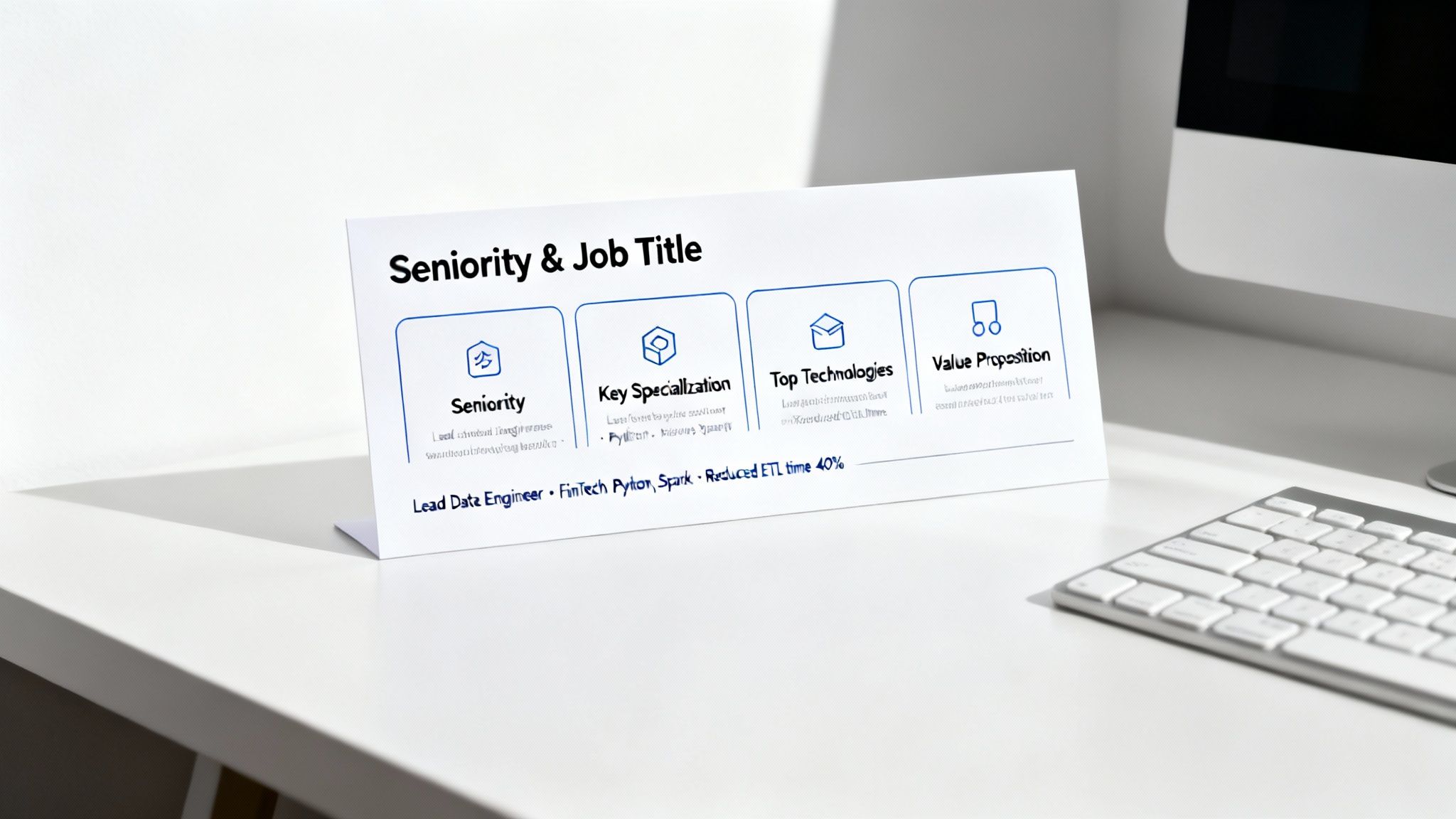
Think of your headline as a modular statement—a core identity you can quickly tweak for any role you're targeting. The best ones I've seen always break down into four key parts. Each piece serves a specific purpose, working together to communicate your value in a matter of seconds.
The Four Core Components
A truly effective headline blends these elements to tell your professional story at a glance:
- Seniority Level & Job Title: Get specific. Are you a "Junior Developer," "Senior Product Manager," or "Lead Data Scientist"? This immediately sets the stage for your experience level.
- Key Specialization or Industry: This is where you add critical context. Mentioning "SaaS," "FinTech," or "eCommerce" shows a recruiter you already know their world and its specific challenges.
- Top 2-3 Core Technologies: List the tools most relevant to the job you want. Think "Python & AWS," "Figma & React," or "Kubernetes & Terraform."
- Value Proposition: This is your knockout punch—a brief, powerful statement about your impact. It could be a key skill like "API Performance Optimization" or a quantifiable achievement.
Following this structure gives a complete snapshot of who you are professionally. You're no longer just a "Software Engineer." Now, you're a "Senior Backend Engineer specializing in FinTech, skilled in Go and PostgreSQL, focused on building scalable payment systems." The difference is night and day.
A strong headline does more than just list skills; it synthesizes your professional identity into a clear, compelling package. It answers the recruiter's most urgent question—"Why should I care about this candidate?"—before they even read your first bullet point.
Putting the Formula into Action
Let's walk through a real-world scenario. Say you're a product manager applying for a remote role at a health tech startup. The job description is screaming for someone with experience in mobile apps, Agile methods, and user growth.
- A weak headline: Product Manager
- A powerful headline: Senior Product Manager | HealthTech & Mobile Apps | Agile & Jira | User Growth Expert
See the difference? The second version is a magnet for the right opportunity. It’s loaded with keywords the ATS will pick up, and it gives the hiring manager an instant, positive signal. This is all about condensing information effectively, a skill similar to what’s needed for mastering summarizing in reading to pull out the most vital points.
This same principle should apply across all your professional branding. A good resume headline often shares the same DNA as a strong professional network title. We actually cover this in more detail in our guide on how to optimize your LinkedIn profile. When you align these elements, you create a consistent and memorable professional story that recruiters won't forget.
Quantifying Your Value in a Single Line
It’s not enough to just list your skills and hope a recruiter connects the dots. If you want to create a truly good resume headline, you need to show them the impact you’ve made. The fastest way to do that? With numbers.
Quantification isn't just for sales reps hitting quotas; it’s a game-changer for every role in tech.
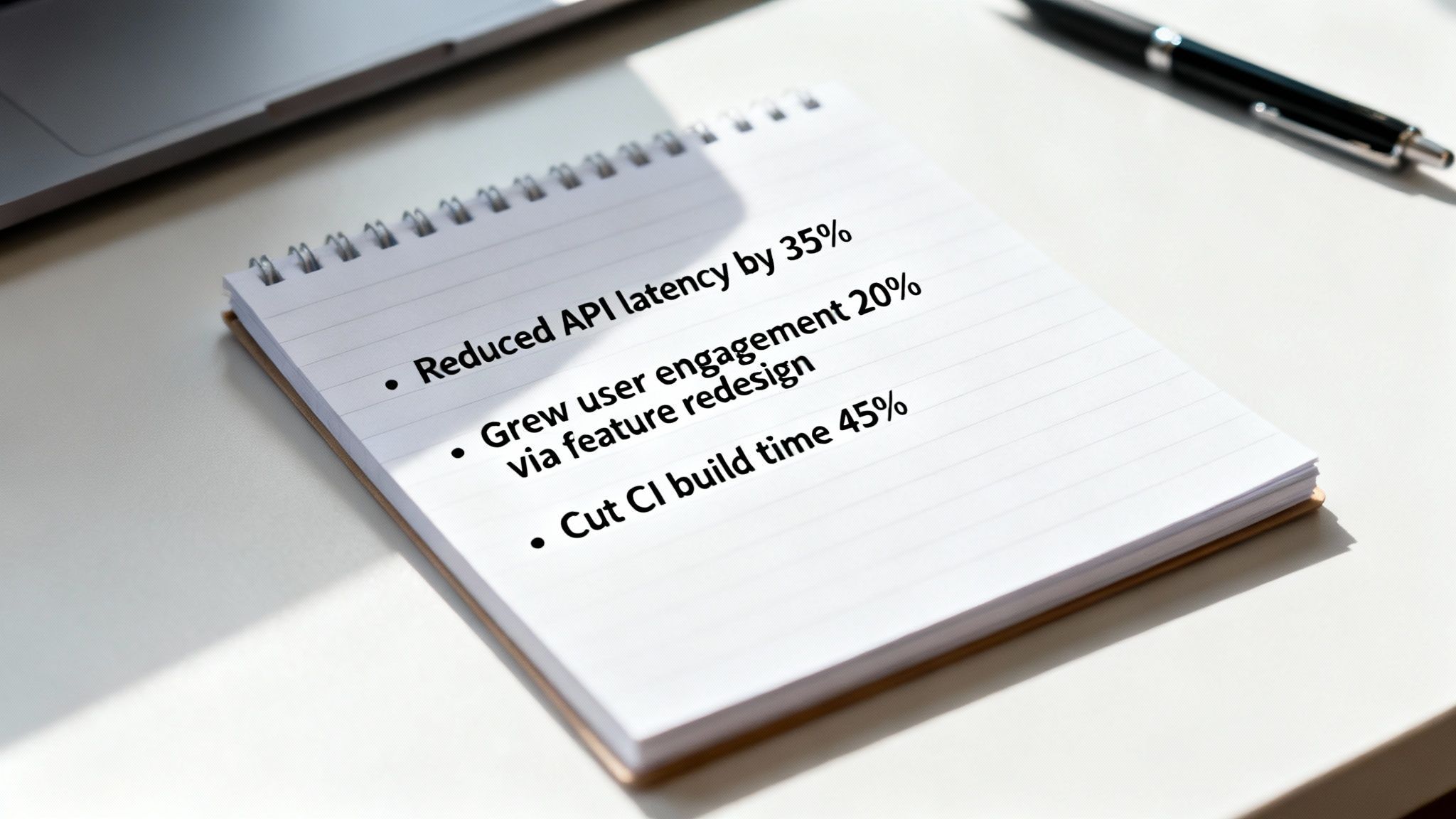
Adding a measurable result to your headline immediately changes the narrative. You go from a candidate who says they’re good at something to one who can flat-out prove it. Think about the difference between "Experienced Software Engineer" and "Software Engineer Who Reduced API Latency by 35%." The second one doesn't just list a skill—it tells a story of tangible value.
This isn't just a hunch. Eye-tracking studies have shown that recruiters scan the top third of a resume looking for hard proof of your value—things like numbers and percentages—before they decide to read on. In fact, one study on executive resumes found that a staggering 68% of them had no measurable results at all, which is a massive red flag for hiring managers. For a deeper dive into these trends, the research on how top leaders are rewriting the rules of professional visibility is an eye-opener.
Translating Accomplishments into Numbers
I get it—many tech professionals think their work is too abstract to quantify. But the truth is, metrics are hiding in plain sight if you know where to look. It’s all about connecting your projects back to a business outcome.
Here are a few places to start digging for those numbers:
- For Engineers: Did you improve performance? Think in terms of percentage improvements in speed, efficiency, or error reduction. How much faster did that process run?
- For Product Managers: How did you influence user behavior? Metrics like engagement growth, feature adoption rates, or churn reduction are pure gold for your headline.
- For UX/UI Designers: Did your redesign move the needle? Look for increases in conversion rates, faster task completion times, or better user satisfaction scores.
A simple framework like "Grew X by Y%" or "Reduced Z by X%" can help you structure these accomplishments. It makes your value crystal clear from the first glance.
A headline with a real number answers the question every recruiter is thinking: "What results can this person actually deliver for us?" It’s a direct promise of future performance backed by hard-won success.
Real-World Examples of Quantified Headlines
Let’s look at this in action. A generic headline is forgettable, but adding one powerful metric can change everything. It gives a recruiter immediate context and proof of what you can do. This is a core part of figuring out what makes you stand out from other candidates in a sea of applicants.
Here are a few quick before-and-afters to show you what I mean:
Before: Senior DevOps Engineer | AWS & Kubernetes
After: Senior DevOps Engineer | Reduced CI Build Times by 40% with Kubernetes Optimizations
Before: Product Manager for SaaS Platforms
After: Product Manager | Grew User Engagement 20% Through Feature Redesign
Before: Lead Front-End Developer | React & TypeScript
After: Lead Front-End Developer | Boosted Page Load Speed by 50%, Improving Core Web Vitals
See the difference? Each "after" example makes a powerful case for the candidate's value. It screams "results-oriented" and shows employers you understand how your technical work connects to the bigger business picture. Let your headline do the heavy lifting for you.
Weaving Culture Fit into Your Headline
Technical skills will get your resume noticed, but culture fit is often what lands you the job—especially in a remote-first company. Your headline is prime real estate to show you're not just technically proficient, but you also get how modern, distributed teams work.
It's about signaling that you’ll thrive in their specific environment. Companies that live and breathe values like autonomy and transparency are always on the lookout for candidates who speak their language right from the top of the page.
Showcase Your Remote Work Style
You can bake your work philosophy right into your headline. This is a subtle but powerful way to grab the attention of a hiring manager who cares deeply about team dynamics. Instead of just a dry list of technologies, add a descriptor that paints a picture of how you collaborate.
Here are a few phrases I've seen work wonders:
- Async Communication Pro: This tells them you excel at clear, written communication and won't be a drag on the team with needless meetings.
- Distributed Team Leadership: This shows you’ve successfully managed people across different cities and time zones.
- Advocate for Document-First Culture: This immediately signals you value transparency and thorough documentation—a lifesaver for any successful remote team.
Let's look at a real-world example. A standard headline might be: "Senior Software Engineer | Python & AWS."
A simple tweak makes it so much more compelling: "Senior Software Engineer | Python & AWS | Advocate for Async Collaboration." The second version isn't just about what you can do; it’s about how you do it.
A headline that signals culture fit acts as a powerful filter. It tells a remote company that you won't just perform the tasks—you'll actively contribute to and strengthen their established way of working.
Mirror the Company's Values
This approach is a game-changer when you're applying to companies known for their strong culture. For businesses with high employee satisfaction, a headline that explicitly mentions remote collaboration and transparency helps you connect with them instantly.
With 43% of companies now citing skills identification as a top priority in their hiring process, branding your work style becomes a huge advantage. You can dig into more data on how resumes are changing with these resume statistics.
Think about the core values of most remote companies: trust, autonomy, and proactive communication. Your headline is the perfect spot to reflect those values back at them. It’s a simple way to show you’ve done your homework and understand what makes them tick before they even get to your first bullet point.
Good Resume Headline Examples for Top Tech Roles
Theory is great, but let's get practical. Seeing real-world examples is what makes the concepts stick. I’ve put together some concrete, adaptable templates for the most in-demand remote tech jobs today. Think of these as a launchpad—you can swap in your own unique skills and wins to build a headline that truly stands out.
The idea here is to go way beyond a generic job title. We're aiming to create something that not only gets past the Applicant Tracking System (ATS) but also grabs a recruiter’s attention instantly. A good resume headline should feel like the perfect, one-sentence summary of your professional value.
Software Engineer Headlines
For software engineers, vagueness is the enemy. A simple "Software Developer" headline gets lost in the sea of resumes. Your headline needs to immediately communicate your experience level, your go-to tech stack, and what you specialize in.
- Junior Engineer: Junior Full-Stack Developer | React, Node.js & TypeScript | Passionate About Clean Code and TDD
- Mid-Level Engineer: Backend Software Engineer | Python, Django & AWS | API Development for FinTech Platforms
- Senior/Lead Engineer: Senior iOS Engineer | Swift & SwiftUI | Led Mobile App Redesign, Boosting User Retention by 15%
See the progression? Each example layers on more specific details, adding a measurable achievement or a niche industry focus as seniority increases. This helps a hiring manager immediately see where you fit.
A great headline for a developer doesn’t just list technologies; it connects them to a purpose. Whether it's building for a specific industry or solving a particular type of problem, context makes your skills more valuable.
As you think about your headline, consider the culture of remote work. Companies want to know you can thrive in a distributed environment. This is where you can weave in keywords that show you get it.
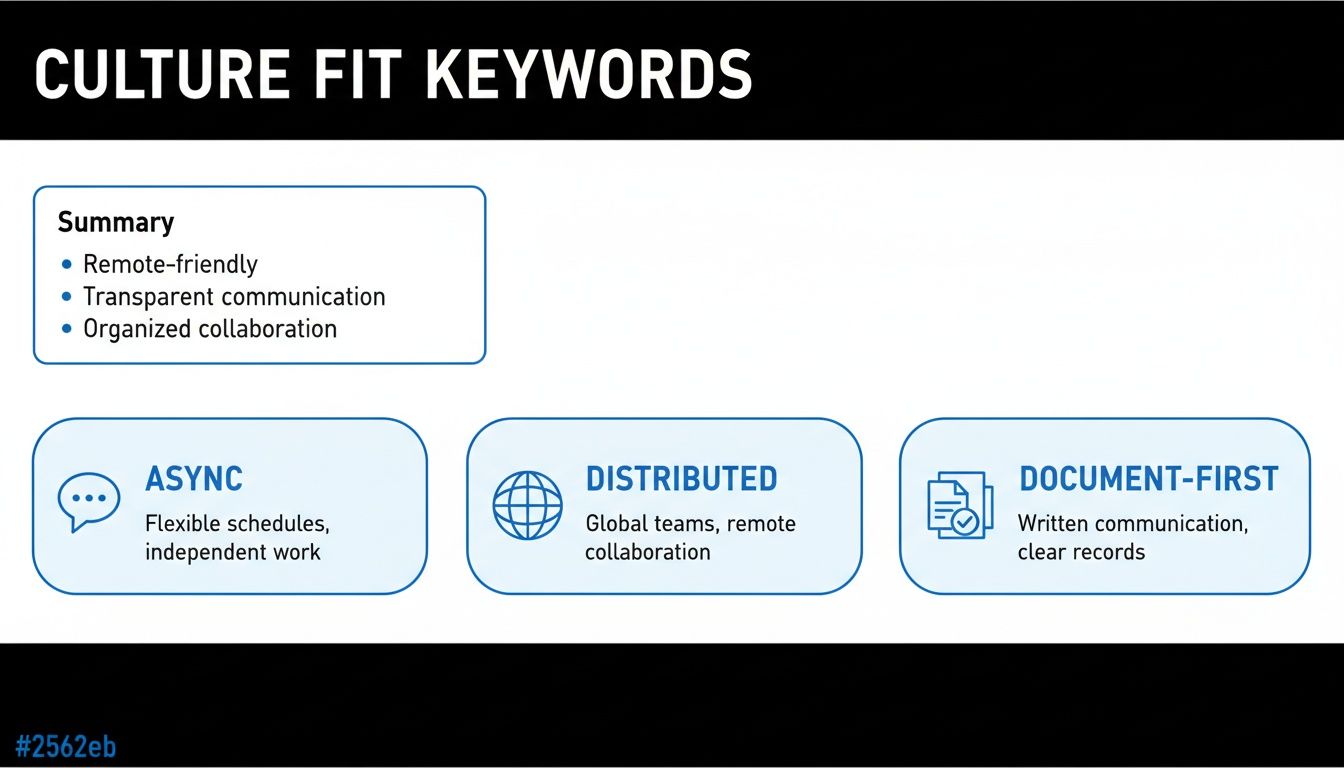
Tucking in a word like "Async," "Distributed," or "Document-First" signals that you're already familiar with the workflows that make remote teams successful.
Product Manager and UX/UI Designer Headlines
When it comes to product and design roles, the conversation shifts from what you can build to the why and how. Recruiters are looking for your impact on the business and your approach to the work.
- Product Manager: Product Manager | B2B SaaS & Agile Methodologies | Grew ARR from $2M to $5M by Leading Platform Relaunch
- UX/UI Designer: Senior UX/UI Designer | Figma & Webflow | Specializing in User-Centric Design for eCommerce Conversions
Data Scientist and DevOps Engineer Headlines
For data and infrastructure professionals, it's all about scale, complexity, and the tools you use to manage it all. Highlight the tech that’s in high demand.
- Data Scientist: Data Scientist | Machine Learning & Python | Built Predictive Models That Improved Forecast Accuracy by 25%
- DevOps Engineer: Lead DevOps Engineer | Kubernetes, Terraform & GCP | Champion for CI/CD and Asynchronous Team Workflows
Each of these examples is crafted to tell a quick, compelling story. They mix technical skills with business results and, when it makes sense, a quick nod to remote-first practices.
Headline Templates by Role and Seniority
To make this even easier, here’s a quick-reference table. Use these structures as a starting point and fill in the blanks with your own details.
| Role | Junior or Mid-Level Headline Template | Senior or Lead Headline Template |
|---|---|---|
| Software Engineer | [Title] | [Top 3 Technologies] | [Area of Interest/Focus] | [Seniority] [Title] | [Primary Tech] & [Cloud Platform] | [Specific Achievement with a Metric] |
| Product Manager | [Title] | [Industry/Product Type] & [Methodology] | [Key Responsibility] | [Seniority] [Title] | [Product Area] Specialist | [Key Metric Improved] (e.g., Grew ARR, Increased Engagement) |
| UX/UI Designer | UX/UI Designer | [Top 2 Tools] | Specializing in [Design Focus] | Senior UX/UI Designer | [Key Methodologies] | [Specific Outcome] (e.g., Redesigned Onboarding, Increased Conversion) |
| Data Scientist | Data Scientist | [Top Tools/Languages] | [Type of Analysis/Modeling] | Senior Data Scientist | [ML/AI Specialty] | [Quantifiable Business Impact from Models] |
| DevOps Engineer | DevOps Engineer | [CI/CD, Iac, Cloud] | Passionate About [Specific Practice] | Lead DevOps Engineer | [Key Orchestration Tools] & [Cloud] | [Process Improvement or Culture Contribution] |
Use these templates to build a headline that truly reflects your professional identity and grabs the attention of your next great employer. You've got this.
Common Headline Blunders (and How to Sidestep Them)
Writing a strong resume headline is a skill, and like any skill, there’s a bit of a learning curve. I’ve seen countless resumes over the years, and even seasoned tech pros often make a few classic mistakes that hold them back. The great thing is, once you know what to look for, these are incredibly easy to fix.
Ditching the Vague Buzzwords
One of the biggest culprits is leaning on fluffy, meaningless buzzwords. Phrases like "Results-Driven Professional" or "Motivated Team Player" might sound impressive, but they tell a recruiter absolutely nothing specific about what you can actually do. They're just empty filler taking up prime real estate on your resume.
Think about a headline like "Detail-Oriented Software Engineer." It’s instantly forgettable.
The Fix: Don't just say you're detail-oriented—prove it. Swap that generic trait for a hard skill or a noteworthy achievement. A much more powerful alternative would be: Senior Software Engineer | Python & AWS | Expert in API Performance Optimization. Now, you’ve gone from a vague platitude to a concrete, valuable specialization.
Forgetting to Customize for the Role
Another major misstep is sending out the exact same headline with every application. This "one-size-fits-all" strategy is a surefire way to get screened out, both by the Applicant Tracking Systems (ATS) and the human on the other side. Every job description is packed with specific keywords and priorities, and your headline is your first chance to mirror them.
When a recruiter sees a generic headline, it can signal a lack of genuine interest in that specific role.
- Before (Generic): Product Manager with SaaS Experience
- After (Tailored): Senior Product Manager | B2B FinTech SaaS | Agile & Jira | User Growth Expert
See the difference? The tailored version directly reflects the language a recruiter would be looking for in a FinTech role, immediately signaling a strong match. Making this quick adjustment is a high-impact edit that shows you’re a serious candidate who’s done their homework.
Common Questions About Resume Headlines
Even after you've nailed down the basic formulas, a few tricky questions always seem to come up. Let's walk through some of the most common ones I hear from job seekers so you can get your headline just right.
How Often Do I Need to Change My Headline?
My advice is simple: customize your resume headline for every single job application. I can't stress this enough. Think of it this way—you wouldn't use the same key for different locks, right? A generic, one-size-fits-all headline just gets lost in the noise and often fails to get past the initial ATS screen.
The best approach is to pull the most important keywords and required skills directly from the job description you're targeting. This small step takes just a few minutes but signals to the recruiter that you're the exact fit they've been searching for, not just another resume in the pile.
Should My Headline Be a Full Sentence?
Definitely not. A great resume headline is a short, punchy, keyword-packed title. It’s not a sentence; it’s more like a professional tagline or a mini-billboard advertising your value.
A pro tip is to use vertical bars (|) or other clean separators to pack in multiple skills, titles, or achievements. The goal is to make it incredibly easy for a recruiter to scan and grasp your expertise in about five seconds flat.
Where Does the Headline Actually Go on the Resume?
Your headline deserves the most valuable spot on the page. It should sit right at the top of your resume, just below your name and contact information.
It takes the place of those outdated "Objective" or "Summary" statements. Putting it front and center ensures it’s the very first thing a hiring manager sees, setting a strong, confident tone for the rest of your application.
Ready to find a remote tech job at a company that truly values its people? At RemoteWeek, we curate roles exclusively from companies with strong employee satisfaction and healthy work cultures. Start your high-quality job search today!