
Your Guide to Landing High-Quality Remote Contract Jobs

Remote contract jobs are essentially project-based gigs you can do from anywhere. Think of yourself as a specialist-for-hire, bringing your expertise to a company for a specific task or timeframe, all on your own terms. It's a career path built on autonomy and flexibility, a stark contrast to traditional 9-to-5 employment.
The New Career Path: Remote Contract Jobs Explained
The whole idea of a "job for life" feels a bit dated now, doesn't it? A new, more agile way of building a career has taken its place. Today, tons of skilled professionals are essentially running their own one-person businesses, lending their talents to different clients instead of committing to a single employer. This is the core idea behind the boom in remote contract work.
So, what does that mean in practice? Unlike a full-time employee, a remote contractor is a self-employed professional. A company brings you in to tackle a specific project, whether that’s building a new app feature, running a marketing campaign, or offering strategic advice. You're the outside expert called in to solve a problem.
Why This Model Is Gaining Momentum
It's a win-win, really. As a contractor, you get to control your schedule, pick projects that actually excite you, and often earn a higher hourly rate. For companies, it’s a smart way to tap into specialized talent without the overhead of a full-time hire—things like benefits, payroll taxes, and office space.
This kind of flexibility has become a go-to strategy for businesses of all sizes, and the numbers back it up.
Before the COVID-19 pandemic, only about 4% of U.S. job postings were for remote positions. By 2025, that number had more than tripled to over 15%, cementing remote contract work as a mainstream part of how we work.
This surge means there are more opportunities out there than ever, especially in tech. If you're curious about a specific high-demand field, you might want to check out a comprehensive technical career guide to becoming a remote DevOps engineer.
Navigating the Landscape Effectively
While the opportunities are out there, finding the good ones takes some strategy. Let’s be honest, giant job boards can be a mess, flooded with low-quality listings, scams, and gigs that don't pay what you're worth. The real secret is knowing where to look—focusing on platforms that value quality over quantity.
This is exactly why curated resources like RemoteWeek exist. We do the heavy lifting by vetting companies for great workplace cultures and high employee satisfaction. That way, you’re connecting with businesses that genuinely respect their contract talent, helping you build a real career, not just find another gig.
Choosing Your Path: Contractor vs. Full-Time Employee
When you dive into the remote work world, one of the first big decisions you'll face isn't just where you work, but how. The choice between a remote contract job and a full-time remote role is a classic fork in the road. Think of it as deciding between being a highly-skilled specialist running your own shop or becoming an essential gear in a larger machine.
Each path has its own set of rules, rewards, and realities.
A full-time remote employee has all the trappings of traditional employment, minus the daily commute. You get a steady paycheck, health insurance, a retirement plan, and paid time off. You're part of a team, working toward a shared company vision with a clear role and opportunities for promotion.
On the flip side, a remote contractor is essentially a business of one. You bring your expert skills to different clients for specific projects. This gives you incredible freedom over your schedule, who you work with, and what you work on. But with that freedom comes the responsibility of handling your own taxes, finding your own benefits, and always keeping an eye out for the next gig.
Freedom vs. Stability
At its core, the decision really boils down to what you value more: freedom or stability.
As a contractor, you are your own boss. Period. You decide your rates, set your hours, and can even juggle multiple clients at once to build a diverse portfolio and income stream. It’s the perfect setup for anyone who thrives on variety and wants to be in the driver's seat of their career.
A full-time role, however, offers a valuable safety net. That consistent salary takes the pressure off client-hunting, and the built-in benefits package handles a lot of life’s big administrative headaches. This path is often a better fit if you prefer predictability, enjoy being part of a tight-knit team, and want a more structured career ladder to climb.
This flowchart can help you visualize which direction might be a better fit based on your desire for autonomy.
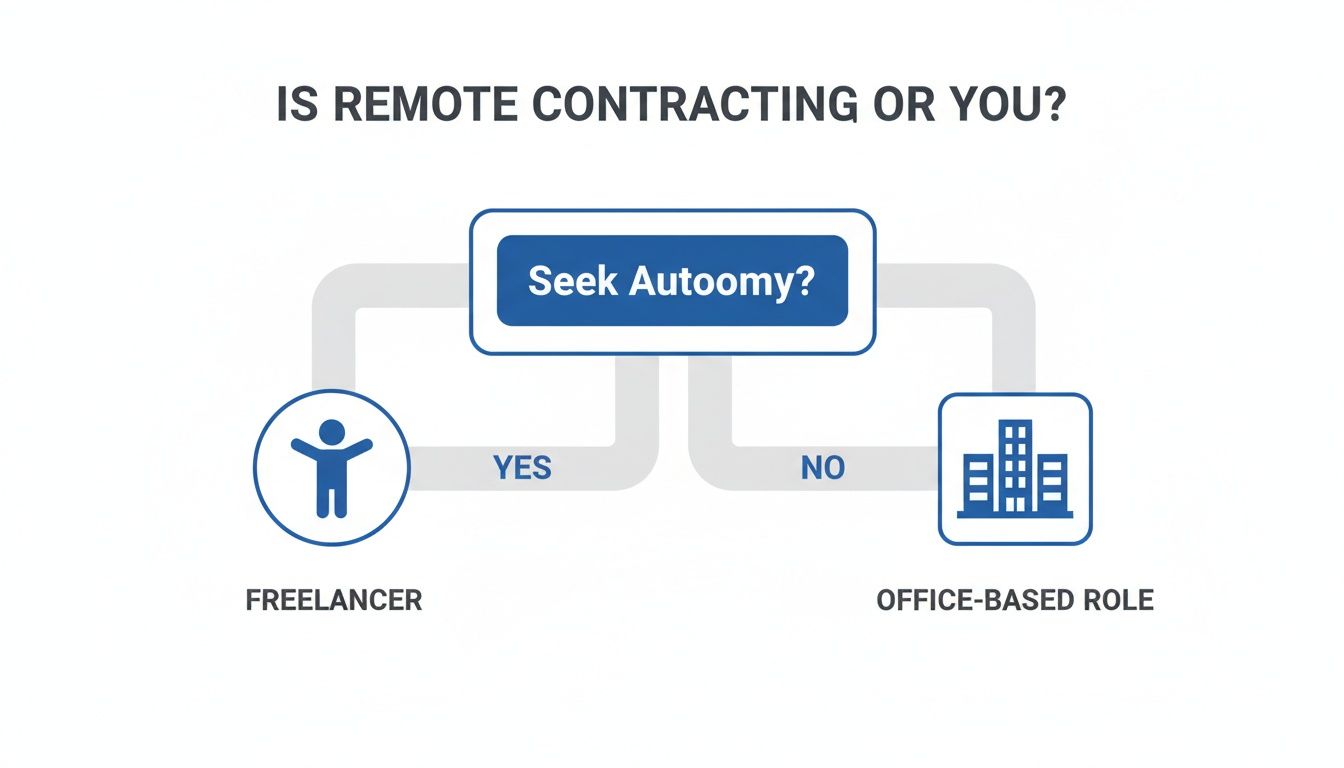
It’s a simple but effective way to think about it: if autonomy is your north star, contracting is the obvious route. If you prefer a more guided journey, traditional employment is likely the way to go.
Comparing Remote Contract Work and Full-Time Employment
To really get into the weeds, you have to look beyond the surface. The financial and lifestyle implications of each path are huge. Contractors often charge higher hourly rates, but that's to cover things like self-employment taxes (which can be a hefty 15.3% in the U.S.), the lack of paid vacation, and the cost of buying their own health insurance. A full-time employee might have a lower base salary, but their total compensation package—including benefits—often bridges that gap.
The table below breaks down the key differences side-by-side.
| Attribute | Remote Contract Job | Full-Time Remote Employee |
|---|---|---|
| Income Stability | Variable; based on your project pipeline and client contracts. | Consistent; you receive a regular salary and potential bonuses. |
| Taxes | You're responsible for paying self-employment taxes (think 1099). | Taxes are automatically withheld from each paycheck (think W-2). |
| Benefits | You have to source and pay for your own health insurance, retirement, etc. | You typically receive a company-sponsored benefits package. |
| Flexibility | A high degree of control over your schedule, location, and projects. | Your schedule is set by the employer, though often with some flexibility. |
| Job Security | Project-based; your security comes from having a strong client base. | Tied to your employer's stability; you're protected by labor laws. |
| Career Growth | Self-directed; you grow by acquiring new skills and clients. | You follow a structured path within the company's hierarchy. |
Ultimately, there's no single "right" answer. The best choice is the one that aligns with your personality, risk tolerance, and what you want your life to look like.
If you're still weighing the pros and cons, our deep-dive guide can help you get even more clarity on the differences between an independent contractor vs. employee.
Finding Vetted Opportunities Beyond Generic Job Boards
Let’s be honest: hunting for a great remote contract job on a massive, generic job board can feel like panning for gold in a river of mud. You know there are good opportunities out there, but you’re buried under an avalanche of listings. Sifting through all that noise to find legitimate, well-paying roles is practically a full-time job on its own. It's draining, and you can easily burn hours applying for low-quality gigs or, even worse, getting tangled up in a scam.
The trick is to stop thinking about quantity and start focusing on quality. Instead of casting the widest net possible on sprawling platforms, you need to point your energy toward channels where the best opportunities have already been filtered for you. Think of it as the difference between digging through a chaotic flea market and walking into a curated boutique. The boutique has fewer items, but you know every single one was chosen for its quality.
The Problem with Mass-Market Job Platforms
Big job aggregators and freelance marketplaces certainly have their place, but they're often built on a model that prioritizes volume above everything else. For a serious contractor, this leads to some pretty common headaches.
- A Race to the Bottom: Many of these sites turn into intense bidding wars. You’re constantly forced to undercut your rates just to get noticed, which ultimately devalues your expertise and makes it impossible to build a sustainable career.
- Vague Project Scopes: How many times have you seen a job post with completely unclear expectations or wildly unrealistic deadlines? They're often posted by clients who don't really understand the work they're asking for.
- Risk of Scams: When there's no real screening process, these platforms become a playground for fraudulent job postings designed to steal your time, your work, or your personal information.
While these sites can be a place to start, relying on them as your only source for work is a fast track to burnout. To land the best remote contract jobs, you have to go where serious companies are actively looking for top-tier talent.
The Power of Curated and Niche Job Boards
This is where curated job boards like RemoteWeek completely change the game. Instead of just scraping and listing every job they can find, these platforms act as a powerful quality filter. They do the hard work for you by vetting companies first, making sure you only see opportunities from businesses that are serious about hiring and truly value their people.
For instance, a key requirement for any company listed on RemoteWeek is a proven positive workplace culture. This is often checked through public employee feedback, like maintaining a Glassdoor rating of 3.5 or higher. That one simple filter immediately weeds out companies with toxic environments, saving you from a contract that could turn into a nightmare.
By focusing on platforms that vet for company culture and employee satisfaction, you dramatically increase your chances of landing a contract with an organization that respects your contributions and treats you like a true partner.
This approach puts you in direct contact with employers who are already prepared to value what you bring to the table. They get why a healthy work environment matters and they're ready to invest in the right talent.
Expanding Your Search Strategically
Beyond curated boards, another goldmine for finding remote contract work is in niche professional networks. These are communities—both online and off—that are built around specific industries, skills, or job functions.
Examples of Niche Channels:
- Industry-Specific Slack or Discord Communities: If you're a software developer, there are dozens of active communities where companies post exclusive roles they need to fill fast. The same goes for designers, marketers, and writers.
- Professional Organizations: Associations tied to your field almost always have private job boards for members. These are often filled with high-quality, relevant roles you won't see anywhere else.
- LinkedIn Groups: Joining and participating in groups focused on your specific expertise can connect you directly with the hiring managers and recruiters looking for specialized contractors.
Building a presence in these communities doesn't just give you access to a hidden job market; it helps you build a professional network that will bring you opportunities for years to come. For a deeper dive into different platforms, check out our guide on the best websites for remote jobs to find the right ones for your skillset. The ultimate goal is to stop endlessly searching and start connecting with the right companies from day one.
Crafting an Application That Gets You Noticed
Applying for a remote contract gig isn’t like applying for a regular job. You need a completely different mindset. You’re not just another person in a long line of applicants trying to get a job; you’re a business owner pitching your services to solve a very specific problem for a client.
So, toss out those generic cover letters and the resume you’ve been using for years. To really stand out in the contracting world, you have to think and act like a strategic partner from the moment you make contact. Your application needs to do more than just list what you did at your last job—it needs to shout competence, show off real results, and prove that you are the exact solution to their problem.

Transform Your Resume into a Highlight Reel
First things first: your standard resume is dead. For contract work, you need to turn it into a dynamic highlight reel of your project wins. Forget about just listing your old job responsibilities. Instead, reframe everything around specific projects and what came of them.
A great way to do this is to think in terms of Problem, Action, and Result. For every project you list, explain the challenge the client had, exactly what you did to fix it, and the measurable results you delivered. This approach transforms a boring list of duties into a powerful story about your impact.
Here's the difference:
- Weak Entry: "Responsible for managing social media accounts."
- Strong Entry: "Grew a B2B client's lead generation by 45% in six months by developing and running a new, targeted social media strategy."
See? That second one immediately shows a potential client the kind of return they can get by hiring you. It's all about the value you bring.
Build a Portfolio That Proves Your Worth
A resume tells a client what you can do, but a portfolio shows them. In the world of remote contracting, a solid portfolio is absolutely essential. It’s the ultimate proof that you can walk the walk.
Your portfolio should be a clean, professional, and easy-to-browse collection of your absolute best work. It doesn’t have to be some fancy, over-the-top website—a simple site or even a well-organized PDF can do the trick. The magic is in adding case studies that give context to each project.
Your portfolio isn't just a gallery of past work; it's a strategic sales tool. Each piece should be chosen to demonstrate your problem-solving skills and align with the types of clients you want to attract.
For every project you feature, give a quick rundown of the client's goal, what your role was, and the results you helped them achieve. And if your work is under an NDA? No problem. Just create a "sanitized" version that describes the process and the fantastic outcomes without spilling any confidential details.
Write a Proposal That Closes the Deal
Finally, your proposal (or cover letter) is your direct sales pitch. This is where you connect all the dots between the client's problem and your proven skills. A generic, copy-pasted message will get you deleted instantly. A truly great proposal is tailored specifically to the job description.
To make your proposal impossible to ignore, follow this simple formula:
- Show You Get It: Start by proving you actually read their project description. Mention a few specific points to show you understand what they need.
- Position Yourself as the Solution: Briefly explain why your skills and experience make you the perfect person to solve their problem.
- Offer Up the Proof: This is crucial. Point them directly to the most relevant examples in your portfolio. Try something like, "This sounds a lot like the work I did for Project X, where I helped increase user engagement by 20%. You can see the case study here."
- Tell Them What's Next: End with a clear and simple call to action. Suggest a quick call to chat more about their project.
This approach immediately positions you as an expert consultant who's ready to deliver results, not just another person looking for a paycheck.
How to Negotiate Your Contract with Confidence
Alright, let's talk about the contract. Negotiating your agreement is so much more than just settling on a price. This is the moment you put a formal number on your value, set professional boundaries, and—most importantly—protect yourself.
Walking into this conversation with confidence is absolutely essential. Think of your contract not as a hurdle to clear, but as the blueprint for a great working relationship. A solid agreement builds a foundation of clarity and mutual respect, stopping misunderstandings before they ever have a chance to start. It gets you and the client perfectly aligned on expectations, which is the secret to a project that runs smoothly from kickoff to completion.
Understanding the Key Components of Your Agreement
Before you can negotiate anything, you have to know what you’re looking at. An independent contractor agreement can look intimidating with all its legalese, but it’s really just a document outlining the terms of your work. Don't just skim it for the dollar signs—read every single line.
Here are the absolute non-negotiables that every single contract should have:
- Scope of Work (SOW): This is the heart of your agreement. It needs to spell out exactly what you'll be doing, including specific tasks, key milestones, and the final deliverables. A vague SOW is a massive red flag.
- Payment Terms and Schedule: This section must clearly state your rate (whether it's hourly, per-project, or a retainer), when you'll send invoices (e.g., net 30), and how you'll get paid. It should also cover what happens if a payment is late.
- Project Timeline: You need clear start and end dates. Period. The contract should also list deadlines for major milestones to keep everyone accountable and the project on track.
- Intellectual Property (IP) Rights: Who owns the work you create? The contract has to specify this. Typically, the client owns the final product once you’ve been paid in full, but this needs to be stated in black and white.
Getting these elements defined upfront protects both you and your client. No ambiguity, no surprises.
Setting Your Rate and Articulating Your Value
Figuring out your rate is easily the most stressful part of this for many people, but it doesn't have to be. Your rate isn't just a number you pull out of thin air; it’s a direct reflection of your skills, your experience, and the real-world value you deliver.
Start by doing some homework on the market rates for your industry and level of expertise. Once you have a baseline, you need to factor in your overhead. Remember, you're the business now. You’re covering your own taxes, health insurance, retirement savings, and software. A good rule of thumb is to add 25-40% to what you might earn as a full-time employee to cover all those costs.
When you present your rate, don’t just say the number—explain the value behind it. Frame the conversation around the client's return on investment. You’re not just a "writer for hire"; you're a "content strategist who can increase their lead generation by 20%." See the difference?
Essential Clauses for Your Protection
Let's be real: a standard contract provided by a client is written to protect them. It's your job to make sure it's a balanced agreement that also protects you. Never be afraid to ask for changes or to add a few clauses of your own.
Clauses to Watch For and Add:
- Kill Fee: This is critical. A kill fee ensures you get paid for the work you've already done if a client suddenly cancels the project for reasons outside of your control. A typical kill fee is 25-50% of the project's remaining value.
- Revisions Clause: To avoid the nightmare of endless feedback loops, your contract must clearly define how many rounds of revisions are included in the fee. This protects you from scope creep and respects your time.
- Termination Clause: This section outlines how either you or the client can end the contract. Make sure it requires a notice period and specifies that you'll be paid for all work completed up to the termination date.
The boom in remote work has created a truly global talent pool. This shift has been a powerful force for inclusion and cost-efficiency, especially in tech. Countries like India, Argentina, Nigeria, Vietnam, and Colombia are becoming major hubs for remote talent in software development, design, and IT, thanks to strong technical skills and competitive costs. Most of this cross-border hiring is done through contractor or employer-of-record models instead of traditional local employment. You can find more insights on this in the state of global remote work report on Remotive.
At the end of the day, negotiating with confidence means treating your contracting work like the serious business it is. When you understand your contract, know how to communicate your value, and ensure you're protected, you're setting yourself up for a successful and profitable career.
Managing Your Finances as an Independent Contractor

When you make the leap to remote contract work, you're not just changing jobs—you're basically becoming the CEO of You, Inc. This switch is incredibly liberating, but it also means you're now the entire finance department. Cashing a check is just the beginning; you’re now in charge of your own taxes, benefits, and retirement planning.
Getting a handle on this financial landscape is what turns a series of gigs into a sustainable, long-term career. If you get these fundamentals right from day one, you'll build the stability and peace of mind you need to really thrive as an independent professional.
Mastering Your Taxes and Expenses
The biggest financial shock for most new contractors? Taxes. As a self-employed professional (often called a 1099 contractor in the U.S.), you're now responsible for paying your own income and self-employment taxes, which cover Social Security and Medicare.
A good rule of thumb is to immediately set aside 25-30% of every single payment you receive just for taxes. This simple habit will save you from a massive, stressful bill come tax season. I'd even recommend opening a separate savings account just for this purpose—out of sight, out of mind, so you don't accidentally spend it.
Think of yourself as both the employee and the employer. The "business" side of you sets aside what it "owes" for taxes before the "employee" side of you gets paid. This mental shift makes managing your cash flow a whole lot easier.
On the bright side, as a business owner, a lot of your work-related costs are now tax-deductible. These expenses lower your taxable income, meaning you keep more of your hard-earned money.
Common Business Expenses for Contractors:
- Home Office Costs: You can often deduct a portion of your rent or mortgage, utilities, and internet bills.
- Software and Subscriptions: Any tools you need to do your job, from project management software to professional memberships.
- Hardware: That new laptop, monitor, or other essential tech you bought for work.
- Professional Development: Courses, certifications, or conferences that sharpen your skills and make you more valuable.
Tracking these expenses meticulously is key. To get a better idea of what you can write off, check out our guide on work-from-home tax deductions that many contractors miss.
Building Your Own Benefits Package
Going independent means you leave behind the safety net of a company-sponsored benefits package. It's now on you to build your own. While that might sound intimidating, it also gives you the freedom to pick plans that are a perfect fit for your life, not just what an employer offers.
Health insurance should be at the top of your list. You can find plans through government healthcare marketplaces or private insurers. This is a non-negotiable—it’s the one thing that protects you from potentially devastating medical bills.
Next up is retirement. Without a company 401(k), it’s up to you to save for your future. Luckily, there are some fantastic options designed specifically for self-employed people.
Retirement Accounts for Contractors:
- SEP IRA (Simplified Employee Pension): This lets you contribute up to 25% of your net adjusted self-employment income and has high contribution limits. It’s also flexible and incredibly easy to set up.
- Solo 401(k): This plan is a powerhouse. It allows you to contribute as both the "employee" and the "employer," which means you can often save even more than with a SEP IRA. It's an excellent choice as your income grows.
Proactively managing your money is the bedrock of a successful contracting career. By mastering your tax obligations, diligently tracking expenses, and building your own benefits package, you create the financial security needed to truly enjoy the freedom of remote contract jobs.
Your Top Questions About Remote Contract Work, Answered
Jumping into the world of remote contract jobs can feel like learning a whole new language. It's a different way of working, with its own rhythm and rules. Getting straight answers to your questions is the first step toward building a career you can count on.
We've gathered some of the most common questions we hear from both aspiring and seasoned contractors to help you get started on the right foot.
Are Remote Contract Jobs Less Stable Than Full-Time Roles?
This is a big one. Stability just looks different when you're a contractor. While a single contract has a clear end date, a smart contractor doesn't just have one contract—they have a pipeline of clients and projects. Think of it this way: instead of relying on a single employer for your entire paycheck, you create your own security by having multiple streams of income.
It's a lot like investing. You'd never pour all your money into one stock, right? Having several clients means that if one project wraps up, you've got others to keep you afloat. It definitely requires you to be more proactive about finding work, but it offers a kind of resilience that a traditional job just can't match.
What Is the Biggest Mistake New Remote Contractors Make?
Hands down, the most common pitfall is forgetting you're running a business. It’s so easy to get wrapped up in delivering amazing work for a client that you completely neglect the operational side of things. This is where people get into trouble.
A few classic blunders we see all the time:
- Forgetting about taxes: Failing to set aside 25-30% of every single payment is a surefire way to end up with a nasty surprise from the IRS.
- Skipping the written contract: A handshake deal isn't going to cut it. A solid contract protects both you and the client by spelling out the scope of work, payment terms, and deadlines in black and white.
- Pricing services too low: New contractors often undercharge because they're afraid of losing the gig. This not only tanks your income but also tells the market that your expertise isn't worth much.
From day one, you have to treat your work like a real business—that means managing your money, marketing yourself, and using clear, professional agreements. That's the bedrock of a long-term contracting career.
The real change is thinking like a business owner, not an employee. An employee completes a task. A business owner manages the entire client relationship, from finances and legal protection to long-term growth.
Do I Need an LLC to Start Working as a Contractor?
Not right out of the gate, no. Most contractors get their start as a sole proprietor, which just means you're operating under your own name and using your Social Security Number for tax purposes. It's the simplest, quickest way to get up and running legally.
But as your income grows, forming an LLC is something you should seriously consider. It creates a legal wall between your personal finances and your business, which is a lifesaver if you ever get into a legal dispute. An LLC can also open up some new tax advantages. It's always a good idea to chat with a legal or financial pro to figure out the best move for your specific situation. As a 1099 contractor, getting a handle on the full 1099 tax deductions list is key to maximizing what you take home.
Ready to find remote contract jobs at companies with great, proven cultures? RemoteWeek vets every single employer to make sure they're a genuinely good place to work, so you can apply with total confidence.