
Remote tech jobs no experience: Proven steps to land your first role

Wondering if you can actually land a remote tech job with no experience? It’s a fair question, and the answer is a resounding yes. The tech world has blown wide open, and the shift to remote work means companies are desperate for talent. More and more, they’re valuing real, practical skills over a fancy degree on a resume.
Your Path Into Remote Tech Without Experience
Let’s get one thing straight right away: you don't need a four-year computer science degree to get your foot in the door. That's an old myth. The industry today is far more welcoming to people from all backgrounds, whether you're switching careers or just starting out. Companies want motivated people who can learn on the fly and contribute.
This guide is your roadmap. We're going to skip the fluff and focus on what actually works: targeting the right roles, building a portfolio with small but impressive projects, and learning how to frame the skills you already have—even from that retail or barista job—to catch a hiring manager's eye.
The Opportunity Is Real (And Growing)
This isn't just a pandemic blip; the remote job market is here to stay. Before 2020, only about 4% of jobs in the U.S. were remote. Fast forward to today, and that number has shot up to over 15% of all job openings—a nearly four-fold jump.
This explosion in remote work is your golden ticket. Companies are no longer limited to hiring people in their city; they're looking for the best talent, period. That means they’re more willing than ever to bet on someone who shows initiative and has a solid skill set, even without a traditional tech background.
Your most powerful asset isn't a long resume. It's your proven ability to learn and build something. A small, finished project speaks volumes more than a half-done online course.
Charting Your Course
Breaking in requires a smart plan, not just blindly sending out resumes. This simple visual breaks down the journey from where you are now to getting hired.
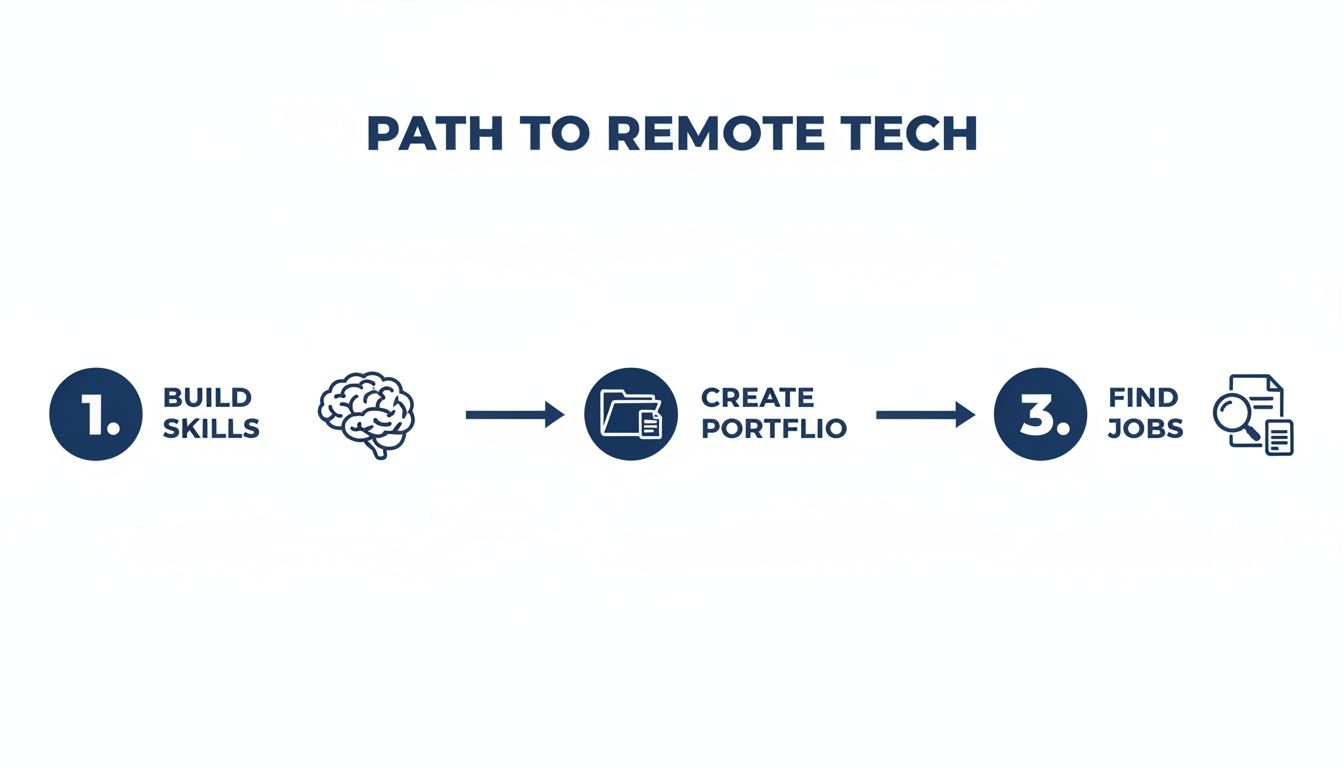
It really boils down to three core steps: build the right skills, create a portfolio to show them off, and then hunt for jobs strategically. For some, the goal is even bigger—you might be surprised to learn you can become a Computer Scientist without traditional qualifications. It's all about building momentum, one step at a time.
Finding Your Footing: The Best Remote Tech Roles for Beginners

Let's be honest, staring at a sea of tech job titles can be completely overwhelming when you're just starting out. Instead of just spraying your resume at any opening with "tech" in the title, the smart move is to zero in on specific, accessible roles where companies are actively looking for motivated beginners.
These are the jobs where your ability to learn, a can-do attitude, and strong communication skills are worth more than a decade of experience. The trick is to find those natural entry points that let you learn on the job and build a solid foundation for your future.
The good news? The demand for tech talent is absolutely booming. Projections show around 170 million new jobs popping up globally in the next ten years, with tech at the forefront. This isn't just a local trend. In regions like Asia-Pacific, for example, a staggering 85% of companies are planning to hire remote workers. This creates a massive global market for remote tech jobs no experience, and you can see more on these global hiring trends.
Top Entry-Level Remote Tech Roles and Core Skills
To help you focus your search, I've put together a table of the most common and high-opportunity roles perfect for someone without a traditional tech background. These are your best bets for getting a foot in the door and gaining those invaluable first-year skills.
| Job Role | Why It's Great for Beginners | Essential Skills | Next Career Step |
|---|---|---|---|
| Technical Support Specialist | You become a product expert and learn to communicate complex ideas simply. It’s a masterclass in empathy and problem-solving. | Patience, clear communication (written & verbal), active listening, basic troubleshooting. | Senior Support Specialist, Customer Success Manager, QA Tester. |
| Junior QA Tester | Perfect for detail-oriented people. You learn the software development lifecycle from the inside out and develop a critical eye. | Attention to detail, methodical testing, clear bug reporting, curiosity. | QA Analyst, QA Automation Engineer, Product Manager. |
| Content Moderator | Vital for online communities. You develop sharp decision-making skills and a deep understanding of digital platform safety. | Strong judgment, consistency, familiarity with online community guidelines, resilience. | Trust & Safety Specialist, Community Manager, Policy Analyst. |
This table isn't exhaustive, but it shows how these roles are built on teachable skills and offer real paths for growth. For a deeper dive, check out our guide on the best entry-level tech jobs you can do from home.
What These Jobs Actually Look Like Day-to-Day
So what does "Technical Support Specialist" actually mean? Let's paint a picture.
You log on in the morning and see a queue of support tickets. The first is simple: a user can't log in and needs a password reset. Easy. The next one is trickier—a key feature in the software is acting up for a customer. Your job is to dig in. You'll use your company's internal wiki, maybe shoot a quick message to a teammate on Slack, and then walk the user through the solution step-by-step. It's less about knowing every answer and more about being a patient, empathetic guide.
The most successful newcomers don't pretend to know everything. They excel at finding answers, asking smart questions, and clearly communicating what they've learned. This resourcefulness is more valuable than any single technical skill.
You Have More Skills Than You Think
You're probably sitting on a goldmine of transferable skills from past jobs or even hobbies. The key is learning to talk about them in a way that tech recruiters will understand.
Think back on your experiences:
- Worked retail or in a restaurant? That’s customer empathy, problem-solving under pressure, and clear communication—all core skills for a Technical Support Specialist.
- Ever proofread a friend's paper? You were using your attention to detail, which is the number one requirement for a Junior QA Tester.
- Helped organize a community event? That's project coordination and time management, skills that are universally valued in tech.
By focusing on these high-opportunity roles, you stop being a generalist and start being a specialist. Your journey into remote tech doesn't begin with becoming an expert overnight; it starts by showing a company where your current strengths can add value right away.
Build Your Skills and a Project-Based Portfolio

Alright, this is where the real work begins—and where you’ll create tangible proof of what you can do. Forget vague goals like "learn to code." A focused strategy is what separates the people who land jobs from those who just keep applying.
The goal isn't to become a master overnight. It's to build a small but mighty collection of skills and projects that directly match the jobs you’re targeting. Instead of trying to learn a bit of everything, focus on foundational skills that are useful across many entry-level roles. Think about mastering a customer support tool like Zendesk or learning the basics of HTML and CSS. These are the building blocks for landing remote tech jobs no experience.
Prioritize Actionable Skills Over Theory
Let's be real: recruiters for entry-level roles aren't looking for a theoretical genius. They want to see that you can actually do the work. This means every bit of your learning should be pointed toward a practical application. A simple, working project is infinitely more valuable than a dozen unfinished online courses.
Your learning needs to be goal-oriented. Before you start a tutorial, ask yourself, "What specific skill will this teach me that I can use to build a portfolio project?"
- For a support role: Learn your way around a popular CRM like HubSpot.
- For a QA role: Study basic testing principles and learn to use a bug-tracking tool like Jira.
- For a content role: Get comfortable with a content management system (CMS) like WordPress.
This targeted approach makes sure your time is spent on skills that show up in job descriptions, making your portfolio instantly relevant.
Micro-Projects: The Secret to a Standout Portfolio
A portfolio doesn’t need to be some massive, complex masterpiece. In fact, a series of small, focused projects is often far more effective. It shows you can start, execute, and complete tasks—a critical skill in any job. These "micro-projects" are your proof of work.
Put yourself in a hiring manager’s shoes. They can look at your simple project in five minutes and immediately see that you understand the core concepts. When you're learning and building, it's crucial to actually retain the information. Check out some strategies for effectively learning from Udemy courses to make sure your study time really sticks.
Here are a few specific project ideas you could knock out this week:
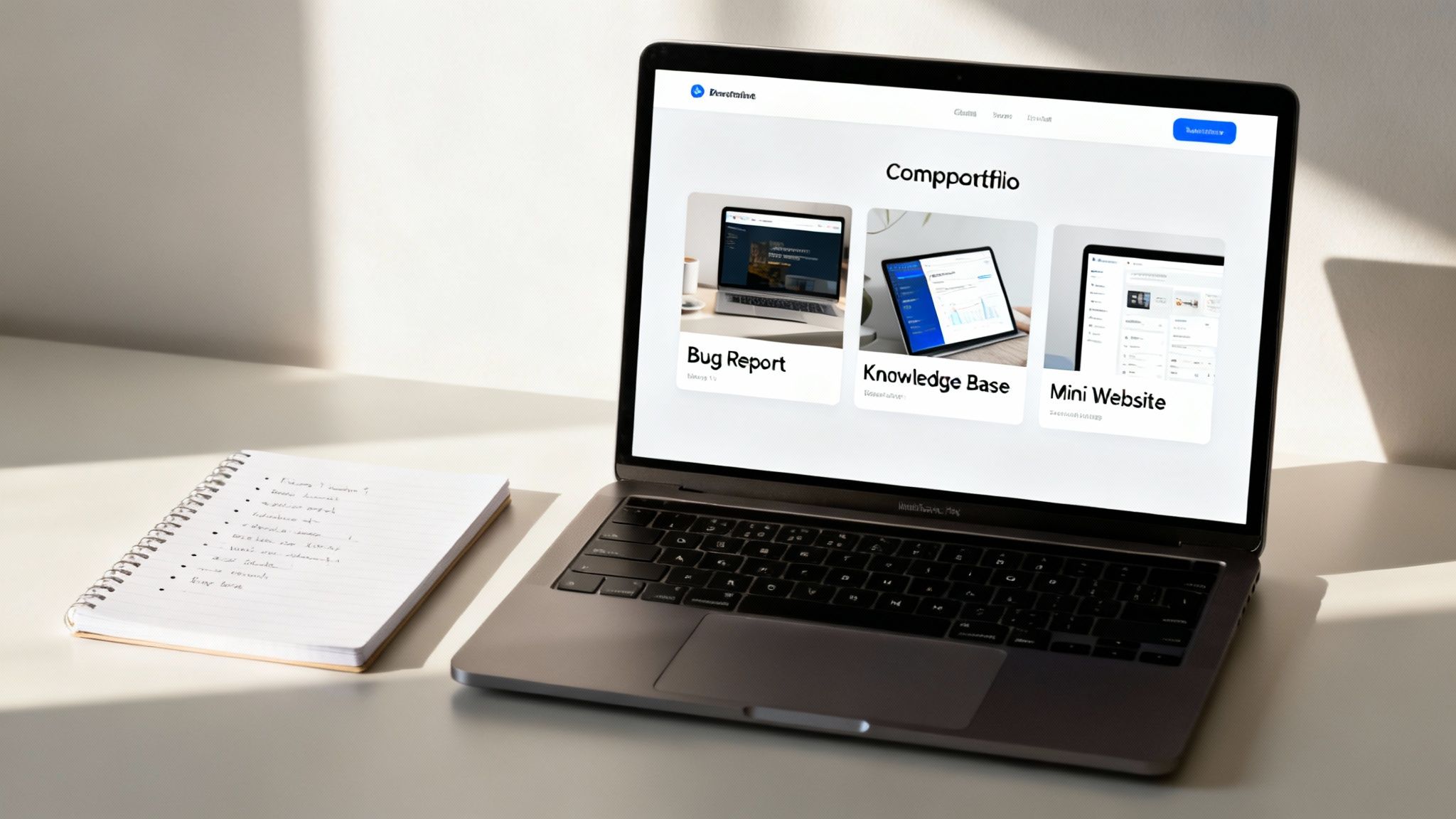
- Aspiring QA Tester: Find a bug on a popular app or website and write a detailed bug report. Use a standard template, include annotated screenshots, and clearly list the steps to reproduce the issue. This showcases your attention to detail and communication skills.
- Future Support Specialist: Create a personal knowledge base using a free tool like Notion or Slab. Write five to seven clear, concise articles answering common technical questions for a product you know inside and out. This proves you can explain complex topics simply.
- Entry-Level Web Developer: Build a simple "link-in-bio" style website for yourself using basic HTML and CSS. Host it for free on GitHub Pages. This is undeniable proof that you grasp foundational web technologies.
Your portfolio is your story. Each small project is a chapter that says, "I'm not just interested in tech; I am actively building things and solving problems."
Finding Free and Low-Cost Learning Resources
You absolutely do not need to spend thousands on a bootcamp to get the skills you need. The internet is overflowing with high-quality, free resources that can teach you everything to get started. Focus and consistency are far more important than a big budget.
Here are some of the best places to start learning today without opening your wallet:
- freeCodeCamp: An incredible non-profit with thousands of hours of free, interactive tutorials on everything from web development to data analysis.
- Coursera and edX: Many top universities offer their introductory courses for free (you can "audit" them). You can gain a massive amount of knowledge, even without paying for the official certificate.
- YouTube: Channels like The Net Ninja, Traversy Media, and Kevin Powell offer world-class tutorials on a huge range of tech topics.
The key is to learn actively, not passively. Don't just watch the videos. Pause, write the code, and solve the problem yourself. That's how you truly solidify your skills and gain the confidence to build your own projects—and your portfolio is the ultimate proof you can apply what you've learned.
Crafting an Application That Stands Out
Think of your application as the first handshake with a hiring manager. When you're looking for remote tech jobs with no experience, this is your single best shot to prove your potential outshines a traditional, linear career path.
You have to show them not just what you've done, but what you're capable of doing. Your real goal is to connect the dots for the recruiter, showing them exactly how your unique background has perfectly prepared you for this specific tech role.
Translating Your Past for a Tech Future
So many career changers get stuck thinking their past experience is irrelevant. It’s not. In fact, it's your biggest asset, but you have to learn how to reframe those skills in the language of the tech world.
Think about your old jobs, even the ones that feel completely unrelated to tech. I guarantee you’ve developed valuable, transferable skills that companies are desperate for. The trick is knowing how to talk about them.
- Retail or Customer Service? You weren't just ringing up sales. You were practicing de-escalation, using empathetic communication, and doing real-time problem-solving. That's the DNA of a great Technical Support Specialist.
- Admin or Project Coordinator? You weren't just booking meetings. You were mastering stakeholder communication, resource management, and process optimization. That’s the foundation of project management.
- Food Service or Hospitality? A fast-paced kitchen teaches efficiency under pressure, team collaboration, and a sharp attention to detail. These are all absolutely critical for a QA Tester.
Your resume needs to show this translation in action. Don't just say, "Assisted customers." Instead, try something like, "Resolved over 50 customer inquiries daily by actively listening to their needs and clearly communicating technical solutions." See the difference? One is passive, the other shows real impact.
Building a Resume for a Career Pivot
When you don't have direct experience, a standard chronological resume can actually hurt you. It highlights what you don't have. Instead, go with a skills-based or hybrid resume that puts your most relevant abilities and projects right at the top where they can't be missed.
Your resume needs to immediately answer the hiring manager's biggest question: "Why should I hire you for this job?"
A Simple Resume Structure for Career Changers:
- Contact Info & Portfolio Link: Make it incredibly easy for them to see your work. Name, email, phone number, and a direct link to your portfolio or GitHub.
- Summary: A punchy, 2-3 sentence statement about your goals and top skills. For example: "Detail-oriented career changer with a passion for user experience, seeking a Junior QA Tester role. Proven ability to identify software bugs and communicate findings clearly, demonstrated through multiple portfolio projects."
- Skills Section: This is your prime real estate. List your technical skills (Jira, Zendesk, HTML/CSS) and crucial soft skills (Problem-Solving, Written Communication) right up front.
- Projects Section: Showcase 2-3 of your best micro-projects. Briefly explain the problem you solved, the tools you used, and the outcome. This is your proof.
- Professional Experience: List your previous jobs, but focus every bullet point on framing your accomplishments using that tech-friendly language we just talked about.
- Education & Certifications: Include your degree, but give just as much, if not more, space to relevant certifications like the Google IT Support Professional Certificate.
For a deeper dive, our complete guide on crafting resumes for remote jobs has templates and more specific tips to help you get noticed.
The Cover Letter Is Your Secret Weapon
If your resume is the "what," your cover letter is the "why." This is where you get to tell the story that a list of bullet points never could. Please, don't just rehash your resume. Use this space to connect your personal journey and passion directly to the company's mission.
For a career changer, a great cover letter nails three things:
- It shows you've done your homework. Mention something specific about the company—a product feature you admire, a blog post that resonated with you, or why their mission matters to you.
- It tells your origin story. Why tech? And why now? Briefly explain what sparked your interest. This turns your lack of experience into a compelling story of ambition and drive.
- It connects the dots for them. Explicitly state how your skills from a past career will make you awesome at this specific job.
A cover letter that reads like a genuine, passionate human wrote it will always beat a generic template. It’s your opportunity to transform from just another applicant into a candidate they’re excited to meet.
How to Find Vetted Remote Jobs and Avoid Scams
Alright, you've built up your skills and have a portfolio that shines. Now it's time to dive into the remote job market. This part is exciting, but let’s be real—it can also feel like the Wild West, packed with ghost jobs, misleading listings, and outright scams. A smart strategy isn't just a nice-to-have; it's essential to protect your time and sanity.
The massive shift to flexible work has completely changed the hiring game. In fact, a whopping 91% of employees around the world would prefer to work remotely most or all of the time. This explosion in demand means more opportunities, but it also brings out bad actors looking to take advantage of eager job seekers. You can read more about the rise of remote work trends on splashtop.com.
Your main goal right now is to cut through the noise and find legitimate companies that actually value their people. That means learning how to spot the red flags and focusing your search on platforms that do the vetting for you.
Spotting Red Flags in Job Postings
Before you even think about clicking "apply," you need to train your eye to spot a shady listing from a mile away. Scammers prey on newcomers with offers that seem too good to be true, and they almost always leave clues behind.
Keep an eye out for these classic warning signs:
- Vague or Generic Job Descriptions: Real companies will tell you exactly what you'll be doing. If a listing is full of corporate jargon but short on actual responsibilities, be skeptical.
- Unprofessional Communication: Got an email from "HR" that's riddled with typos, bad grammar, or a weirdly casual tone? That's a huge red flag.
- Requests for Payment or Personal Data: This is the big one. A legitimate employer will never ask you to pay for your own training, software, or background check. And you should never give out sensitive bank details before you have a formal, verified offer in hand.
Knowing these signs is critical when you're looking for remote tech jobs no experience. To get a deeper look at the tactics scammers use, check out our guide on how to identify and avoid remote job scams.
Leveraging Curated Job Boards
Instead of getting lost in massive job sites where literally anyone can post a listing, focus your energy on curated platforms. These job boards actually vet the roles they list, so you can be confident the companies are legitimate and often meet certain standards for how they treat their employees.
Think of curated job boards as your first line of defense. They filter out the most obvious scams and low-quality employers, freeing you up to focus on writing great applications for companies you can trust.
Sites like RemoteWeek are built for this exact purpose. By only featuring companies with solid employee reviews (a Glassdoor rating of 3.5 or higher), they connect you directly with employers who have a proven track record. This approach can save you dozens of hours of grunt work and lets you apply with way more confidence.
Researching Company Culture Beyond the Listing
Finding a good job is about more than just the daily tasks—it's about the environment you'll be working in. A supportive remote culture is absolutely crucial for your success, especially when you're just starting your career.
Once you find a promising role on a vetted board, do a little more digging.
- Read Employee Reviews: Head over to Glassdoor and see what current and former employees are saying. Look for patterns in their comments about management, work-life balance, and opportunities for growth.
- Check Their Digital Footprint: How does the company present itself on LinkedIn? Do their employees seem engaged and happy to work there? A company that invests in its public image often invests in its people, too.
- Look for Transparency: Do they have their company values listed on their site? Do they have a blog that gives you a feel for their culture? Companies that are proud of their workplace are usually happy to talk about it.
By combining a sharp eye for red flags with a focus on quality job boards and some deep-dive research, you can confidently find a remote role where you’ll not only get your start but actually have a chance to thrive.
Got Questions? Let's Talk About Starting Your Remote Tech Career
It's totally normal to have a ton of questions when you're about to jump into something new. The idea of landing remote tech jobs with no experience is exciting, but let's be real—it can also feel a bit daunting.
Let's cut through the noise and tackle some of the biggest questions I hear from people just starting out. I want to give you direct, honest answers to help you move forward with confidence.
Do I Really Need a College Degree for a Remote Tech Job?
Straight answer? No. While a degree is never a bad thing, the tech world has shifted its focus in a big way. For most entry-level remote jobs, what you can do matters far more than a diploma hanging on the wall.
Hiring managers are looking for proof that you can solve problems. A solid portfolio showcasing a few relevant micro-projects, maybe backed by a certification from a place like freeCodeCamp or Coursera, often carries more weight than a traditional four-year degree. The goal is to show them you have the skills and, just as importantly, the hunger to learn and grow on the job.
Your portfolio is your proof. It's the concrete evidence that you can take what you've learned and build something real with it. That’s what companies want to see.
This focus on practical skills is what opens the door for so many career-changers and self-taught professionals. It truly levels the playing field.
How Much Can I Realistically Expect to Earn?
Okay, let's talk money. Entry-level remote tech salaries can swing quite a bit depending on the role, the company's size, and the specific skills you bring to the table. It’s smart to set realistic expectations while keeping an eye on the huge potential for growth down the road.
Here’s a rough idea of what starting salaries look like in the U.S. market:
- Technical Support Specialist: You’ll typically see a starting range of $40,000 to $55,000. This is an amazing foot-in-the-door role with a clear path for advancement.
- Junior QA Tester: If you have a knack for finding what’s broken, these roles often start between $45,000 and $60,000.
- Entry-Level Web Developer: For those with some foundational coding ability, starting salaries can land anywhere from $50,000 to $70,000, sometimes even higher if you know a popular tech stack.
Before you start applying, do your homework on sites like Glassdoor and Levels.fyi to see what the going rate is for the roles you're interested in. And don't forget the hidden savings of remote work—no commute, no expensive lunches, no office wardrobe. That all adds up.
What Are the Biggest Challenges When You're Just Starting Out?
Making the switch to a remote tech role comes with its own learning curve, but every challenge is manageable if you know what to expect. The two biggest hurdles for most people are communication and self-discipline.
When there’s no one physically looking over your shoulder, you have to be your own engine. That means being proactive on Slack or Microsoft Teams, asking for help before you're completely stuck, and constantly seeking feedback. In a remote setup, over-communicating is almost always the right move.
The other big one is "imposter syndrome"—that nagging feeling that you're a fraud and don't actually belong. Trust me, nearly everyone feels this, especially when they're new.
How to Handle Those Early Hurdles:
- Build a Routine: A consistent schedule tells your brain when it’s time to work and when it’s time to switch off. It's your best defense against burnout.
- Communicate Proactively: Don't be a ghost. Send regular updates, ask smart questions, and make your presence felt.
- Celebrate the Small Wins: Solved a tough support ticket? Wrote a clean bug report? Take a second to acknowledge it. These little victories build real confidence.
- Find Your People: Connect with other folks in similar roles online. Having a community to vent to, ask for advice, and share experiences with is a game-changer.
Remember, the company hired you for your potential. They expect you to have questions and take time to ramp up. Just focus on being a great communicator, staying organized, and bringing a positive attitude. Your ability to learn and adapt is your most valuable asset right now.
Ready to stop endlessly scrolling and start applying to high-quality, vetted remote jobs? RemoteWeek cuts through the noise to bring you the best remote tech roles from companies that actually value their people. Find your next opportunity with confidence at https://www.remoteweek.io.